
Soft-armed drone uses rolling cam joints to squeeze through tight spaces at 4.5 mph
Navigating collapsed buildings, dense industrial piping, or narrow ventilation shafts usually forces small drones to...
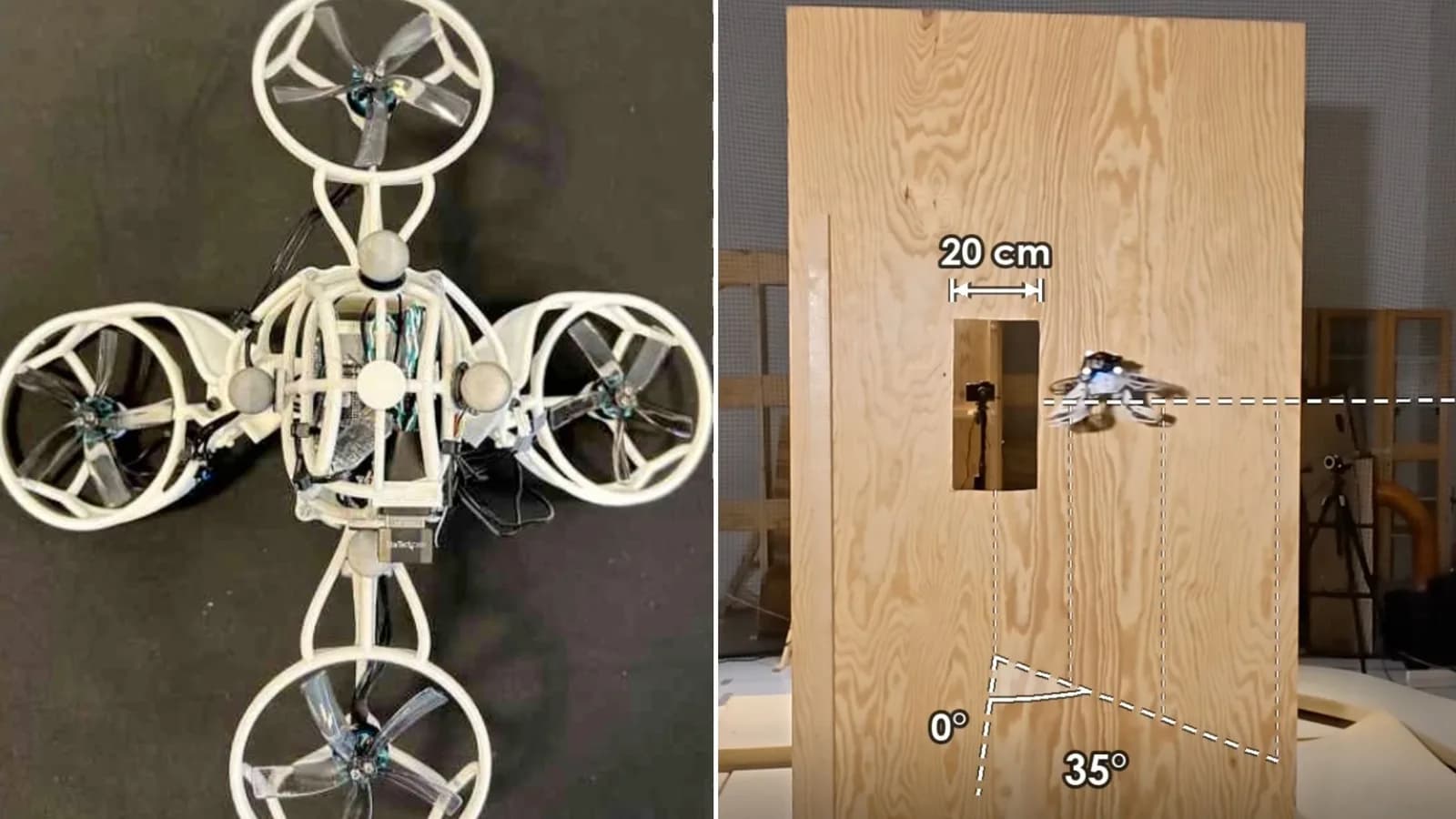
Navigating collapsed buildings, dense industrial piping, or narrow ventilation shafts usually forces small drones to make a painful trade-off. Rigid frames depend on precision sensors and slow maneuvers to avoid fatal collisions, while motorized folding arms add batteries, servos, and wiring that slash flight time.
Researchers at the Autonomous Robots Lab at the Norwegian University of Science and Technology (NTNU), collaborating with ETH Zurich, have built a quadrotor that solves this without a single folding actuator. Using two passive, spring-loaded soft arms, the prototype folds inward on physical contact, shrinking its width by more than half before snapping back open in mid-air.
Elastic rolling cam joints and task-driven design
In a preprint study published on arXiv and demonstrated in a lab video, the team replaced standard rigid side booms with two compliant arms arranged in a plus configuration. Each side arm pivots on an elastic rolling cam joint, a single-degree-of-freedom mechanism made of two spring-loaded cams with interlocking teeth that roll against each other without slipping. By shaping the profile of those cams, engineers can program the exact torque-to-angle stiffness response of the arm.
Rather than guessing how stiff or long those arms should be, the researchers fed a 22-parameter airframe geometry and joint-stiffness model into a closed-loop optimizer. In simulation, a nonlinear model predictive controller flew each candidate design through gaps ranging from 5.9 to 9.8 inches (15 to 25 centimeters), using successful traversal rates to iteratively refine the physical layout.
Optimizing both arm geometry and joint compliance together proved essential, enabling the drone to clear openings 52 percent narrower than its nominal span, compared to roughly 29 percent for earlier contact-folding quadrotors.
Squeezing through narrow gaps and tubes at 4.5 mph
When translated into a physical prototype, the quadrotor measures 12.3 inches (31.3 centimeters) wide in normal flight and collapses to 5.6 inches (14.1 centimeters) when pressed against an obstacle. In flight tests, the drone flew directly into a 5.9-by-7.9-inch (15-by-20-centimeter) rectangular opening at 4.5 mph (2 meters per second).
Physical contact with the frame edges folded both side arms backward, allowing the vehicle to slip through while tilting up to 94 degrees and losing 22 inches (56 centimeters) of altitude before its elastic joints snapped the arms back out and stabilized in hover.
The team also flew the drone through a 15.7-inch-long (40-centimeter) cylindrical tube measuring 8.9 inches (22.5 centimeters) across, which held the arms folded throughout the transit until the vehicle emerged and recovered.
In misaligned approach trials against a 7.9-inch (20-centimeter) gap, the prototype successfully squeezed through and recovered at approach-angle errors up to 30 degrees, though impacts at 35 to 40 degrees occasionally dislocated an arm.
Minimal efficiency penalty in open flight
Adding passive compliance often degrades flight precision or drains power through structural wobble, yet tests against an identical rigid twin showed negligible losses. Flying a circular path at 3.4 mph (1.5 meters per second), the soft-armed drone added just 0.08 inches (2 millimeters) of position tracking error and consumed less than 1 percent extra electrical power.
The researchers also released their open-source optimization code on GitHub, so other engineers can tailor contact-folding airframes to different gap sizes and payloads.
Source: https://interestingengineering.com/ai-robotics/soft-armed-quadrotor-drone-folds-on-contact
Get the latest news delivered to your inbox.
Related articles