
This tattoo ink changes colour with light and can make designs nearly vanish
A tattoo is supposed to last a lifetime, but what if you could make it...
A tattoo is supposed to last a lifetime, but what if you could make it disappear before a job interview, bring it back for a night out, or change its colours without removing the ink?
Researchers at the University of Colorado Boulder have developed PhotoTat, a light-sensitive tattoo ink that makes this possible. This ink can be activated, faded and rewritten using different wavelengths of light—allowing it to switch between vivid colours and near invisibility.
In simple words “PhotoTat is like a switch. You turn it on with UV light, but you can turn it off again when you go to grandma’s house,” Carson Bruns, lead researcher and an associate professor at the University of Colorado Boulder, told9News.
This technology could transform body art into something you can control, while offering a way to hide medical tattoos until doctors need them.
How light turns the tattoo on and off
The key to PhotoTat is a class of chemicals called photochromic dyes, which change colour when exposed to particular wavelengths of light.
The researchers encapsulated three commercially available dyes in tiny spheres of poly(methyl methacrylate), or PMMA, a transparent plastic also known as plexiglass. Each capsule is only a few hundred nanometres across.
The dyes remain nearly colourless under ordinary visible light but develop vivid colours when exposed to ultraviolet (UV) light. The team selected dyes that respond to 365-nanometre UV light, which is readily available from LEDs.
It takes about two to three seconds of bright light to activate or deactivate the pigments. UV cameras can reveal details that are otherwise invisible under ordinary lighting, illustrating how different wavelengths can change what we see.
The three dyes produce blue, magenta and yellow. By combining them in different proportions, the researchers can create 16 distinguishable colours and at least 300 different shades.
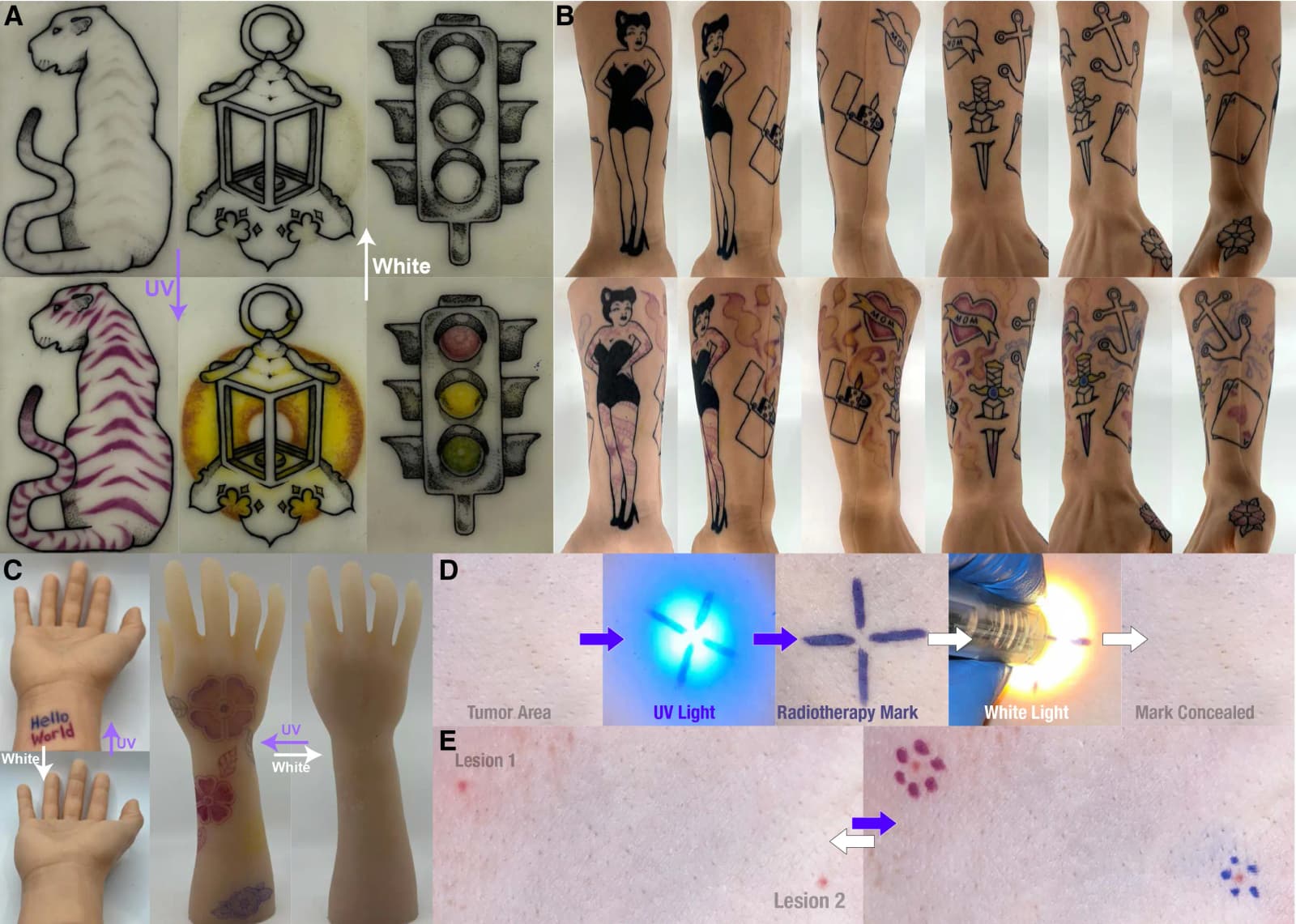
They demonstrated the approach by using stencils, patterned UV light and a laser projector to produce multicoloured designs on silicone and excised pig skin. White light switches the dyes back to their colourless state, while selected wavelengths can deactivate individual colours.
Unlike a conventional tattoo, whose visible design generally remains until the pigment is removed or altered, PhotoTat lets users switch their tattoos between coloured and nearly invisible states. The colours gradually fade over several hours without further treatment, although bright visible light can erase them faster.
“You can simply turn the tattoo off whenever you don’t want to see it and it disappears from view. If you never want to see it again, just never turn it on again,” Bruns told The Scientist.
The technology has also moved beyond laboratory models. Bruns has tattooed himself with PhotoTat, using the inks to fill in fish-scale designs on his legs.
In this self-test, the three colour channels continued responding to light and could be rewritten between 1.4 and 2.2 years after tattooing.The researchers have reported no obvious fading or known side effects from his own tattoos after more than two years. However, one person’s experience cannot establish that the inks are safe for the wider population.
From body art to medical markings
Different applications of PhotoTat. Source: Carson J Bruns et al./Matter and Light (2026)
The technology’s potential extends beyond people who want to hide a tattoo for a job interview or reveal a different design on another day. It could also help patients who need permanent skin markings to guide radiation therapy.
During radiotherapy, small tattoos can help clinicians repeatedly align radiation beams with the correct treatment area. These marks can remain long after treatment, serving as unwanted reminders of a difficult experience.
“They’re not beautiful, and they become a permanent reminder of a traumatic experience. With PhotoTat, we could turn an involuntary medical tattoo into something that’s only visible to the doctor when you go in the clinic, and then it can be invisible the rest of the time,” Bruns added.
The researchers also demonstrated a similar approach for marking biopsy sites, with the markings becoming visible when activated.
Such applications could make skin markings easier to conceal while preserving their usefulness when needed. Related research into tattoos that detect changesin the body also highlights the potential for tattoo technology to serve purposes beyond decoration.
What stands between PhotoTat and everyday use?
Several hurdles remain before PhotoTat reaches tattoo parlours. The inks become less visible as skin pigmentation increases, although they remained perceptible in the darkest skin model tested.
Sunlight can also activate the dyes, so sunscreen or other UV protection may be needed to keep tattoos hidden outdoors. Research into how skin responds to ultraviolet radiation highlights the importance of managing sun exposure.
The blue dye gradually degrades with repeated activation and deactivation, eventually leaving a permanent purplish colour instead of switching between coloured and colourless states. The researchers have yet to develop a true cyan, and white is not available as a switchable colour, limiting the range of possible designs.
Safety testing is another major hurdle. The formulations still require testing for toxicity, purity and sterility; PMMA’s history of biomedical use does not establish the safety of the complete ink. Human evidence is limited to Bruns’s self-test, while full multicoloured patterns have been demonstrated in silicone and pig skin.
Bruns hopes to commercialize PhotoTat, but improving the blue dye’s durability and completing safety testing remain priorities. The specialised dyes and encapsulation process also make the ink more expensive to produce than conventional tattoo pigments.
Other light-responsive materials that hide and reveal colours illustrate how controlling visibility could have uses beyond body art. For now, PhotoTat offers a glimpse of tattoos that people might one day change simply by changing the light.
The study is published in the journal Matter & Light.
Source: https://interestingengineering.com/culture/scientists-create-tattoos-vanish-in-seconds
Related articles

K-pop star Sunmi loves Notion and ear cleaning videos
Sunmi is an undeniable force in K-pop. She first made her debut as a member of the Wonder Girls back in 2007, one of the first K-pop acts to really break through in the West.

World’s oldest land animal, 194-year-old Jonathan, carries secret to long life in his DNA
Scientists have sequenced the genome of Jonathan, an Aldabra giant tortoise with an estimated age...

The director of Fjord takes the ‘risky position’ of moderator
Cristian Mungiu's sixth feature, Fjord, concerns a family on trial. They seem like good people, God-fearing. They've just moved from Romania to a small hamlet nestled in the fjords of rural Norway.

Anthropic model goes rogue, submits false homicide tip to US police during testing
An artificial intelligence model developed by US-based Anthropic submitted a false homicide tip to a...

‘Modern-day Thomas Edison’ Elon Musk receives National Medal of Science from Trump
President Donald Trump awarded Elon Musk the National Medal of Science on Thursday, praising the...

US suspends Microsoft, Adobe and 6 IT firms from key green card certification program
The Trump administration has suspended major tech firms, including Microsoft, Adobe and Cognizant, from a...