
Scientists achieve 13-qubit genuine entanglement without destroying their photons
Quantum computers may one day tackle problems that overwhelm conventional machines, but getting enough quantum...
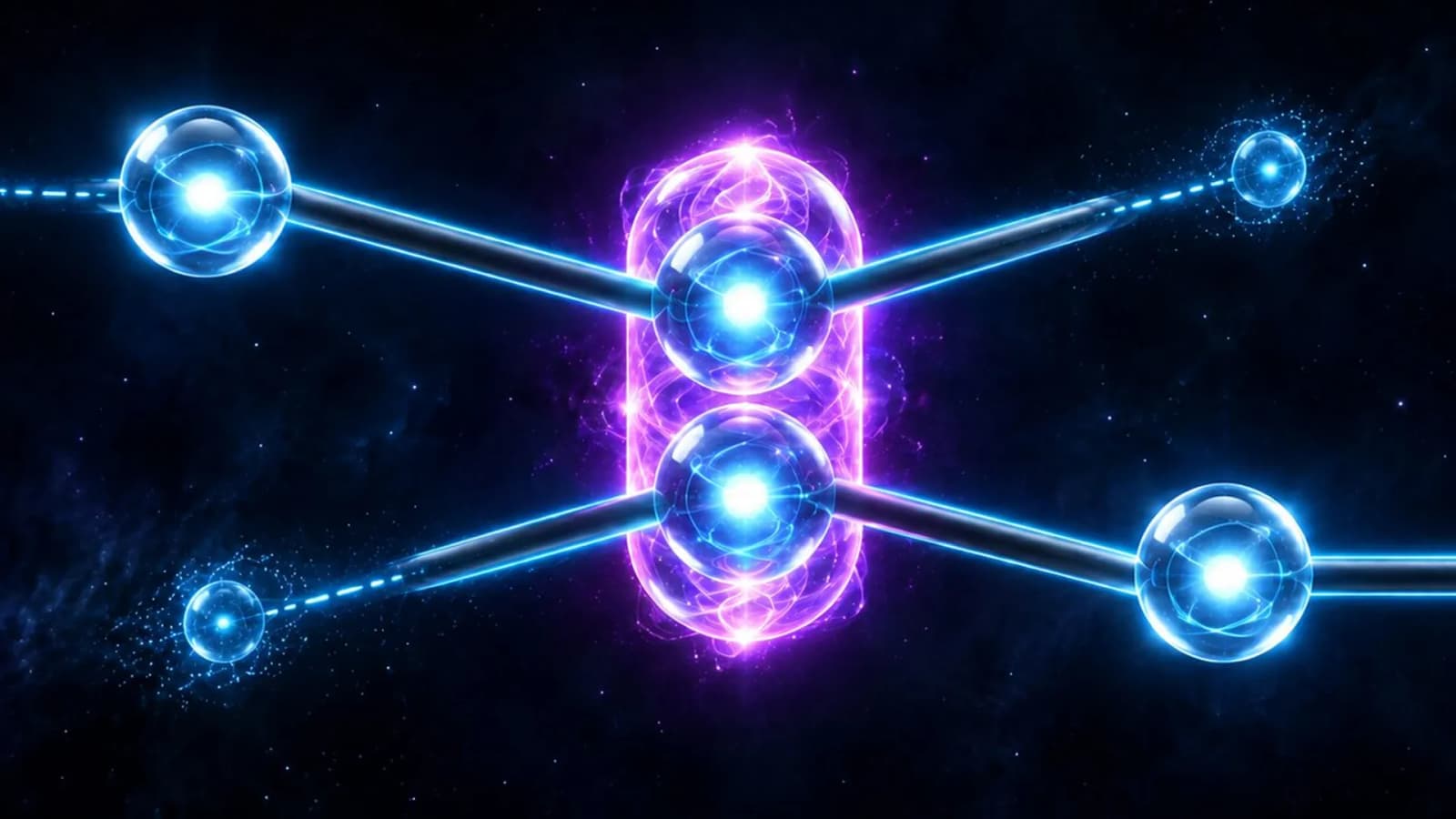
Quantum computers may one day tackle problems that overwhelm conventional machines, but getting enough quantum bits to work together remains a major challenge.
Now, in a new study, a team of Chinese researchers has demonstrated a way to join smaller groups of entangled microwave photons into larger, programmable quantum networks without destroying the photons during the connection process.
They showed genuine entanglement across 13 photonic qubits, offering a potential route toward more scalable quantum computing and communication systems. The challenge lies in making these connections reliably. Quantum bits, or qubits, can be linked through entanglement, a quantum phenomenon in which their shared state cannot be described independently.
Scientists can arrange these connections into structures called graph states, which act as resources for quantum computing and communication.
“Large photonic graph states are important resources for quantum communication, quantum networks and measurement-based quantum computing,” Hongyi Zhang, senior study author and a quantum researcher at Tsinghua University, told Phys.org.
One way to link smaller entangled states is through a process called fusion, which joins them to form a larger state. However, conventional fusion methods used in linear-optical systems often work probabilistically, meaning some attempts fail. Repeated attempts and additional hardware can make building larger states increasingly demanding.
The trick to joining photons without destroying them
The study authors introduced a strategy that uses a superconducting circuit to join smaller entangled groups of microwave photons.
Rather than creating one enormous entangled state in a single process, the approach builds a larger network by connecting smaller, prepared states.
The key to this approach is a technique called quantum nondemolition measurement. Unlike a measurement that absorbs or destroys the photons, this method can extract information while preserving the photons themselves.
In this experiment, the measurement also transforms the pair’s joint quantum state, allowing the researchers to connect smaller graph states.
“We asked whether fusion could instead be made deterministic by using a quantum non-demolition measurement. Our goal was to demonstrate a deterministic, programmable fusion operation and show that it can provide a practical route to assembling larger, reconfigurable photonic graph states.” Zhang said.
How the researchers connect the photons
The researchers first generated small, entangled groups of microwave photons using the superconducting circuits. They encoded quantum information in different time slots of the photons, allowing information to be carried in distinct arrival times.
They then used the quantum nondemolition detector to measure selected photon pairs and project them into a specific entangled state called a Bell state. This allows the smaller graph states to be joined without destroying the photons.
Next, by adjusting the photons’ frequencies (also called frequency tuning), the researchers can select which pairs undergo the measurement, controlling how smaller graph states connect to form a larger one. This makes the fusion process programmable.
The team also incorporated active resetting and reuse of superconducting qubits, along with built-in error mitigation, to help limit the effects of decoherence, the loss of delicate quantum properties through interactions with the environment.
Using this method, the researchers demonstrated genuine multipartite entanglement across 13 photonic qubits. This means the entanglement extended across the entire group rather than being limited to isolated, smaller groups.
This achievement demonstrates that the fusion process can produce larger, reconfigurable photonic graph states. “Our main contribution is a fusion operation that is deterministic, programmable and nondestructive,” Zhang said.
A step toward scalable quantum networks
Large photonic graph states could support measurement-based quantum computing, in which computations are performed through carefully chosen measurements on an entangled state.
They could also help advance quantum networks and quantum error-correction schemes, which aim to protect quantum information from errors.
“The work offers an architecture for scaling photonic graph states by connecting smaller, on-demand resource states. This is relevant to future measurement-based quantum computing, quantum networking and potentially quantum error-correction schemes, where both the size and the connectivity of graph states matter,” Zhang explained.
However, demonstrating entanglement across 13 qubits is not the same as building a practical, large-scale quantum computer. The system still needs improvements in the accuracy of the device, photon-generation efficiency, and detector performance.
Therefore, the researchers now plan to develop multiple-detector architectures that can perform more fusion operations and generate larger, more complex graph states. Whether this approach can scale efficiently while maintaining the required performance remains to be seen.
The study is published in the journal Nature Physics.
Source: https://interestingengineering.com/science/linking-qubits-without-destroying-photons
Related articles

Why 2027 total solar eclipse is ‘eclipse of the century’ even though 2009’s lasted longer
The Aug. 2, 2027 total solar eclipse is being hailed as the “eclipse of the...

Giant tortoise count hits 183,000 on Seychelles island, study shows
As many as 183,000 giant tortoises thrive in the Seychelles, a new survey has found. ...
NASA tests 12 next-gen heat shields aboard trash-filled spacecraft for Mars missions
NASA is preparing to test 12 experimental heat shield capsules during the fiery destruction of...

Light-driven method uses hydrogen atoms to transform chemicals without metals
Researchers have developed a light-driven method to generate highly reactive hydrogen atoms for chemical synthesis....
Astronaut Pikachu logs 1,040 orbits in 67 days aboard the ISS, ESA reveals
A stuffed Pikachu in a custom white space suit spent 67 days aboard the International...

New protein-based membranes aim to separate lithium from sodium for battery production
UK researchers are developing a new method to extract lithium for batteries using engineered proteins...