Underwater exoskleteon slashes breathing volume by 30 percent in early human tests
Researchers at the Shenzhen Institute of Advanced Technology say a soft, wearable hip exosuit lowered...
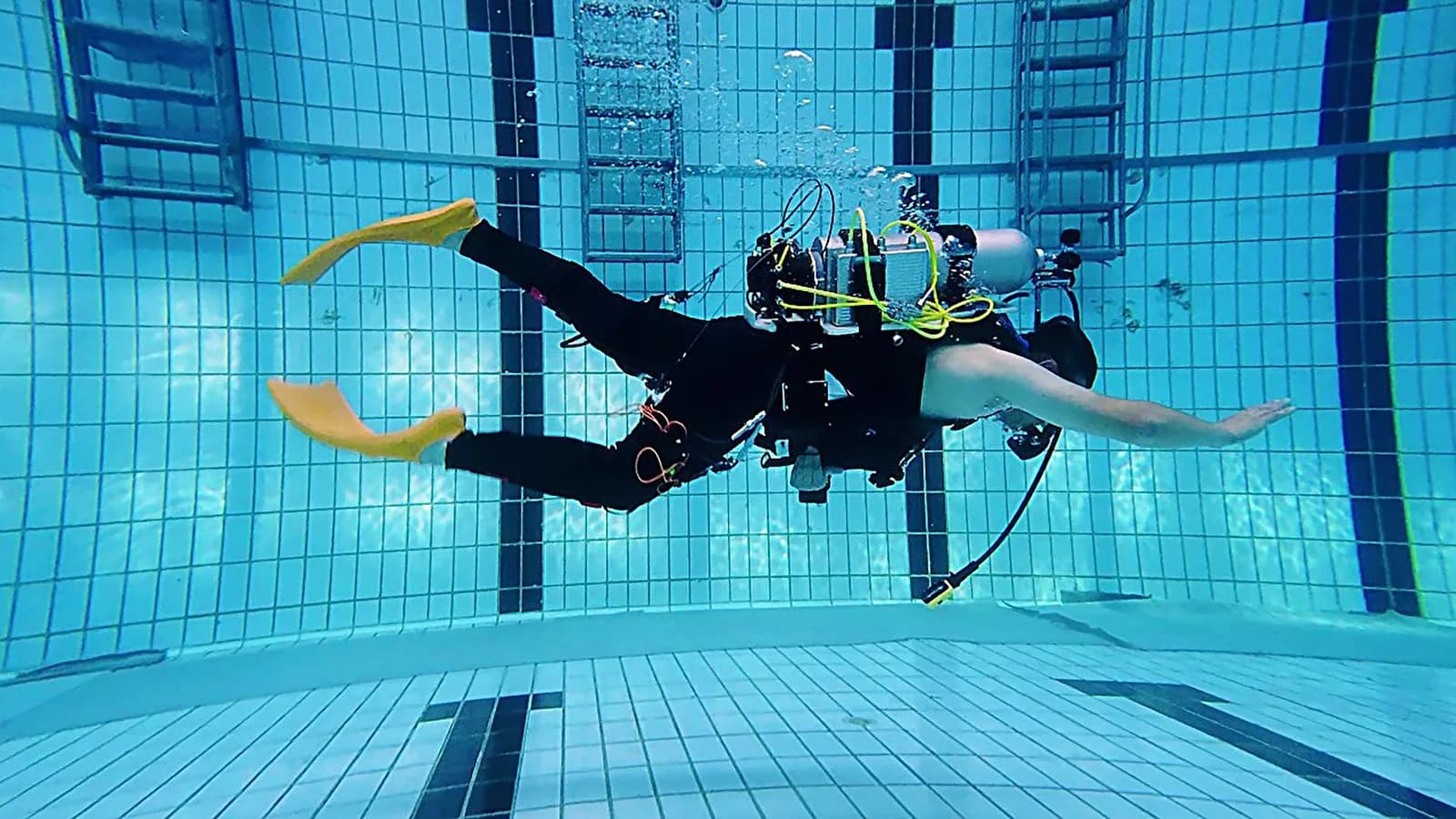
Researchers at the Shenzhen Institute of Advanced Technology say a soft, wearable hip exosuit lowered how much gas wearers breathed in earlier human tests, according to a Chinese Academy of Sciences release.
An exosuit is a flexible garment that gives a wearer mechanical help moving. Scuba diving is hard on the body: divers push against water while carrying gear, and their time below depends on endurance and how much breathing gas they carry, the release said. The team, led by Wu Xinyu, a professor at the institute, described the work in a Focus article in Science Robotics on Oct. 21.
In those tests, the release said, the exosuit cut respiratory minute volume (the amount of gas a person breathes per minute) by 29.77 percent during flutter kicking, 25.70 percent during frog kicking and 18.35 percent during underwater walking. The researchers say the results suggest exoskeletons may reduce divers’ breathing demands.
Built for water, not land
The exosuit is called PEAKED. It is designed to assist the hip as the leg swings forward and backward, known as flexion (lifting the leg forward) and extension (swinging it back). The release said it supports several common underwater movements, including those three. Unlike rigid robotic frames, PEAKED has a compliant design, meaning it bends with the body, so the legs can move widely and naturally while still getting help, the release said. The researchers say the assistance lets divers keep control of their movements and sense their surroundings directly.
Underwater exoskeletons cannot simply copy land exoskeletons made for walking or running, the researchers say. Buoyancy, the upward push of water, reduces the need to support body weight, while water resistance acts during much of the leg movement. That makes help in both directions especially important for kicking. The device’s structure, the joints it helps and the timing of that help must all match specific underwater movements, according to the release.
What is still unproven
The figures come from the release, which does not say how many people took part, or whether they were divers. It also does not say where the tests were ran. The Science Robotics piece is a Focus article, and its data statement says it reports no new data, so the human-test figures appear to come from earlier studies. The paper lists Wu and five co-authors as inventors on a patent for a wearable exoskeleton system for ocean diving. The patent is assigned to the institute.
Practical systems must also work with scuba tanks, ballast and other gear, stay waterproof under pressure and come off quickly in an emergency, the release said. Looking ahead, the researchers point to personalized assistance and posture stabilization, or help keeping the body steady underwater. Future systems using those advances could adjust automatically to different divers, movements and tasks, and might become intelligent wearable systems rather than simple assistive devices, the researchers said. The release gave no timeline for real-world use.
The Focus article appeared in Science Robotics.
Get the latest news delivered to your inbox.
Related articles