
US Army tests autonomous robot mules for frontline resupply and evacuation
The U.S. Army has selected six companies to develop production-ready robotic vehicles for a program...
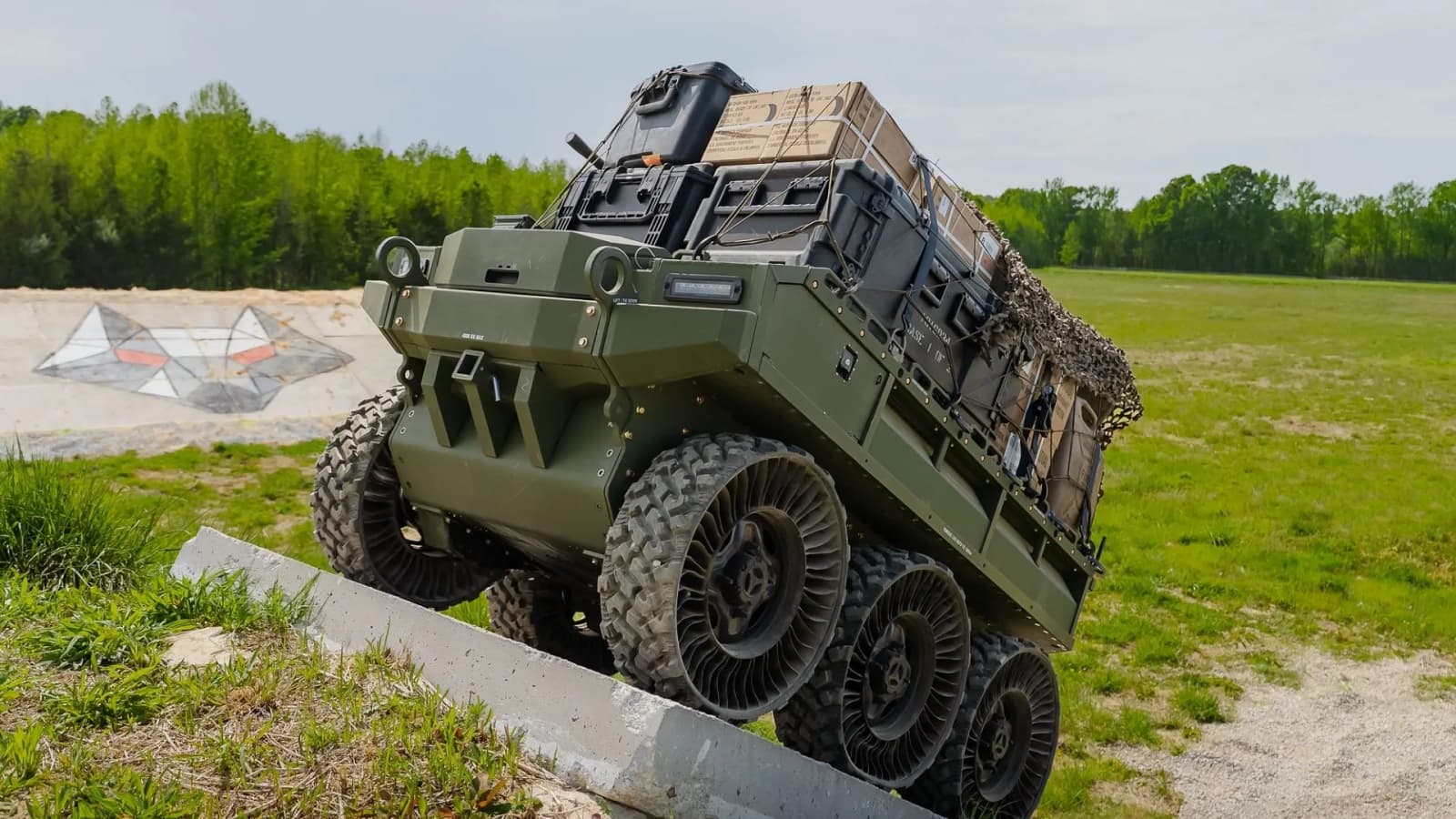
The U.S. Army has selected six companies to develop production-ready robotic vehicles for a program to automate one of the most dangerous logistical tasks on the battlefield: moving supplies and evacuating casualties close to the front line.
BLADE, the robotics company formerly known as HDT, is one of the six companies selected for the Army’s Infantry Last Tactical Mile (ILTM) initiative. The company has submitted its Hunter WOLF unmanned ground vehicle (UGV), a six-wheeled diesel-electric hybrid designed to support light and dismounted infantry.
The ILTM program focuses on the stretch between rear logistics units and the forward line of own troops (FLOT), where soldiers moving ammunition and supplies forward—or carrying wounded personnel back—can be exposed to enemy fire.
Hunter WOLF brings a mature design to the program
BLADE describes the Hunter WOLF as a production-ready, Technology Readiness Level 9 system. TRL 9 is the highest level on the U.S. military’s technology-readiness scale and indicates a system demonstrated in an operational environment.
The company says the vehicle can autonomously carry up to 2,800 pounds (1,270 kg) of cargo. Its six-wheel configuration is designed to handle difficult terrain, including dense forests, 60-percent grades, and 40-percent side slopes.
The vehicle can also provide electrical power to other equipment and accept different payloads depending on the mission. That allows the same platform to be configured for logistical resupply or casualty evacuation rather than being limited to a single task.
“The Hunter WOLF is engineered, manufactured, field-proven and ready to support warfighters in challenging contested environments,” said Tom Van Doren, president of robotics at BLADE.
Six companies will compete for the Army’s next robotic infantry system
BLADE is one of six companies selected by the Army for the ILTM prototype effort. The other participants are Maren-Go, Overland AI, Forterra, Hendrick’s Motorsports and American Rheinmetall.
The Army selected the companies through prototype Other Transaction Agreements. Defence Blog reported that the participating companies are expected to provide production-ready prototypes for demonstrations and an operational assessment with an Army unit in early 2027.
The results of that assessment are intended to help the Army determine the requirements and inform a potential production decision for its next generation of autonomous infantry support systems.
The program is therefore not yet a selection of a single vehicle for Army-wide service. Instead, it is a competitive prototype effort intended to evaluate different approaches to autonomous logistics and casualty evacuation.
Hunter WOLF has already undergone military evaluations
BLADE is entering the competition with a vehicle already used in military exercises and evaluations. According to the company, the Hunter WOLF has been in service since 2017 and received upgrades in 2025. It has participated in more than 60 field exercises, with BLADE saying the platform has supported U.S. Marine Corps, Australian, and Ukrainian forces.
The vehicle has also undergone recent U.S. Army evaluations. In May, BLADE delivered Hunter WOLF vehicles to the 10th Mountain Division at Fort Polk under the Army’s Ground Optionally Autonomous Transport effort, where soldiers trained to operate and maintain the systems in different mission configurations.
The company also reported evaluations with the 10th Mountain Division and 101st Airborne Division during 2026, as well as an August event involving the 82nd Airborne Division at Fort Polk, Louisiana.
For the ILTM effort, the Army will now assess whether systems such as Hunter WOLF can reliably perform resupply and casualty evacuation missions in the difficult terrain and contested conditions infantry units face.
If the prototypes demonstrate that they can reduce the need to expose soldiers to these dangerous logistical tasks, autonomous ground vehicles could become an increasingly important part of how the Army moves supplies and casualties across the final stretch of the battlefield.
Related articles

New leaks provide our first look at Apple and LG’s smart home devices
Following a report from Bloomberg yesterday that Apple is collaborating with LG for a new collection of smart home devices and accessories, a reliable leaker known as "pdfu" on X has revealed more…

Google invests millions in Mark Zuckerberg’s efforts to create a ‘virtual cell’
Google DeepMind, Meta, and AI drug discovery startup Isomorphic Labs are jointly investing $300 million into Biohub, the nonprofit biomedical research organization founded by Mark Zuckerberg and his…
US firm’s microreactors to power Canada’s first 50 MW-class transportable nuclear plant
A coastal community in eastern Canada could soon host one of the world’s first transportable...

Windows and Surface event: how to watch and what to expect
Microsoft is heading to San Francisco this morning to reveal what's coming next for Windows and Surface and a "conversation on how local AI will shape the next chapter of the PC.

Amazon uses its tracking data to guess whether shoppers have a flat butt and no friends
Most people know that Amazon collects data about your shopping history to serve up personalized product recommendations.

My cats hate to see this great upright carpet cleaner coming
For a while, I swore by Bissell’s Little Green carpet cleaner.