
US Army’s cheap Blackbeard hypersonic missile gets its first ground launch glimpse
Defense startup Castelion has released what appears to be the first image of its low-cost...
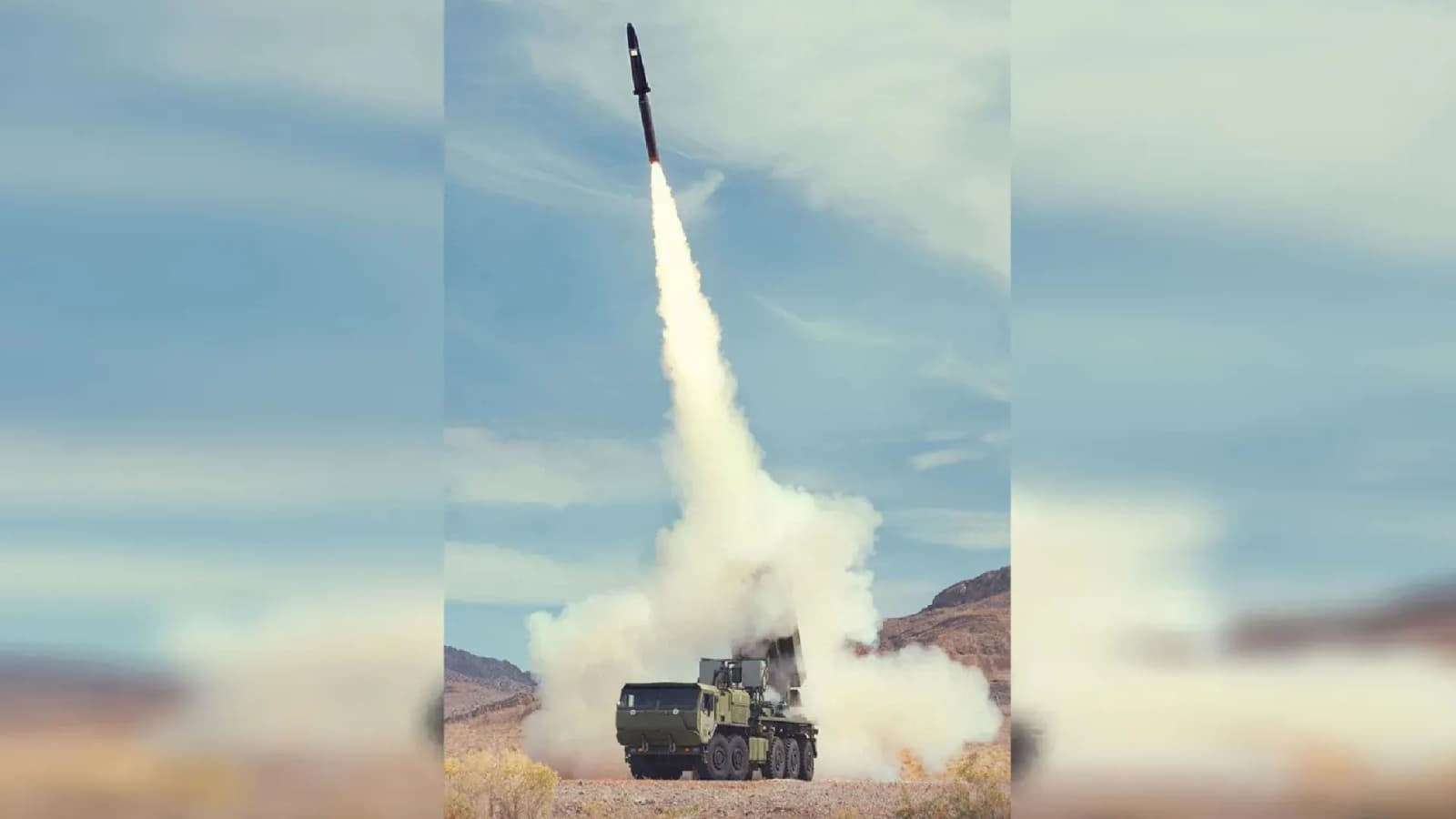
Defense startup Castelion has released what appears to be the first image of its low-cost Blackbeard hypersonic missile being fired from a ground launcher, offering a new look at the containerized launch system under development for the U.S. Army.
The photograph, posted on X, shows a Blackbeard missile leaving a launcher mounted on a high-mobility truck chassis. It gives the first public glimpse of how Castelion plans to package and operate the ground-launched version, known as Blackbeard GL.
Army plans and next milestone
The Army’s plans call for an initial ground-launch demonstration using a modified Multiple Launch Rocket System Family of Munitions (MFOM) pod, followed by Blackbeard GL prototypes and a dedicated launcher pod. A flight test using the M142 High Mobility Artillery Rocket System’s (HIMARS) fire-control system would follow. Fiscal 2027 budget documents list a live-fire launch of a “production representative” Blackbeard GL and launcher pod as the next major milestone.
What the image shows
Earlier images showed a two-stage arrangement with a booster and an upper vehicle consistent with a hypersonic glide or maneuvering payload. The ground-launch model lacks the cruciform tailfins at the rear of the lower stage seen on the air-launched version but otherwise appears similar.
Container-compatible Blackbeard. Built to move with the fight. pic.twitter.com/OzWbiChCPQ
— Castelion (@Castelion) October 8, 2026
The launcher appears to use a compact enclosed container, consistent with the Army’s interest in leveraging the MFOM ecosystem and, eventually, HIMARS. The photograph does not confirm the load, but based on its dimensions, The War Zone reported, the container could feasibly hold at least two and perhaps as many as four missiles.
The truck appears to be the Oshkosh MKR18 Logistics Vehicle System Replacement that Castelion said it was converting into a launcher for flight testing.
Unknowns remain
The production weapon’s propulsion and flight profile remain undisclosed. Castelion has hinted at ranges of just under 500 miles, though range would likely be shorter from the ground without an aircraft’s altitude and speed. The company has stressed its test hardware may not represent the final system.
Cost drives the concept
The Army’s interest is rooted in cost as much as performance. The service has described Blackbeard as an affordable, mass-produced hypersonic precision-fire capability to engage time-sensitive moving and hardened targets. Its stated goal is roughly 80% of the capability of the planned Precision Strike Missile Increment 4 at a substantially lower cost per round.
Existing U.S. hypersonic weapons such as the Army’s Dark Eagle use large, specialized launch equipment. A containerized launcher compatible with existing mobile fires could let the Army field a hypersonic weapon without a separate launcher, crew, transport and reload architecture.
Navy orders and procurement
Castelion is also working with the Navy to integrate Blackbeard onto the F/A-18E/F Super Hornet. In April, it received a $105 million Navy contract supporting integration and an early operational capability, followed by a $23.4 million order for 50 pre-production missiles with storage and shipping containers.
In May, the Pentagon said that once Castelion achieves testing and validation, it will award a two-year multiyear contract for at least 500 Blackbeard missiles annually, with options to extend up to five years. It is also seeking authorizations and appropriations to buy more than 12,000 missiles over five years.
The effort reflects a broader U.S. push for lower-cost precision weapons that can be built at scale, particularly with a potential large-scale conflict with China in the Pacific in mind, The War Zone reported.
Related articles


Microsoft 365 Family subscribers will finally be able to share AI benefits
Microsoft bundled its AI-powered Office features into Microsoft 365 Personal and Family subscriptions last year, but it only allowed the primary account holder to access the AI benefits.
PhotoTat: Switchable tattoo ink lets you hide your body art at work, no laser needed
Engineers have designed a new line of multicolored tattoo inks that switch on and off...

Subsea cables and oil pipelines: The infrastructure linking AI, empire, and occupation
The growing importance of subsea cables in military and economic policy offers an entrypoint into understanding the corrosive, yet dependent, relationship between AI and oil infrastructure

Soft sensor recreates 3D shapes through bending and twisting despite fiber damage
MIT researchers have developed a soft sensor that recreates its own three-dimensional shape as it...

Green hydrogen process reaches 98% efficiency while producing valuable chemicals
A new electrochemical process developed by researchers at the Technion, Israel Institute of Technology, could...