
US student builds smart X-ray tool that cuts 44-hour particle analysis to 10 hours
A student in the US has come up with a new automated X-ray tool that...
A student in the US has come up with a new automated X-ray tool that can slash the time needed to examine 500 microscopic air pollution particles from 44 hours to just 10 hours.
The technology, known as X-AutoMap, was designed by Carlos DeLeon during his internship at Brookhaven National Laboratory’s (BNL) National Synchrotron Light Source II. DeLeon participated in the US Department of Energy’s (DOE) Science Undergraduate Laboratory Internship (SULI) program.
Under the supervision of Ajith Pattammattel, PhD, a beamline scientist at the lab, DeLeon worked to automate the X-ray analysis process. The tool allows an X-ray microscope to automatically identify particles of interest and study their chemical composition in greater detail.
The software could make it easier to understand how air pollution affects human health. It could also be useful for studying batteries and electronics. “It would be so much more efficient if we could determine detailed chemical compositions without requiring a human to steer the experiment,” Pattammattel said.
Automated X-ray scans
Air pollution contains thousands of microscopic particles with different chemical compositions. This can include soot, dust, pollen, and airborne microplastics that people inhale every day. Some pose greater health risks depending on the chemical composition.
However, identifying them can take several days because researchers must manually examine large samples and select individual particles for closer analysis. To speed up the process, the team came up with the X-AutoMap software to work with the facility’s Hard X-ray Nanoprobe (HXN).
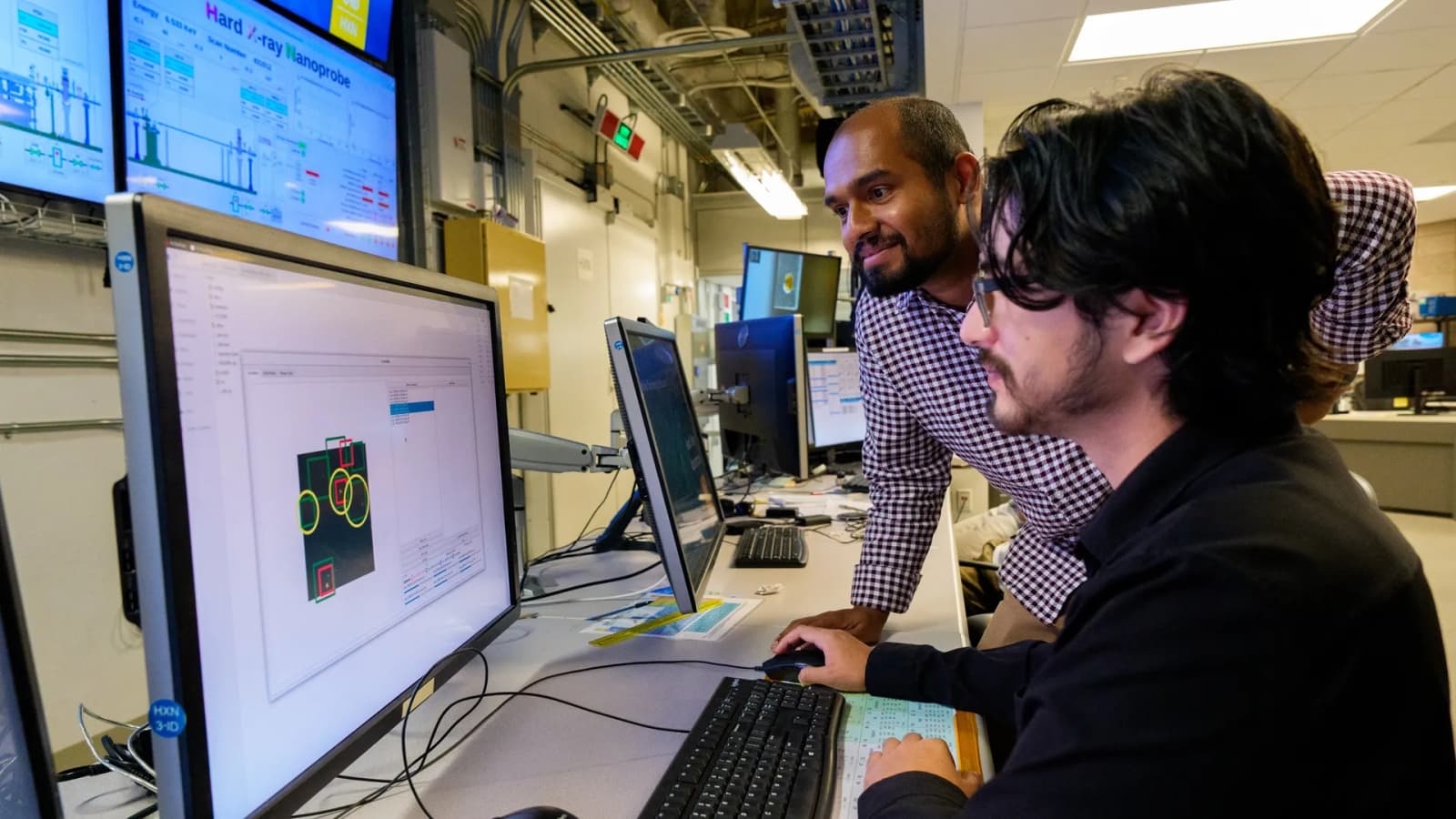
Carlos DeLeon at the Hard X-ray Nanoprobe beamline with Ajith Pattammattel. Credit: Timothy Kuhn / Brookhaven National Laboratory
The HXN is a powerful microscope that can examine materials at extremely small scales. It initially performs a quick, low-resolution scan of a sample. The software then analyzes X-ray fluorescence signals to detect particles that match specific chemical patterns.
When the software finds the particles, the microscope automatically starts a high-resolution scan to show their chemical composition and structure. Pattammattel elaborated that the software follows scientific rules that the researchers set ahead of time.
He explained the reason behind this approach. “We thought it would be so much easier if we could encode and combine different pieces of expert knowledge into a computer model, letting the microscope use that information to automatically identify where high-resolution scans would be needed,” Pattammattel added.
Cutting examination time
In lab tests, the scientists used samples of particulate matter which they collected from urban air pollution. The software successfully examined around 500 particles in 10 hours. In contrast, manual data collection took them a total of 44 hours.
The system also showed crucial differences between two types of iron-containing particles. Some particles contained iron, chromium, and manganese closely mixed. Many had a spherical shape, which is associated with high-temperature industrial processes.
Others contained iron, calcium, and silicon arranged in clusters of separate grains. This structure is commonly associated with natural or geological materials. According to the team, these differences can be hard to detect with lower-resolution scans.
However, because the software can only identify particles scientists specify and may miss very small ones or those with weak chemical signals, the team plans to improve it and explore AI models to detect more materials.
DeLeon reflected on his internship experience and encouraged hesitant students to apply for similar opportunities. “So many people tend to doubt themselves or sell themselves short and miss out on opportunities like this,” he concluded in a press statement. “You really never know where an experience like this could lead, so I encourage anyone interested to apply and see what happens.”
The study has been published in the journal Advanced Intelligent Discovery.
Source: https://interestingengineering.com/science/us-students-tool-cuts-particle-analysis-10-hours
Related articles

Microsoft has a new machine learning tool to improve weather forecasts
Old-school physics-based weather forecasting and even new AI models typically become less reliable beyond two weeks, a problem Microsoft claims to have solved using machine learning.

Ukraine claims Starlink is suddenly disrupting service for its military
Ukrainian officials claim the Elon Musk-owned Starlink put new limits on its service in the area without warning, disrupting the country's drone operations and missions, according to reports from…
Cold-proof alloys: Scientists find new class of metal that resist cracking at minus 423°F
A pair of experimental alloys has stayed tough at 20 kelvin, or minus 423 degrees...
X-ray imaging detects pores as small as 80 nanometers in nuclear fuel cladding
Researchers at Switzerland’s Paul Scherrer Institute (PSI) used a new X-ray imaging technique to examine...
How orbiting mini organs could help humans live longer on Earth and in space
Spaceflight does strange, rapid things to the human body. Six months in orbit can age...

Nearly 12,000 new viruses found in Pacific Ocean region targeted for deep-sea mining
A new study has uncovered vast, previously unknown viral diversity in the Clarion-Clipperton Zone (CCFZ),...