
Video: Worm-like robot shifts its own weight to crawl over rocks, climb steps and swim
Researchers at New York University have developed a worm-like robot designed to navigate rugged coastal...
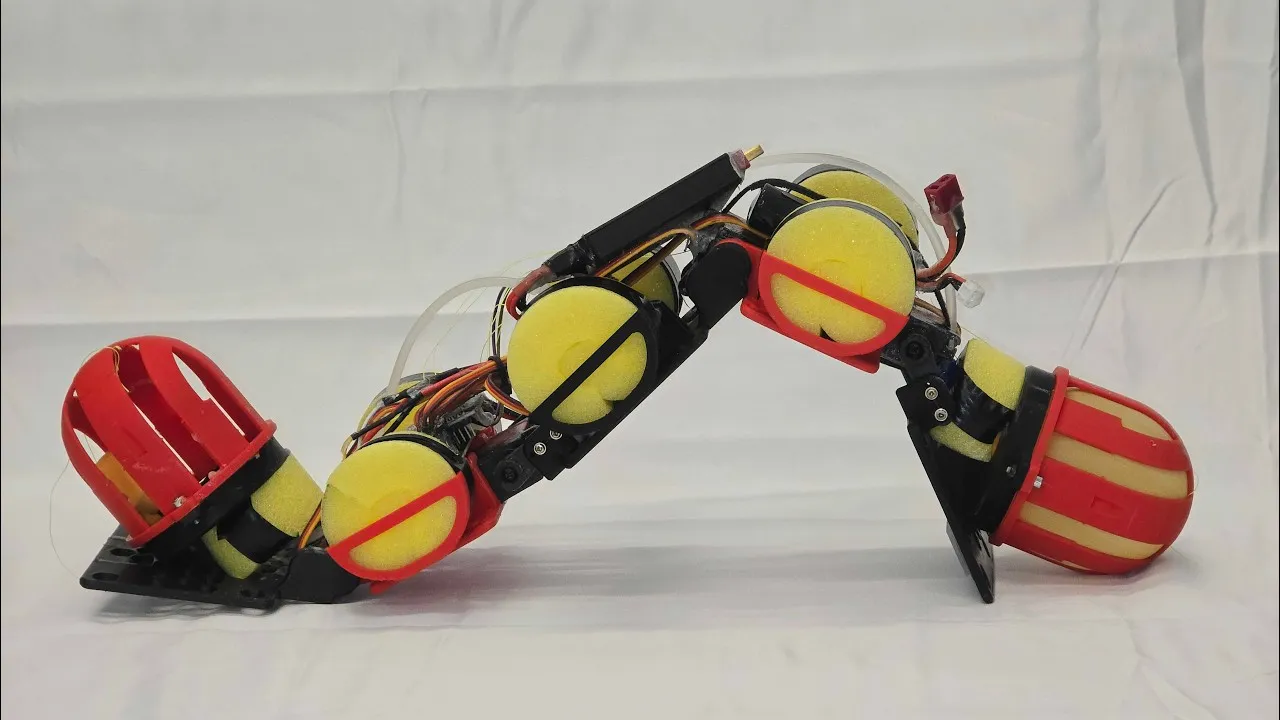
Researchers at New York University have developed a worm-like robot designed to navigate rugged coastal terrain. Called WorMa, the robot can move across rocks and slopes before entering and exiting water.
Its design is inspired by the way worms adapt their movement to changing environments. The researchers developed the robot to tackle terrain that can be difficult for conventional wheeled or legged machines.
Water-powered weight shift
Researchers at NYU’s Tandon School of Engineering developed WorMa, an amphibious, worm-like robot that changes how it moves across different terrain by shifting its weight.
Instead of switching between entirely different gaits or mechanically reconfiguring its body, the robot uses water as a movable ballast. A pump transfers water between tanks in its head and tail, allowing WorMa to redistribute its mass and adjust how it interacts with the ground or water.
WorMa is designed to handle transitions between surfaces that can challenge conventional robots. The five-link, four-joint robot is about 20 inches long (50 centimeters) long and weighs slightly more than 2.2 pounds (1 kilogram). Its body contains latex water balloons at the head and tail, while a pump located in the middle section moves about 10.6 ounces (about 300 grams) of water between them.
The technology relies on changing the robot’s center of mass rather than adding specialized mechanical components for each environment. Moving the water toward the head increases the force applied through the front contact points. This gives the robot greater traction when climbing sloped surfaces.
During testing, the head-heavy configuration allowed WorMa to climb an incline as steep as 19.5 degrees, while other weight configurations caused it to slide backward. The configuration also reduced the robot’s cost of transport by at least 33 percent compared with the alternatives tested.
The same weight-shifting mechanism produces a different effect in water. Moving the water toward the tail improves the robot’s swimming performance by changing its mass distribution. In tests, the tail-heavy configuration allowed WorMa to swim up to 26 percent faster and operate 52 percent more efficiently than when its weight was concentrated toward the head.
WorMa tackles terrain
The robot uses a more complex sequence to overcome steps. It first approaches with its water concentrated in the head to maintain traction. The pump then moves the water toward the tail, causing the front section to rise and allowing the tail to push the robot closer to the obstacle. Once the head establishes contact with the step’s edge, water is transferred back toward the head, helping the robot anchor itself and continue forward. Using this sequence, WorMa cleared steps about 6 inches (up to 15 centimeters) high.
According to the team, the same principle helps the robot leave water. With its mass concentrated toward the head, WorMa can generate enough force at its front section to pull itself onto a slope. Other tested configurations could not produce sufficient traction for the transition.
The researchers demonstrated the robot crossing a course containing flat ground, a step, a slope, and open water. WorMa adjusted its mass distribution for each section while maintaining its basic undulatory movement pattern.
“What it gives you is a robot that doesn’t need to be redesigned every time the terrain changes. That could matter for environmental monitoring or infrastructure inspection, where a robot may need to cross dry ground, obstacles, and water during the same mission,” said Nana Obayashi, an assistant professor at Tandon, in a statement.
The approach could simplify amphibious robots by replacing multiple specialized mechanisms with a single adaptable mass-shifting system. The researchers are also working on faster pumps and sensor-based controls that could let WorMa detect terrain changes and automatically redistribute its weight. This could eventually enable the robot to adapt more dynamically while operating in environments such as coastlines, wetlands, and flooded areas.
Related articles

How Apple can win the smart home
This week, Apple is hosting its first-ever dedicated smart home event.

Anthropic adds live dashboards and animated explainers to Claude with Dashboards and Motion
Anthropic launched Claude Dashboards, which builds auto-updating dashboards from data platforms and CRMs, and Claude Motion, which turns reports and charts into editable animations, in beta, while making Docs, Slides and Design available on every plan.

Microsoft launches Microsoft-Decision-1, a fast decision-scoring model, on Foundry and OpenRouter
Microsoft released Microsoft-Decision-1, a model that returns calibrated probabilities over fixed options instead of generating text. Microsoft says it topped a 36-benchmark comparison and ran 35 times faster than GPT-6 Sol.

Microsoft’s Satya Nadella says advanced AI needs a human-controlled ‘emergency brake’
Microsoft CEO Satya Nadella urged the industry to treat frontier AI models like insider risks, wrapping them in containment, independent controls and an “emergency brake” that lets an authorized person pause or shut down a model mid-task.

Amazon in talks to buy AI startup Decart for around $7 billion, WSJ reports
Amazon is negotiating to acquire Decart, maker of real-time video-editing and robotics-simulation AI models, in a deal that could be valued at about $7 billion, The Wall Street Journal reported. Decart was valued at nearly $4 billion in May.

A college in Illinois tried to cancel its Flock contact and it refused
In April of 2025, Elgin Community College had six Flock safety cameras installed to "enhance the safety and security of students.