Where Each U.S. State Gets Its Tax Revenue From
California taxes income, while Florida and Texas rely on property tax. Each U.S. state has its own approach to raising government revenue.
How the 50 States Generate Their Tax Revenue
Key Takeaways
Property taxes are the largest individual tax category in 25 states, including Florida, Texas, and New York.
Washington collects nearly half of its combined state and local tax revenue from general sales and gross receipts taxes.
Delaware stands out for license taxes, reflecting its role as a legal home for businesses.
From paychecks and purchases to homes and businesses, states rely on different combinations of taxes to fund public services.
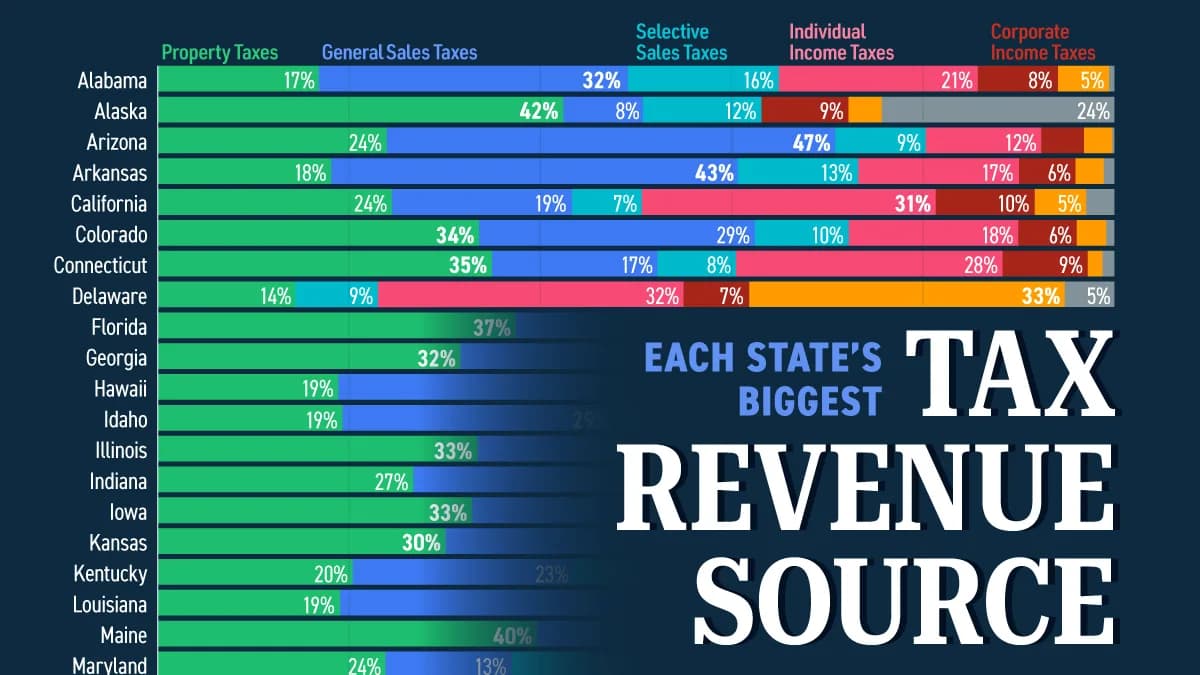
This graphic breaks down combined state and local tax revenue across all 50 states using 2024 government finance data from the U.S. Census Bureau. The percentages show each category’s share of tax collections, excluding federal taxes and funding such as federal grants.
Property Taxes Lead in Half the Country
Property taxes are the largest revenue source in half of U.S. states, with particularly high shares in New Hampshire (64.3%), Alaska (42.4%), and Texas (41.1%). General sales and gross receipts taxes lead in 16 states, while individual income taxes top the list in seven.
The country’s largest states illustrate these differences. Individual income taxes dominate in California, while property taxes narrowly exceed general sales taxes in Florida and individual income taxes in New York.
StateBiggest Revenue Source in 2024Share of Total Tax Revenue
AlabamaGeneral sales taxes32.3%
AlaskaProperty taxes42.4%
ArizonaGeneral sales taxes46.9%
ArkansasGeneral sales taxes42.5%
CaliforniaIndividual income taxes30.7%
ColoradoProperty taxes33.6%
ConnecticutProperty taxes34.9%
DelawareLicense taxes33.0%
FloridaProperty taxes37.4%
GeorgiaProperty taxes31.6%
HawaiiGeneral sales taxes35.9%
IdahoGeneral sales taxes28.5%
IllinoisProperty taxes33.4%
IndianaGeneral sales taxes28.4%
IowaProperty taxes32.9%
KansasProperty taxes30.1%
KentuckyIndividual income taxes28.0%
LouisianaGeneral sales taxes39.1%
MaineProperty taxes39.6%
MarylandIndividual income taxes35.6%
MassachusettsProperty taxes34.1%
MichiganProperty taxes33.9%
MinnesotaIndividual income taxes27.5%
MississippiGeneral sales taxes34.5%
MissouriProperty taxes28.8%
MontanaProperty taxes36.4%
NebraskaProperty taxes33.3%
NevadaGeneral sales taxes44.8%
New HampshireProperty taxes64.3%
New JerseyProperty taxes40.5%
New MexicoGeneral sales taxes33.7%
New YorkProperty taxes28.8%
North CarolinaGeneral sales taxes29.0%
North DakotaOther taxes40.7%
OhioProperty taxes28.1%
OklahomaGeneral sales taxes33.4%
OregonIndividual income taxes34.2%
PennsylvaniaIndividual income taxes26.4%
Rhode IslandProperty taxes34.3%
South CarolinaProperty taxes29.0%
South DakotaGeneral sales taxes43.3%
TennesseeGeneral sales taxes47.8%
TexasProperty taxes40.9%
UtahGeneral sales taxes30.3%
VermontProperty taxes39.8%
VirginiaProperty taxes31.9%
WashingtonGeneral sales taxes49.0%
West VirginiaIndividual income taxes23.2%
WisconsinProperty taxes31.0%
WyomingProperty taxes38.5%
Including local governments makes a substantial difference. In Texas, for example, property taxes are collected by local tax authorities and support services such as schools, roads, and fire protection, even though the state government itself levies no property tax.
These shares describe how governments raise money, rather than how much an individual household owes. A large property-tax share can reflect limited collections from other taxes as well as substantial property-tax revenue.
How States Fund Services Without Taxing Wages
Florida collects no individual income tax revenue, with property and general sales taxes together supplying about three-quarters of state and local tax collections. In Texas, those two categories account for nearly 79%, highlighting both states’ reliance on property and consumption taxes.
New Hampshire takes that pattern further: property taxes generated 64.3% of tax revenue, the highest share nationwide. The state has no general sales tax and does not tax wages. Its small individual income tax share in 2024 reflects the interest and dividends tax, which was repealed effective in 2025.
Sales-related collections also extend beyond the checkout counter. General sales taxes include taxes on business gross receipts, while selective sales taxes apply to particular products or activities, such as fuel, tobacco, and utilities. This helps explain why a state’s revenue mix can look different from the taxes shoppers encounter directly.
Delaware and North Dakota: The Outliers
Delaware’s largest revenue source is license taxes, accounting for roughly one-third of collections. This category includes corporate franchise licenses and related charges, giving it a much broader meaning than driver’s licenses or hunting permits.
That revenue source connects to Delaware’s position in corporate America. In 2024, the state was the legal home of more than two million business entities and about two-thirds of Fortune 500 companies. Incorporation generates public revenue from businesses whose operations extend far beyond Delaware’s borders.
North Dakota’s unusual mix reflects another economic advantage: natural resources. “Other taxes,” which include severance taxes on resource extraction, supplied 40.7% of collections. The state levies taxes on oil and gas production and oil extraction, linking part of its public finances to the value of energy produced within its borders.
Learn More on the Voronoi App
To explore the role of property taxes worldwide, check out Revenues from property taxes are much higher in advanced economies on Voronoi.
Source: https://www.visualcapitalist.com/where-each-states-tax-revenue-comes-from/
Related articles