
World’s first heavy-ion collider crushes gold ions in Mini Big Bang, finds 5-sigma dip
Researchers in the US have turned to the world’s first heavy-ion collider to smash gold...
Researchers in the US have turned to the world’s first heavy-ion collider to smash gold nuclei together at nearly the speed of light and probe some of the densest nuclear matter ever created in a lab setting.
For the study, the research team used the STAR detector at the Relativistic Heavy Ion Collider (RHIC) at the US Department of Energy’s (DOE) Brookhaven National Laboratory (BNL). They found an unusual dip in particle momentum fluctuations.
The dip appeared during lower-energy collisions that compress nuclear matter to extreme densities similar to those inside neutron stars.. The departure from the expected smooth trend had a statistical significance of about 5 sigma.
“The type of matter we are trying to study is a recreation, or a mini version, of the Big Bang,” Rutik Manikandhan, a STAR Collaboration member from the University of Houston and a leader on the new analysis, said. The discovery could shed light on nuclear matter phase changes and the hunt for a critical point.
Extreme nuclear matter
RHIC operated at BNL from 2000 to 2026 and was designed to investigate exotic forms of nuclear matter by colliding heavy atomic nuclei, like gold, at nearly the speed of light. It shut down after completing its final operations on February 6, 2026.
At its highest collision energies the machine could effectively melt the boundaries of protons and neutrons, as well as free their constituent quarks and gluons. This creates quark-gluon plasma, an exotic state of matter believed to have filled the universe shortly after the Big Bang.
Lower-energy collisions, on the other hand, don’t completely break apart protons and neutrons. Instead, they compress nuclear matter to enormous densities which are similar to those inside neutron stars.
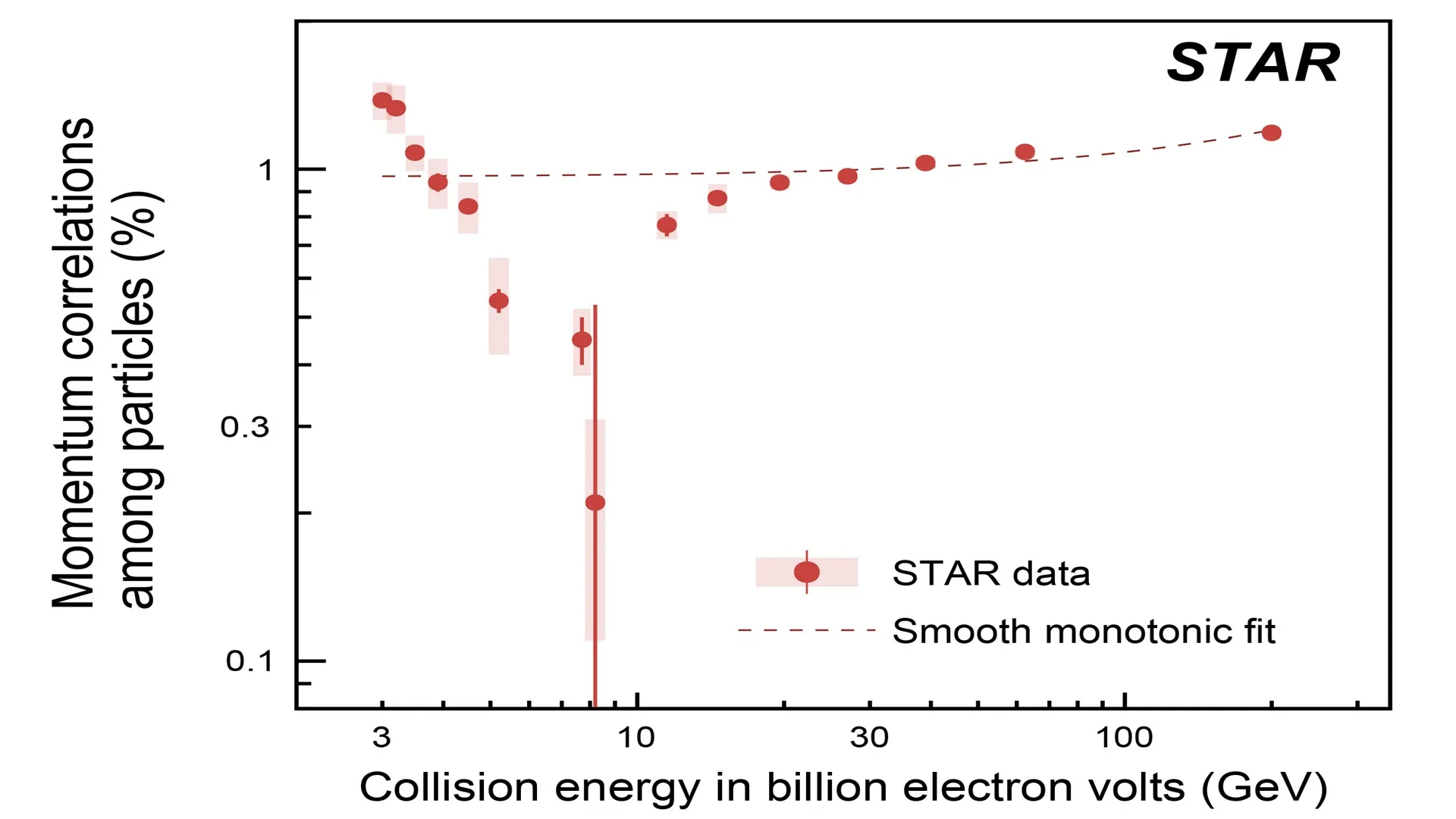
STAR data on the transverse momentum correlations in the most central gold-gold collisions at the RHIC, plotted against collision energy. Credit: Brookhaven NationalLaboratory
For the latest study, the team analyzed gold-gold collisions at energies between 3 and 7.7 billion electron volts (GeV). To get a better understanding, they compared the results with previously published STAR measurements extending up to 200 GeV.
The STAR scientists measured how much the particles’ momentum changed from one collision to another. Since particles from hotter matter generally have more momentum, the changes revealed how the fireball’s temperature varies between collisions.
“This momentum correlation measurement gives us an experimental window into temperature fluctuations,” Chunjian Zhang, PhD, a Fudan University junior faculty member and STAR analysis co-leader, noted. “We can use it as a proxy to look for temperature fluctuations.”
Looking for a critical point
The momentum fluctuations fell sharply as collision energy increased from 3 GeV. They hit a minimum at around 5.2 to 7.7 GeV, before they began rising again at higher energies. The dip could indicate suppressed temperature fluctuations, something theories predict near a critical point.
Near this point, matter can absorb energy without its temperature changing as much. The critical point would mark a change in how nuclear matter moves between phases. At RHIC’s highest energies, this transition happens gradually, while at higher densities scientists expect a sudden phase change. Pinpointing where this behavior changes could help physicists locate the critical point.
While the dip aligns with other possible signs of critical-point behavior seen by STAR at low energies, the team stressed that it does not prove the critical point exists. “No single observable settles the question of finding the critical point, and other explanations for this new STAR result still remain open,” Manikandhan said in a press release.
The researchers also compared their measurements with predictions from the A Multi-Phase Transport model, which does not include critical-point behavior. The model failed to reproduce the observed dip. The team warned that this still does not establish the existence of a critical point.
The study has been published in the journal Physical Review Letters.
Related articles
70cm axon, 35,000 neurons, 400,000 cells: Researchers map brain’s ‘blue place’
Deep in the brainstem sits a cluster of neurons so small it makes up only...
California’s ‘fire amoeba’ reproduces at 145°F, sets new heat record for complex life
A single-celled organism collected from a steaming creek in California can reproduce at temperatures that...

74 million years apart, same technique: Lemurs use formant tuning like trained sopranos
An international research team has found the first direct evidence that a wild animal independently...

Ancient oxygen signatures in meteorites trace origins of early Solar System organics
Before our planet had oceans, air, or even a solid surface, the raw ingredients for...
US school teacher discovers first-ever adult T. rex trackway from 66.5 million years ago
Millions of years after a massive Tyrannosaurus rex trudged through a prehistoric mudflat, paleontologists can finally follow...

Chinese researchers find link between prenatal rare earth exposure and low birthweight
A study of nearly 4,900 pregnant women in China has found an association between prenatal...