29-pound underwater drone dives 985 feet to hunt naval mines, launches with one operator
French underwater drone maker SEABER has launched RAVEN, a compact autonomous underwater vehicle (AUV) for...
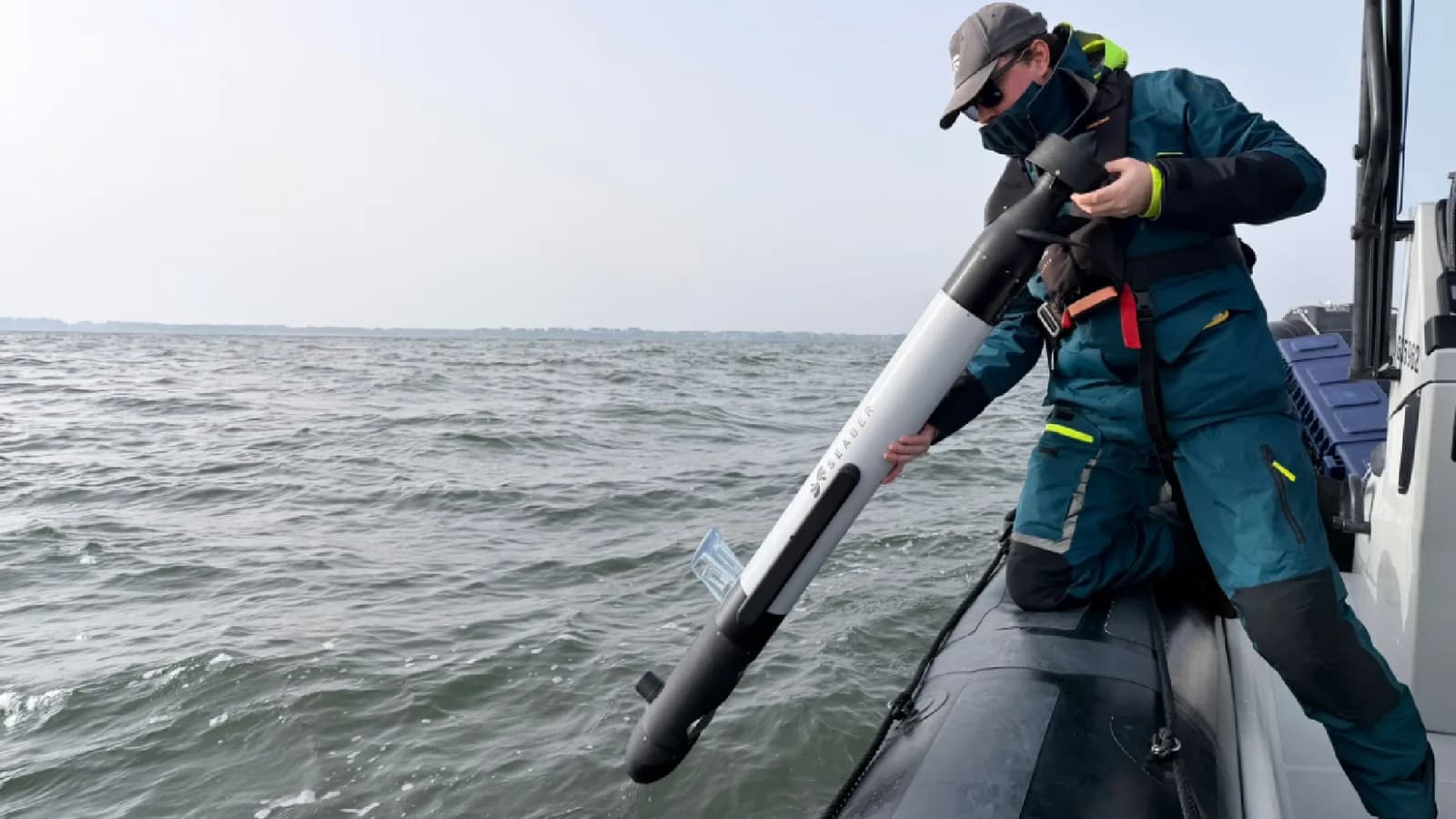
French underwater drone maker SEABER has launched RAVEN, a compact autonomous underwater vehicle (AUV) for hunting naval mines and surveying the seabed. Weighing 29 pounds (13 kg), it can be launched by a single operator.
SEABER announced the launch Oct. 26. The company says RAVEN will offer performance comparable to high-end conventional mine-hunting drones at about one-third of their price.
The company, based in the Brittany port of Lorient, did not give a price, name any launch customers or say when deliveries will begin. It also did not identify which competing vehicles it used as the benchmark for its cost claim.
Size, depth and endurance
RAVEN is about 4.5 feet (131 to 137 cm) long with a diameter of 4.7 inches (12 cm). It can dive to 985 feet (300 meters), travels at 3 to 6 knots (about 3.5 to 7 mph) and can run for up to eight hours.
Every version carries a side-scan sonar, which paints an acoustic image of the seabed to spot mine-like objects. Published specifications put the sonar at 600/1200 kHz or 900/1800 kHz.
The vehicle comes in two configurations. SCAN-MAG adds a magnetometer to detect and locate metal objects such as naval mines and shipwrecks. SCAN-LUMEN adds a high-definition camera and a 24,000-lumen lighting system so operators can visually inspect a contact.
Navigation takes center stage
Navigation is the part of the design SEABER is emphasizing most. The vehicle relies on LYNX, the company’s own optical-based inertial navigation system, combined with a Doppler velocity log that measures speed over the seabed.
SEABER says LYNX drifts by less than 0.2% of the distance traveled on straight runs and does even better on the back-and-forth lawnmower patterns used for searches. Accurate navigation matters for mine hunting because a detected object is only useful if divers or a neutralization drone can find it again later.
Before diving, RAVEN fixes its position with a dual-antenna satellite navigation receiver that SEABER says resists jamming. That matters for navies operating where GPS signals are deliberately disrupted, as has happened widely in the Baltic and Black seas.
Communications and recovery
Underwater, operators can send commands and track the vehicle in real time through an acoustic modem. The modem works at ranges of 1.2 to 1.9 miles (2 to 3 km) using SEABER’s SEAPLAN software.
At the surface, RAVEN communicates by UHF radio at up to 3 miles (5 km) and by Iridium satellite. It also carries infrared lights visible only through night-vision equipment, so crews can find and recover it at night without giving away their position.
According to published descriptions, RAVEN can be deployed from rigid-hulled inflatable boats or shore bases without specialized crane infrastructure.
Moving up from micro-AUVs
RAVEN moves SEABER up from the micro-AUV segment, where it built its YUCO range of small underwater drones supplied to European navies for mine countermeasures work. The company says it has sold more than 200 AUVs internationally through a worldwide distributor network.
Navies are already moving toward drone-based mine warfare. France’s armed forces said in 2024 they were buying eight autonomous underwater drones from Exail, with an option for eight more, to replace crewed mine hunters.
SEABER President Vidal Teixeira said the company’s ambition is simple: “to deliver the performance of the best conventional AUVs at one-third of their price.” He added that LYNX and the vehicle’s inspection and detection capabilities give RAVEN the potential to fundamentally change the rules of the market.
Source: https://interestingengineering.com/military/seaber-raven-mine-hunting-underwater-drone
Related articles