6-tesla magnetic fields support electron pairing in copper-oxide superconductor
Physicists at Ludwig Maximilian University of Munich and Utrecht University report that electrons in a...
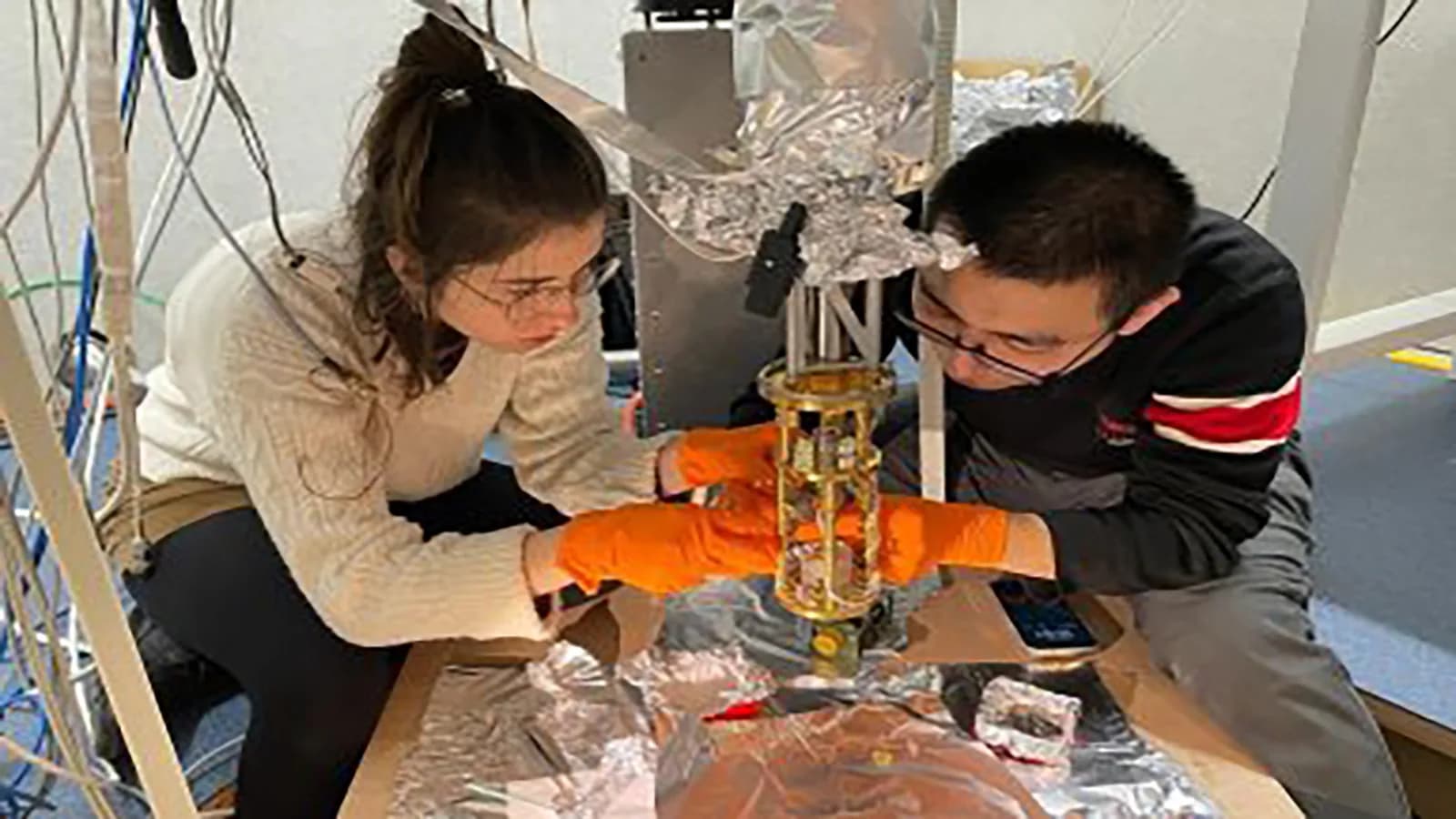
Physicists at Ludwig Maximilian University of Munich and Utrecht University report that electrons in a copper-oxide superconductor begin pairing at the same energy where a puzzling state, the pseudogap, appears. In a pseudogap, electrons seem to go missing from the material’s energy spectrum, and researchers have argued for decades about why.
Superconductors carry current without electrical resistance. In conventional ones, electrons bind into Cooper pairs and move in step at the same temperature. Copper-oxide materials, known as cuprates, break that pattern, the authors said. Their pseudogap appears above the temperature where resistance vanishes, and its origin has split the field into two camps.
One camp holds that static patterns, such as charge density waves, cause the pseudogap while superconductivity arises separately. The other says the pseudogap marks electron pairs that have formed but do not yet move together. The new data favor the second view, though a mix of both remains possible.
Listening for pairs in electrical noise
The published study describes a scanning tunneling microscope, which holds a needle-sharp tip near a crystal and records the current that jumps across the gap. That current arrives in random bursts known as shot noise. A Cooper pair carries twice the charge of one electron, so pairs make the noise louder. The signal is faint in cuprates because single electrons keep flowing alongside the pairs, the authors said.
The team cooled crystals of a bismuth-based cuprate to at or below minus 452 degrees Fahrenheit (minus 269 degrees Celsius). Across samples with different amounts of added charge carriers, the extra noise switched on at the local pseudogap energy, not at the lower energy tied to superconductivity.
The authors report that this energy varied across the surface and reached more than 70 millielectronvolts, a unit used for single-electron energies. Magnetic fields of up to six tesla (a unit of magnetic field strength) pushed the noise back toward the single-electron level, which the authors said supports pairing as the cause of the signal.
Phase coherence becomes the open question
Utrecht’s Ingmar Swart, a study co-leader, said the results suggest the pairing bond could survive at room temperature, which would make phase coherence, the pairs moving in step, “the bottleneck.”
Cuprates still hold the normal-pressure temperature record. A Houston team reported superconductivity at minus 188 degrees Fahrenheit (minus 122 degrees Celsius) in March. That is far below room temperature. Superconductor uses today include MRI machines and particle accelerators.
There are several limits. All measurements were taken near absolute zero, so the room-temperature statement is an inference, not a direct test, and the release does not say how the team reached it. The noise method loses sensitivity as samples warm, and the authors could not check whether the extra noise persists above the superconducting transition temperature. The data also do not exclude a pseudogap tied to both pairing and local order. The work covers one compound.
Swart plans follow-up experiments on how phase coherence develops and what blocks it at higher temperatures. The paper has been published in the journal Science on Nov. 5.
Get the latest news delivered to your inbox.
Related articles