China pairs upgraded J-20 stealth fleet with aerial tankers and combat drones
China has revealed new details about the upgraded J-20A stealth fighter and the development of...
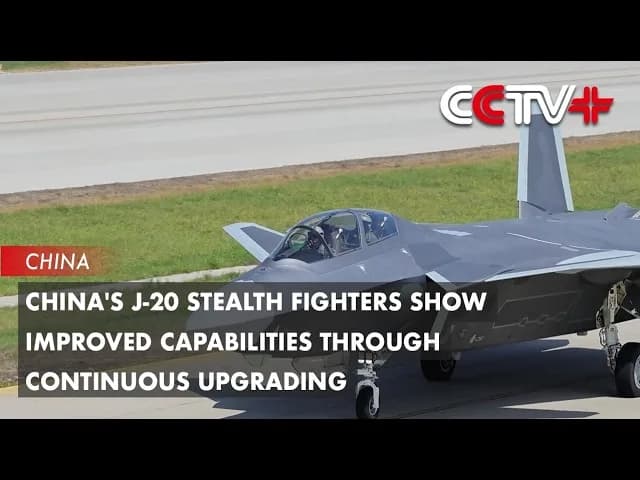
China has revealed new details about the upgraded J-20A stealth fighter and the development of the two-seat J-20S variant.
The latest disclosures highlight advances in engine technology, aerodynamic design, and sensor systems as China continues to expand the capabilities of its fifth-generation fighter family.
The domestically powered J-20 made its public debut at the 2021 Airshow China in Zhuhai, marking a major milestone in the aircraft’s development.
Its indigenous engines reportedly provide greater thrust, enabling higher speeds, sustained supersonic cruise, and high-overload maneuvers.
China refines stealth
China has revealed further details about technological upgrades to its J-20 stealth fighter family, highlighting improvements to engine performance, aerodynamics, and onboard sensors.
The upgraded J-20A features changes intended to improve flight performance and detection capabilities, while the two-seat J-20S is designed to support coordination with unmanned aircraft. Together, the developments point to a broader role for the aircraft beyond conventional air-superiority missions, reflecting China’s efforts to integrate stealth fighters into increasingly networked combat operations, reports the Global Times.
One of the most significant developments in the J-20’s evolution has been its transition to domestically developed engines. The domestically powered version made its public debut at the 2021 Airshow China in Zhuhai, marking an important step toward reducing reliance on foreign propulsion technology.
The indigenous engines reportedly deliver greater thrust, allowing the aircraft to achieve higher speeds, sustain supersonic cruise, and perform high-overload maneuvers. Domestic engine development also gives China greater control over the fighter’s propulsion system and provides a foundation for future aircraft programs.
The upgraded single-seat J-20A incorporates further changes to its aerodynamic design. One visible modification is the raised section behind the cockpit, where the transition between the cockpit and main fuselage has become smoother and more gradual than on the earlier version. This revised profile is believed to improve aerodynamic performance and support higher-speed flight. Although detailed performance figures have not been disclosed, the changes suggest continued efforts to refine the aircraft’s flight characteristics.
J-20 coordinates drones
Another noticeable modification is a protruding component beneath the aircraft’s nose, associated with its electro-optical detection system. The earlier configuration reportedly featured six optical lenses, while the upgraded version has eight.
The additional optical elements indicate improvements to the aircraft’s detection and tracking capabilities. The upgraded sensor arrangement could strengthen its ability to detect and track stealth aircraft while supporting networked operations involving multiple platforms.
The two-seat J-20S represents another approach to expanding fifth-generation fighter capabilities. Unlike the single-seat J-20 and J-20A, it introduces a second crew member who can handle mission-related tasks while the pilot concentrates on flying and air combat. The rear-seat operator is expected to manage unmanned aircraft formations, coordinate battlefield information, support intelligent collaboration, and plan missions against targets on land and at sea.
This division of responsibilities could become increasingly important as air combat incorporates more unmanned systems, advanced sensors, and interconnected platforms. Managing multiple aircraft and processing information from different sources can place considerable demands on a single pilot.
The additional crew member could help the J-20S function as an airborne coordination platform. The operator can assist with processing information, assigning targets and coordinating operations between aircraft and other combat assets. Such capabilities would support manned-unmanned teaming, in which crewed fighters work alongside unmanned aircraft to expand surveillance, targeting and operational reach.
The J-20 family is also being integrated into a broader network of Chinese military aircraft, including KJ-series airborne early warning aircraft, YY-20 aerial refueling tankers, J-16 multirole fighters and J-10C fighters.
According to experts, the integration allows the stealth fighter to operate as part of a wider combat network rather than relying solely on its individual sensors and weapons. Its reported routine missions across the East China Sea, South China Sea and Taiwan Strait also reflect its expanding operational role.
Get the latest news delivered to your inbox.
Related articles