
‘Enormous population crash’: World’s largest penguin colony shrinks by two-thirds
The world’s largest penguin colony has shrunk by two-thirds since 2011, with climate change the...
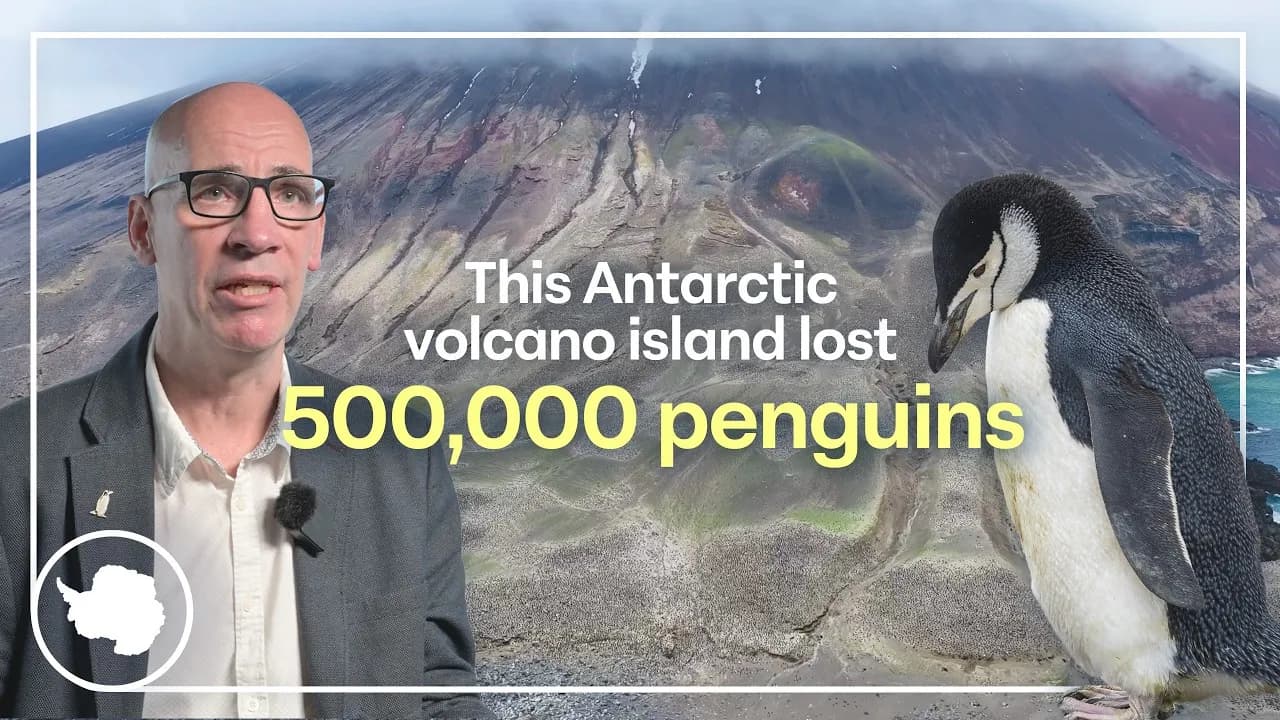
The world’s largest penguin colony has shrunk by two-thirds since 2011, with climate change the most likely cause, according to a new study.
Scientists said the rapid decline of chinstrap penguins on Zavodovski, the northernmost of the South Sandwich Islands in Antarctica, raises the risk of a wider ecosystem collapse.
“It is an enormous population crash, equivalent to half a million breeding individuals being lost from that island,” said Norman Ratcliffe, a penguin ecologist at the British Antarctic Survey who led the research.
The study suggests the collapse may be accelerating so quickly that the chinstrap penguin, named for the black line running below its beak from cheek to cheek, may need to be classified as endangered.
A title likely lost
When the population was measured in 2011, Zavodovski had by far the world’s biggest penguin colony, with about 600,000 chinstraps and 90,000 macaroni penguins. Given the decline between then and 2025, the island has likely lost that title to Cape Adare in the Ross Sea.
Chinstraps were already under pressure elsewhere. A 2020 Guardian report found chinstrap populations decreasing in the South Shetland Islands, prompting concerns among scientists that “something is broken” in the world’s wildest ecosystem.
Warming waters, shifting krill
Scientists believe the most likely cause is climate disruption. Human-driven heating has pushed winter temperatures on and around the Antarctic peninsula to 9 degrees Fahrenheit (5 degrees Celsius) above preindustrial levels, one of the fastest rises in the world.
On June 6, Argentina’s Esperanza base on the Trinity peninsula registered a record winter high of 59.7 degrees Fahrenheit (15.4 degrees Celsius), about 36 degrees Fahrenheit (20 degrees Celsius) above normal for the time of year. Scientists described the margin as “absolutely crazy.”
Chinstraps are struggling to adapt because they have special diets and specific ocean temperature preferences. Tracking data shows they prefer to forage in cooler waters northwest of the island, where they would expect to find Antarctic krill, the bulk of their diet. As the waters warm, the krill have moved south into the Weddell Sea.
Macaroni penguins, which are less fussy eaters, increased 30%, though not nearly enough to offset the chinstrap losses. Ratcliffe said that offered only small comfort because all penguins would run out of space if current trends continued.
Other causes ruled out
The scientists ruled out several other possible causes. There was no sign the two species were competing for food, and the nearest humans live thousands of miles away. Together, the findings point toward climate disruption rather than competition or human activity.
The island is volcanic and had a major eruption in 2016, prompting a “Penguin Pompeii hypothesis” of a sudden population fall. The data did not support it, however, showing a steady linear decline. Observations also showed chinstraps avoided the main “asphyxia plain” area where ash and lava were deposited.
Ratcliffe said the loss of chinstraps would have wider repercussions for food webs.
“Each ecosystem could be regarded as like a giant Jenga set, and every component that you remove increases the risk of ecosystems collapsing completely,” he said.
The study was first published in Current Biology.
Related articles
China beats world’s first nuclear clock with 6x stability edge in early tests
China’s experimental nuclear clock has emerged as the more stable of the world’s first two...
Scientists crack hidden solar cell leak that could boost efficiency to near 43%
Solar cells could potentially generate more electricity by controlling not only how they absorb sunlight,...

Nobel Prize in Chemistry awarded to two scientists for providing solution to a century-old mystery
The Nobel Prize in Chemistry 2026 awarded to two scientists for providing a solution to...
Smart US tool could cut quantum device tuning time in hunt for elusive dark matter
Scientists in the US have been developing a smart agent that could automatically tune sensitive...
‘Camera’ captures atomic shockwaves before quantum bit forms inside a crystal
Scientists have recorded what happens inside a crystal in the split second before a quantum...
Microscopic nuclear fuel particles from Chernobyl still intact after 40 years
Forty years after explosions scattered radioactive debris from Chernobyl’s reactor across the surrounding landscape, some...