
Laser-marking tech helps track nuclear fuel pebbles, can unlock scalable advanced reactors
Kairos Power has commissioned an automated inspection and laser-marking system for its nuclear fuel pebbles,...
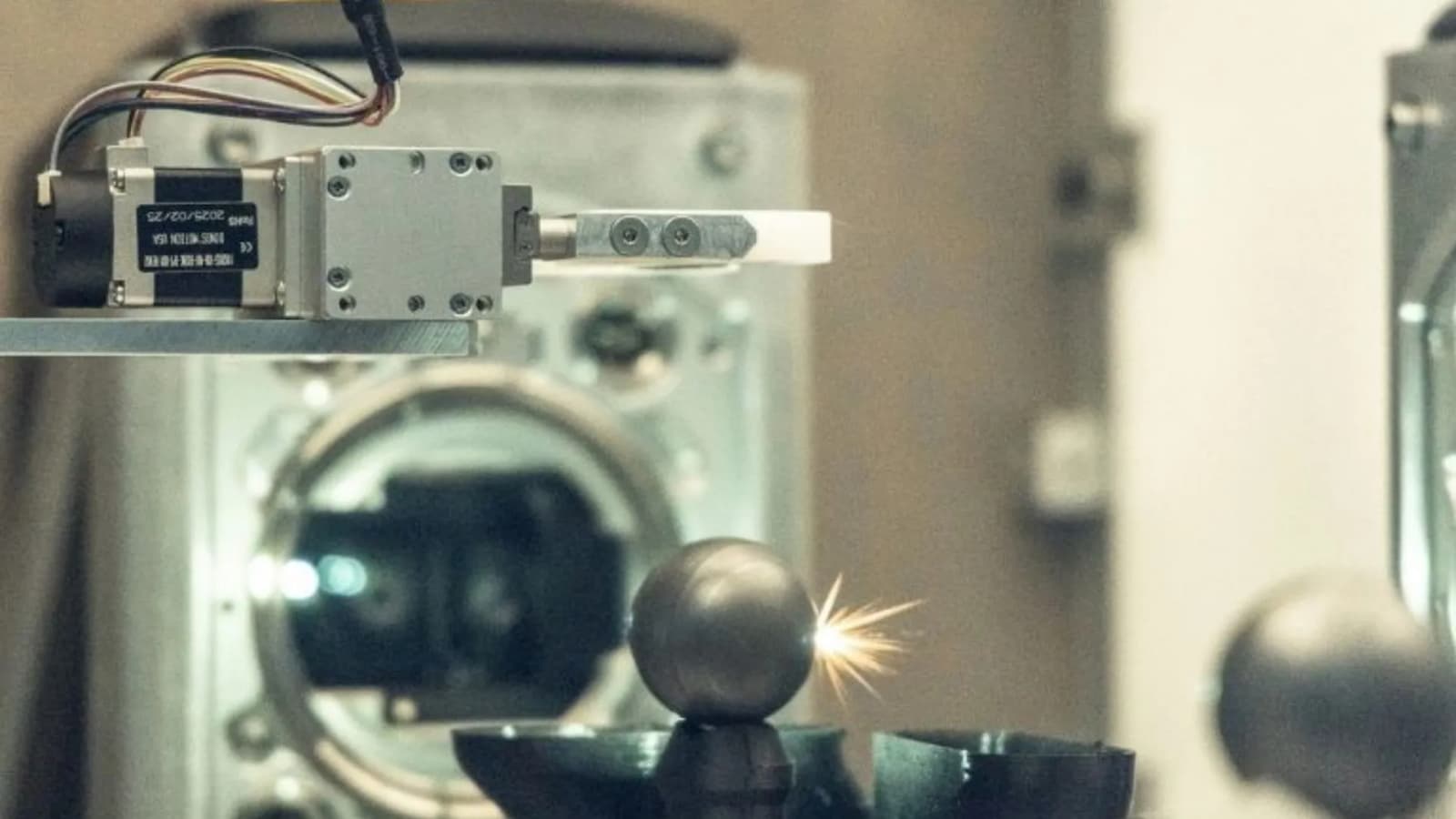
Kairos Power has commissioned an automated inspection and laser-marking system for its nuclear fuel pebbles, adding a new quality-control capability as the company prepares for upcoming reactor hardware tests and the future deployment of its Hermes 2 demonstration plant.
The custom-built system is operating at the company’s Manufacturing Development Campus in Albuquerque, New Mexico. It measures individual fuel pebbles against manufacturing specifications, records their characteristics, and engraves each one with a unique tracking code.
Kairos Power is targeting 70,000 inspected pebbles for upcoming testing platforms, including its second Engineering Test Unit (ETU). The company says the same inspection and tracking capability will support the future Hermes 2 plant in Oak Ridge, Tennessee.
The milestone addresses a practical challenge in developing pebble-based nuclear reactors: maintaining consistent manufacturing quality while tracking individual fuel elements throughout testing and operation.
Automated inspection checks each fuel pebble
Kairos Power is developing fluoride salt-cooled, high-temperature reactor technology that uses spherical fuel elements, commonly called pebbles. Before the pebbles enter testing platforms or are prepared for transport, the new automated line subjects them to a series of quality checks.
The system measures each pebble’s diameter, geometry, and density in real time to confirm it meets manufacturing specifications. High-precision lasers then scan the exterior surface at the micron level to assess its structural integrity.
Automating these checks allows the company to process pebbles while collecting standardized measurements for individual records. The resulting data can help engineers identify manufacturing variations and improve subsequent production campaigns.
Rather than relying solely on batch-level records, the system links inspection results to each pebble, providing more detailed information about the fuel elements entering tests.
Laser codes create individual fuel records
After inspection, each pebble moves to an infrared laser engraving station. The system etches three redundant data matrix codes, similar to QR codes, into the graphite surface, with markings approximately half a millimeter deep, according to the company.
Each code links the pebble to an individual record containing its dimensions, density measurements, production batch, and inspection status. Additional markings around the codes let optical systems identify different pebble types if a data matrix is damaged.
That traceability could become increasingly important as Kairos Power expands its fuel development and testing activities. By linking physical fuel elements to manufacturing and inspection data, engineers can track individual pebbles through downstream handling and testing.
The company also expects the markings to help distinguish different pebble types, improve fuel-consumption measurements, and strengthen material accountability during reactor operations.
“By automating our quality control and laser-engraving processes in-house, we are building the foundational capabilities and traceability required to support our iterative approach to fuel development,” said Kirby Boone, a senior engineer on Kairos Power’s fuel team.
Boone added that the system will generate data to inform future manufacturing and handling systems, from Hermes 2 to the company’s planned commercial fleet.
Supporting Hermes 2 and future fuel production
The automated line is currently processing pebbles for upcoming hardware demonstrations, with a near-term target of 70,000 inspected fuel elements for testing platforms that include the second ETU.
The system is also intended to support Hermes 2, the company’s planned demonstration plant in Oak Ridge. Kairos Power is developing the inspection infrastructure in-house so it can use lessons from each production campaign to refine manufacturing processes and prepare for larger-scale fuel production.
Related articles

Sony’s WH-1000XM6 headphones are $130 off today only
If you missed out on Prime Day’s headphones deals, you’re in luck. Sony’s latest flagship headphones are selling for even less than they did during Amazon’s big fall sale.

Google is making inline links more prominent in AI responses
Google is updating its AI search results to make inline links appear "higher up in responses more frequently," according to a blog post.

Alienware’s latest 34-inch QD-OLED gaming monitor is $50 off
The Alienware AW3426DW is discounted to $742.22 at Amazon, just over $50 off its usual price of $799.99.

Sony made a $5,900 gold-plated Walkman MP3 player
Sony has announced a trio of new Walkman portable media players that start at an already absurd $1,899.99 for the NW-ZX900 and climb all the way up to $5,899 for the gold-plated NW-WM1ZM3.

World’s most advanced fighter jet makes arrested landing aboard 100,000-ton aircraft carrier
The world’s most advanced stealth fighter jet recently made its first arrested landing aboard a...

NVIDIA’s latest 120-billion-parameter model completes agent tasks 5x faster than rivals
NVIDIA has unveiled three open AI models designed to bring autonomous agents to more computing...