Light-powered catalyst delivers 200% more hydrogen peroxide with an atomic twist
A new light-powered catalyst developed by German scientists increases hydrogen peroxide production by 200 percent...
A new light-powered catalyst developed by German scientists increases hydrogen peroxide production by 200 percent through a clever tweak involving lithium and potassium atoms.
Known as CALiK, the photocatalyst is based on carbon nitride. Its unique structure enables it to utilize light more efficiently to produce hydrogen peroxide. Lab tests showed that it can produce three times as much hydrogen peroxide as a standard material.
This represents a 200 percent increase in output. The catalyst also outperformed the best tested lithium-only catalyst by roughly 40 percent. Anna Lo Presti, a PhD student at the Max Planck Institute and lead author of the study, pointed out the catalyst’s improved performance comes from the way the lithium and potassium atoms are arranged.
She emphasized that the spatial position of the ions makes a big difference. “We were able to demonstrate for the first time that it is not only the type or quantity of ions that matters, but also their position in the lattice,” Presti added.
Clever atomic switch
Hydrogen peroxide is a colorless, odorless, and slightly viscous liquid that is used as a disinfectant, bleaching agent, and industrial chemical. It is made through the anthraquinone process (also called the Riedl-Pfleiderer process), which uses a lot of energy and involves several chemical processing steps.
By contrast, photocatalysis harnesses light in order to trigger chemical reactions that produce hydrogen peroxide. Carbon nitride has become a promising option for this process, because it can absorb light and use its energy to drive chemical reactions.
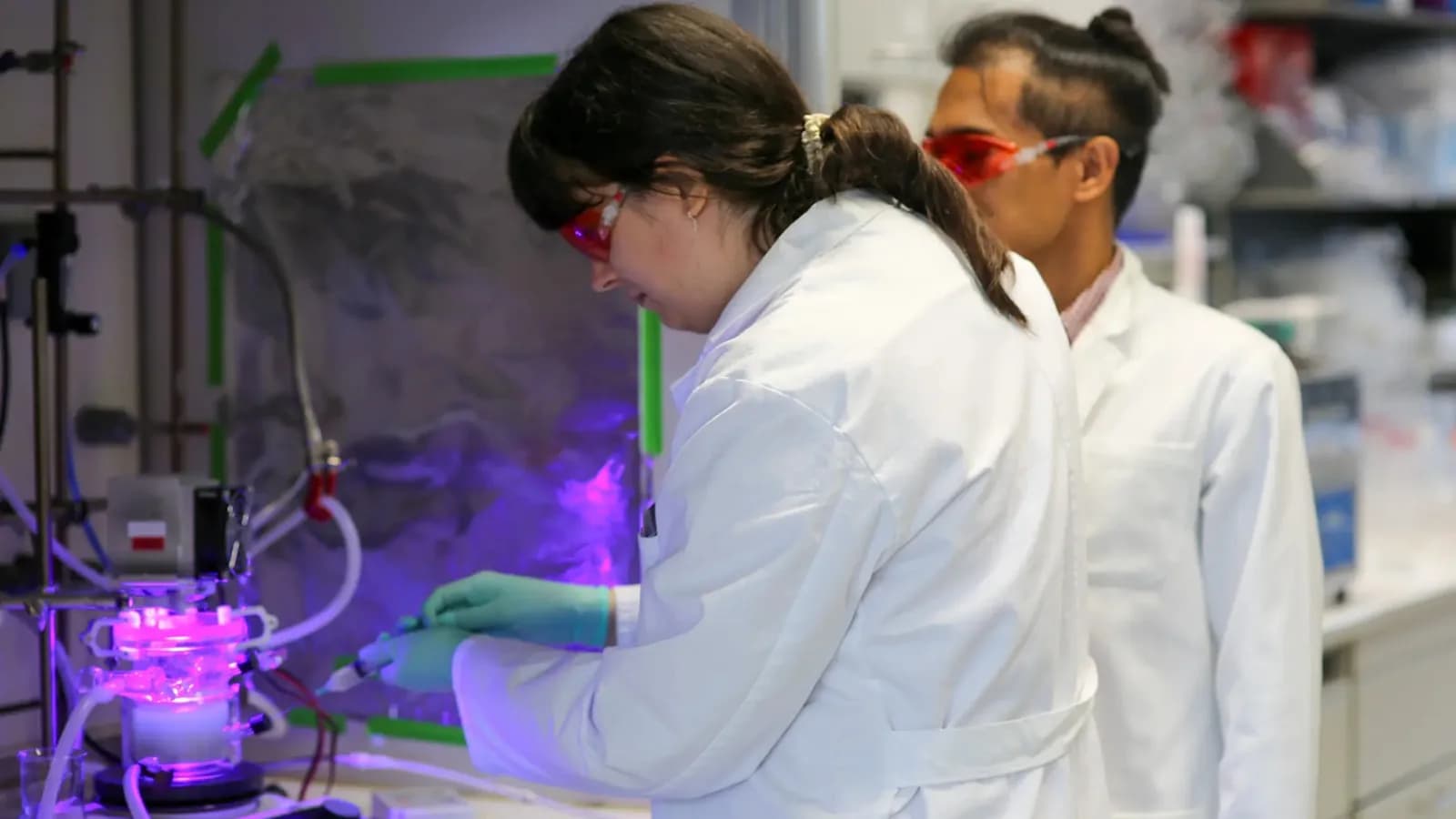
Anna Lo Presti and Christian Mark Pelicano investigating the photocatalyst CALiK. Credit: MPIKG / Neubauer
However, it often becomes less effective as the electrical charges created when it absorbs light quickly recombine. To tackle this problem, the scientists introduced lithium and potassium into the carbon nitride structure and controlled where the atoms were positioned.
They then created a specific atomic arrangement that improved the separation of light-generated electrical charges. “Instead of changing the chemical composition of a photocatalyst to make it more efficient, we tried to change how the building blocks are arranged,” Christian M. Pelicano, PhD, a researcher at the Max Planck Institute, and the corresponding author of the study, said.
Threefold rise in output
For the catalyst, the team started with special crystals made from a carbon- and nitrogen-containing compound and lithium chloride. These crystals already had their components arranged in a regular three-dimensional structure. They then heated the crystals with potassium chloride to create CALiK.
Pelicano highlighted that the crystals were not new, but their use in producing carbon nitrides was. “What caught our interest was that they contain the same chemical components as the precursors we normally use,” he added.
The team then compared CALiK with conventionally prepared carbon nitride and a lithium-only version known as CALi. They were surprised to find that it produced three times as much hydrogen peroxide as the conventional catalyst.
It moreover delivered 40 percent more hydrogen peroxide than the best lithium-only catalyst. The findings suggest that the precise placement of atoms can be just as important as the chemical composition of a catalyst.
“The key difference is that the ions are already arranged in a specific way, and we wondered whether this arrangement could be transferred to the carbon nitride material,” Pelicano concluded in a press release.
The study has been published in the journal Advanced Materials.
Get the latest news delivered to your inbox.
Related articles