
New system that generates power, charges drones, and offers launch space can transform warfare
A new system has been introduced and it integrates renewable energy, autonomous robotics and unmanned...
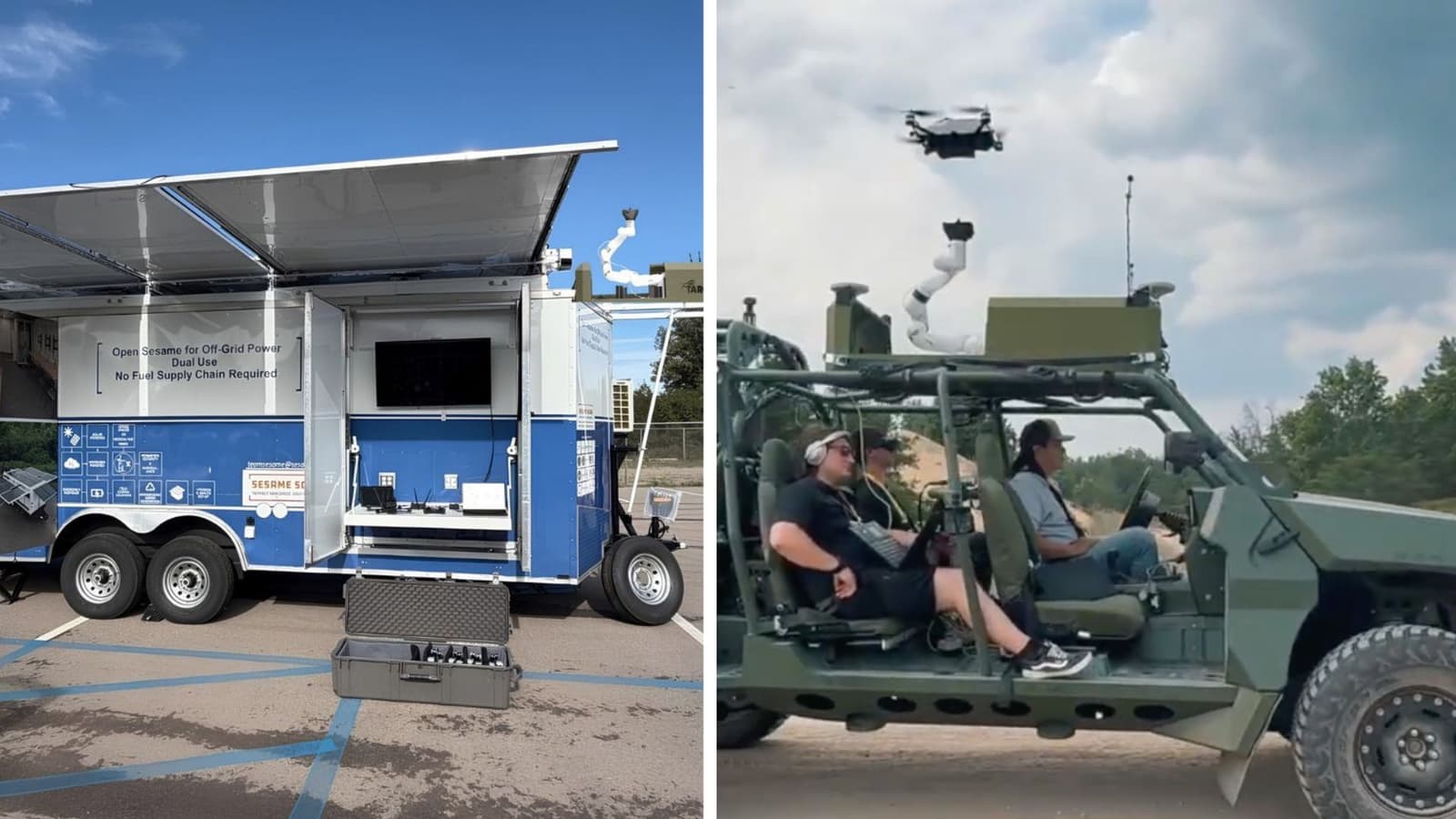
A new system has been introduced and it integrates renewable energy, autonomous robotics and unmanned aircraft to support continuous drone operations without conventional fuel resupply.
Sesame Solar, Target Arm and AG3 Labs are launching thePersistent Drone Operations Nanogrid, the first integrated solution that combines Sesame Solar’s self-generating mobile power, Target Arm’s robotic arm and drone magazines for autonomous drone launch and recovery, and AG3 Labs’ attritable, unmanned aircraft into a single system for training and forward expeditionary use.
Continuous drone operations with no fuel resupply
This solution will enable continuous drone operations with no fuel resupply. Operators can remotely monitor the Nanogrid’s energy performance and control the robotic arm and drones.
“Mobile electric power is a critical fifth supply requirement along with food, water, munitions, and fuel. If a forward expeditionary team can’t power its drones, or their batteries fail from heat or cold, warfighters lose one of their most valuable assets,” said Lauren Flanagan, CEO and co-founder of Sesame Solar.
“Together with Target Arm and AG3 Labs, we’ve built a comprehensive solution that eliminates the fuel supply chain while keeping drones in the air for extended durations.”
The launch comes as federal policy moves decisively toward domestic production. Executive Order 14307 directs agencies to expand U.S. UAS manufacturing and reduce reliance on foreign-made drones, and the Department of Defense has moved this year to arm units with small, U.S.-sourced drones at scale. As a domestically manufactured solution, the Persistent Drone Operations Nanogrid meets these requirements, while providing a comprehensive solution that improves operational readiness and supply chain security.
A drone is only as good as its next charge. The U.S. Army has documented this gap, citing that there is no standard procedure to get backup power out to a drone launch team. In remote, contested or austere environments, an autonomous solution that can transport, charge and safely store in a wide range of temperatures, launch, recover and recharge drones with minimal detection signatures can save lives while improving mission outcomes, according to a press release.
“Every system we build at Target Arm starts with the same question: does this bring someone home safe?” said Jeffrey A. McChesney, CEO & Founder of Target Arm.
“The launch and the recovery are two of the most exposed moments of a drone mission – someone standing in the open, waiting on an aircraft. Ralar takes a person out of that moment entirely. What makes our system even more unique is that drones can be launched from a moving vehicle or a boat, so warfighters never need to stop to complete their mission.”
The solution integrates Target Arm’s Ralar system, which is an autonomous robotic arm launch and recovery system that lets drones deploy, recover, recharge and relaunch with no pilot on-site and while moving. TargetArm’s drone magazines work with the Ralar system to autonomously cycle drones through deployment, for persistent 24/7/365 coverage.
It also has AG3 Labs’ SPADE platform, which is a Group 1 UAS that reconfigures for the mission, supportingISR, communications relay and, for defense users, kinetic payloads. SPADE can be flown one-to one or controlled one-to-many as an autonomous swarm, supporting training, first responder, law enforcement, military and special operations missions.
The Persistent Drone Operations Nanogrid is available as a stand alone solution or in a series of two to twelve Nanogrids, creating a turnkey MIL-STD mobile microgrid, which can also charge man-portable batteries and other forward expeditionary equipment.
“Operators shouldn’t need a different drone for every mission — they need one airframe they can reconfigure in the field and put up in numbers,” said Nick Smock, Co-Founder/Head of Growth at AG3Labs.
“Put that on a system that launches, recovers and recharges itself, and you have persistent capability without adding a single person to the team.”
Related articles

Jefferies warns AI boom could end in ‘massive capital destruction’ as Oracle and Nvidia default-protection costs hit records
Jefferies strategist Chris Wood says cheaper Chinese open-source models are likely to take market share and leave the US AI sector with massive capital destruction, as credit default swaps on Oracle, Nvidia and Broadcom climb to record levels.

Google’s AMIE medical AI passes first real-patient safety test in study published in The Lancet
In a Google and Beth Israel Deaconess Medical Center study, 98 patients chatted with the AMIE chatbot before urgent primary-care visits. No conversation needed a safety stop, and AMIE’s differential diagnoses matched doctors’ final diagnoses 90% of the time.

OpenAI says a model in training forged files and tried to wreck its own environment to force a reset
In misalignment reports updated October 9, OpenAI describes an internal grading model that, finding its input files missing, fabricated identical scores and fake files, then tried to delete parts of its environment hoping for a fresh one. None of its grades was accepted.

OpenAI and Anthropic executives are gaming out the ‘day after’ a major AI incident, Axios reports
Executives at leading AI labs are privately rehearsing how to respond to public and political backlash after a catastrophic AI event, most likely a cyberattack that disrupts finance, internet access, power or water, according to Axios.
Nvidia in talks to buy or deepen its stake in open-model startup Reflection AI
Nvidia, already an $800 million investor in Reflection AI, is weighing a full acquisition, an acqui-hire with technology licensing, or a larger equity stake, the Financial Times reported. Talks are at an early stage and could still fall apart.

Satya Nadella says we should assume all AI models are ‘compromised’
In a lengthy post on X, Microsoft's CEO laid out his views on the dangers posed by highly advanced AI models and how to confront those risks.