
Ranked: The World’s Heaviest Animals on Land and Sea
How much bigger are ocean giants than land animals? Compare the heaviest creatures living on Earth.
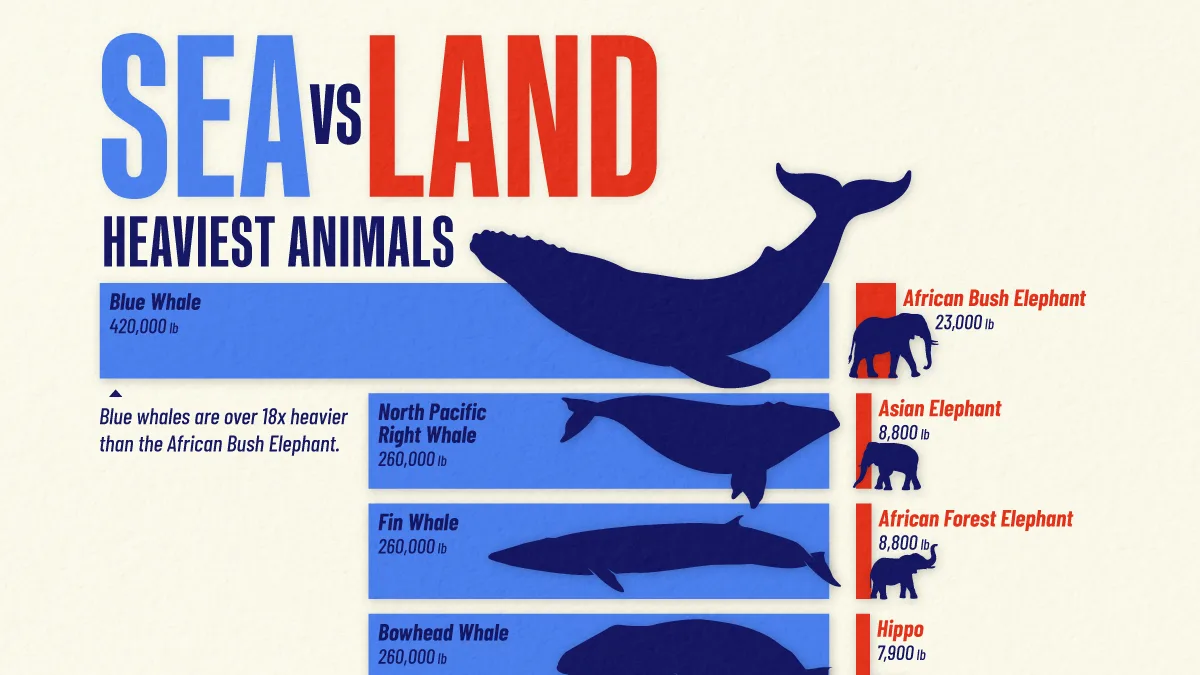
How Do the World’s Heaviest Land and Sea Animals Compare?
Key Takeaways
At 420,000 pounds, the maximum reported weight of a blue whale is more than 18 times that of an African bush elephant.
All 10 sea creatures in this ranking are whales, while elephants and rhinoceroses dominate the land list.
Even the lightest whales in the marine ranking outweigh the heaviest land animal by more than four times.
From African elephants to blue whales, the world’s heaviest animals reach extraordinary sizes. But how do the largest animals on land compare with those living in the ocean?
This visualization compares maximum reported weights from Fact Animal and World Atlas.
These figures represent approximate maximum reported weights rather than typical adult weights. Marine-animal weights were converted from metric tonnes to pounds and rounded to the nearest 10,000 pounds.
The Heaviest Animals on Land
Here are the 10 heaviest land animals, based on figures reported by Fact Animal.
RankAnimalMax Weight (lb)Max Weight (kg)
1African Bush Elephant23,00010,400
2Asian Elephant8,8004,000
3African Forest Elephant8,8004,000
4Hippo7,9003,600
5White Rhinoceros5,3002,400
6Indian Rhinoceros5,0702,300
7Black Rhinoceros2,8661,300
8Rothschild Giraffe2,8661,300
9Javan Rhinoceros2,6451,200
10Bison1,984900
The African bush elephant tops the ranking at 23,000 pounds (10,400 kg), more than twice the weight of the Asian and African forest elephants, both at 8,800 pounds. Rhinoceroses occupy four of the top 10 positions, while the bison rounds out the list at 1,984 pounds.
Despite their enormous mass, land animals must support their full weight against gravity. Their size also influences how they move across landscapes, including the remarkable distances covered by some of the world’s longest-migrating land animals.
The Heaviest Animals in the Sea
Here are the 10 heaviest marine animals, using maximum reported weights from World Atlas, rounded to the nearest 10,000 pounds.
RankSea CreatureMax Weight
(lb)Max weight
(tonnes)
1Blue Whale420,000190
2North Pacific Right Whale260,000120
3Fin Whale260,000120
4Bowhead Whale260,000120
5Southern Right Whale240,000110
6North Atlantic Right Whale240,000110
7Sperm Whale130,00057
8Humpback Whale110,00048
9Sei Whale100,00045
10Gray Whale100,00045
The blue whale tops the ranking at 420,000 pounds (190 tonnes), followed by the North Pacific right whale, fin whale, and bowhead whale, each listed at 260,000 pounds.
Why can whales grow so much heavier than land animals? Much of the answer comes down to buoyancy. Water supports a substantial portion of an animal’s weight, allowing marine giants to reach sizes that would be difficult to sustain on land.
Larger bodies also retain heat more effectively in water. However, Stanford research suggests that the energy required to sustain enormous bodies helps limit how large aquatic mammals can become.
These maximum weights should also be treated as estimates. Weighing a massive whale is far more challenging than weighing a land animal, and some figures rely on exceptional specimens or indirect measurements.
How Did Whales Become So Enormous?
Despite spending their lives in the ocean, whales descended from mammals that once walked on land. Over millions of years, their ancestors adapted to aquatic life, developing streamlined bodies, powerful tails, and other traits suited to the marine environment.
That evolutionary transition eventually produced the blue whale, the heaviest animal known to have ever lived.
The contrast with modern land mammals is striking. While elephants remain the heavyweight champions on land, the ocean provides the physical conditions that allow whales to reach an entirely different scale.
Learn More on the Voronoi App
To explore another comparison from the animal kingdom, see Humans are the Second-Deadliest Animals…for Humans on the Voronoi app.
Related articles
Scientists achieve 13-qubit genuine entanglement without destroying their photons
Quantum computers may one day tackle problems that overwhelm conventional machines, but getting enough quantum...
Why 2027 total solar eclipse is ‘eclipse of the century’ even though 2009’s lasted longer
The Aug. 2, 2027 total solar eclipse is being hailed as the “eclipse of the...
Giant tortoise count hits 183,000 on Seychelles island, study shows
As many as 183,000 giant tortoises thrive in the Seychelles, a new survey has found. ...
NASA tests 12 next-gen heat shields aboard trash-filled spacecraft for Mars missions
NASA is preparing to test 12 experimental heat shield capsules during the fiery destruction of...
Light-driven method uses hydrogen atoms to transform chemicals without metals
Researchers have developed a light-driven method to generate highly reactive hydrogen atoms for chemical synthesis....
Astronaut Pikachu logs 1,040 orbits in 67 days aboard the ISS, ESA reveals
A stuffed Pikachu in a custom white space suit spent 67 days aboard the International...