
Scientists catch a type-I superconductor breaking time-reversal symmetry
The creation of a superconducting material is one of the most sought-after and complicated processes....

The creation of a superconducting material is one of the most sought-after and complicated processes. These materials have to be cooled to extremely low temperatures before its electrical resistance vanishes and they begin expelling magnetic fields.
However, one such material has now revealed an even stranger trick. YbSb₂ is the first known type-I superconductor to spontaneously break time-reversal symmetry, creating a tiny magnetic field inside itself as it enters the superconducting state.
Time-reversal symmetry means that a physical system should behave the same way whether time runs forward or backward. Rare superconductors can break this symmetry, but until now, every known example belonged to the type-II family.
For the first time, “we report evidence of time-reversal symmetry breaking in the type-I superconductor YbSb2,” the researchers note. This finding could open a new route for exploring exotic superconducting states.
A tiny magnetic field revealed the hidden change
The researchers from the Indian Institute of Science Education and Research Bhopal grew single crystals of YbSb₂ and tested how they behaved as they were cooled. The material became superconducting at about 0.95 kelvin, just above absolute zero.
They also needed to determine what kind of superconductor it was. Below their critical magnetic field, type-I superconductors expel magnetic fields from their interiors, while type-II superconductors can allow magnetic flux to enter in organized regions.
YbSb₂ behaved like a type-I superconductor. At 20 gauss, it remained in the Meissner state, where the applied magnetic field is expelled from the superconducting bulk.
At 40 gauss, it entered an intermediate state in which superconducting and normal regions coexisted. The researchers measured a critical field of about 51 gauss at 0.1 kelvin, supporting its classification as type I.
Heat-capacity measurements also showed a fully opened superconducting gap, meaning the superconducting state has a finite energy barrier before its paired electrons can be excited.
Then came the surprising part
The team used muon spin relaxation to look for extremely weak magnetic fields inside the material. Muons are tiny subatomic particles whose spins act like sensitive magnetic-field detectors.
The researchers placed them inside YbSb₂ and watched how their spins changed as the material crossed into its superconducting state.
A new magnetic signal appeared below the superconducting transition. The researchers estimated that the material was producing an internal field of about 0.44(3) gauss. “Zero-field μSR measurements reveal spontaneous internal magnetic fields emerging just below the superconducting transition,” the study authors added.
A small external field of about 10 millitesla could also suppress the muon relaxation, supporting the conclusion that the newly detected field was static or slowly changing.
The signal appeared as the material became superconducting, providing evidence that YbSb₂ was breaking time-reversal symmetry rather than simply responding to an outside magnetic field.
A possible path to exotic quantum states
The researchers think the material’s unusual behavior may come from an unconventional form of superconductivity called an internally antisymmetric nonunitary triplet state.
YbSb₂ is a “unique material platform where type-I superconductivity coexists with triplet-pairing and nontrivial topology,” the researchers said.
In simple terms, the electrons may be pairing in an unusual way that gives the superconducting state an internal magnetic character.
Their calculations also identify YbSb₂ as a Z₂ topological metal and suggest that its superconducting state could host Majorana surface modes — unusual quantum states that are of interest for future quantum technologies.
However, this remains a theoretical prediction; the researchers have not detected Majorana modes in YbSb₂.
They plan further μSR, angle-resolved photoemission spectroscopy, and scanning tunneling microscopy experiments, as well as studies of related RSb₂ materials, to determine what causes the symmetry breaking and whether the predicted surface states actually exist.
The study is published in the journal Physical Review Letters.
Related articles

3D light field lets scientists unlock electron states that were once impossible to reach
Some quantum states of electrons have remained out of reach not because they do not...
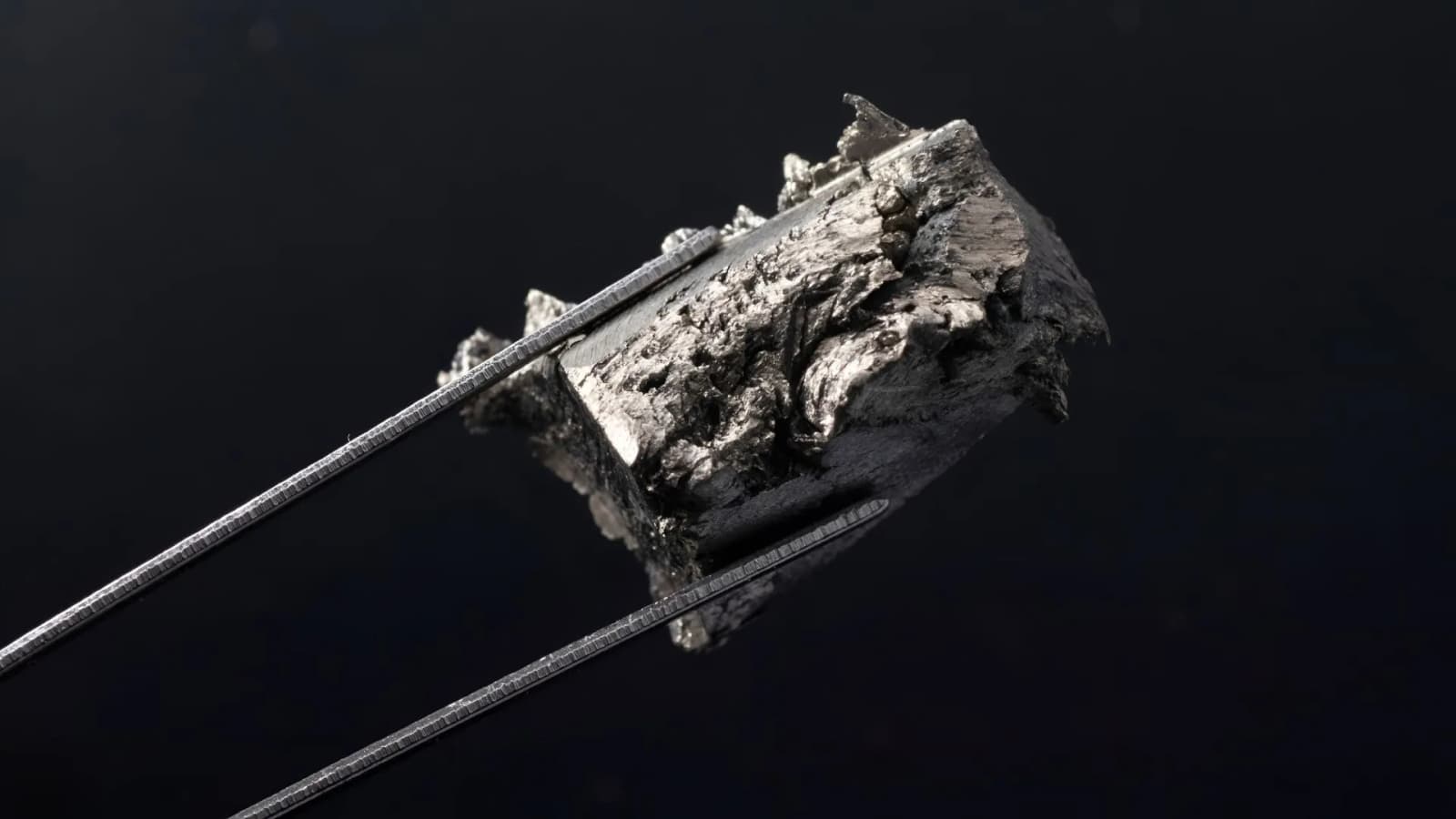
Scientists find rare-earth compound with liquid crystal-like magnetic state
A strange magnetic state inside a compound called YbMnBi₂ could help explain one of its...

Your brain has 86 billion neurons: Here are 10 facts worth knowing
Your brain makes it possible to recognize voices, recall holidays, or learn new skills. Yet...

Ultra-high-power lasers open new pathways for non-destructive material inspection
Superman’s X-ray vision isn’t actually that super. X-rays work well for seeing through thin objects...
CERN researchers report first observation of differences in nucleons within the atom
Researchers at the ATLAS Collaboration at the CERN have found the origins of an observation...

US scientists find 7-volt switch can strain sapphire thousands of times its depth
Researchers in the US have recently discovered that a 7-volt pulse applied to an ultra-thin...