US intel confirms China’s mysterious X-37B-like spaceplane, with a sharper image in orbit
China’s experimental reusable spaceplane, long glimpsed only in grainy pictures, now has a sharp orbital...
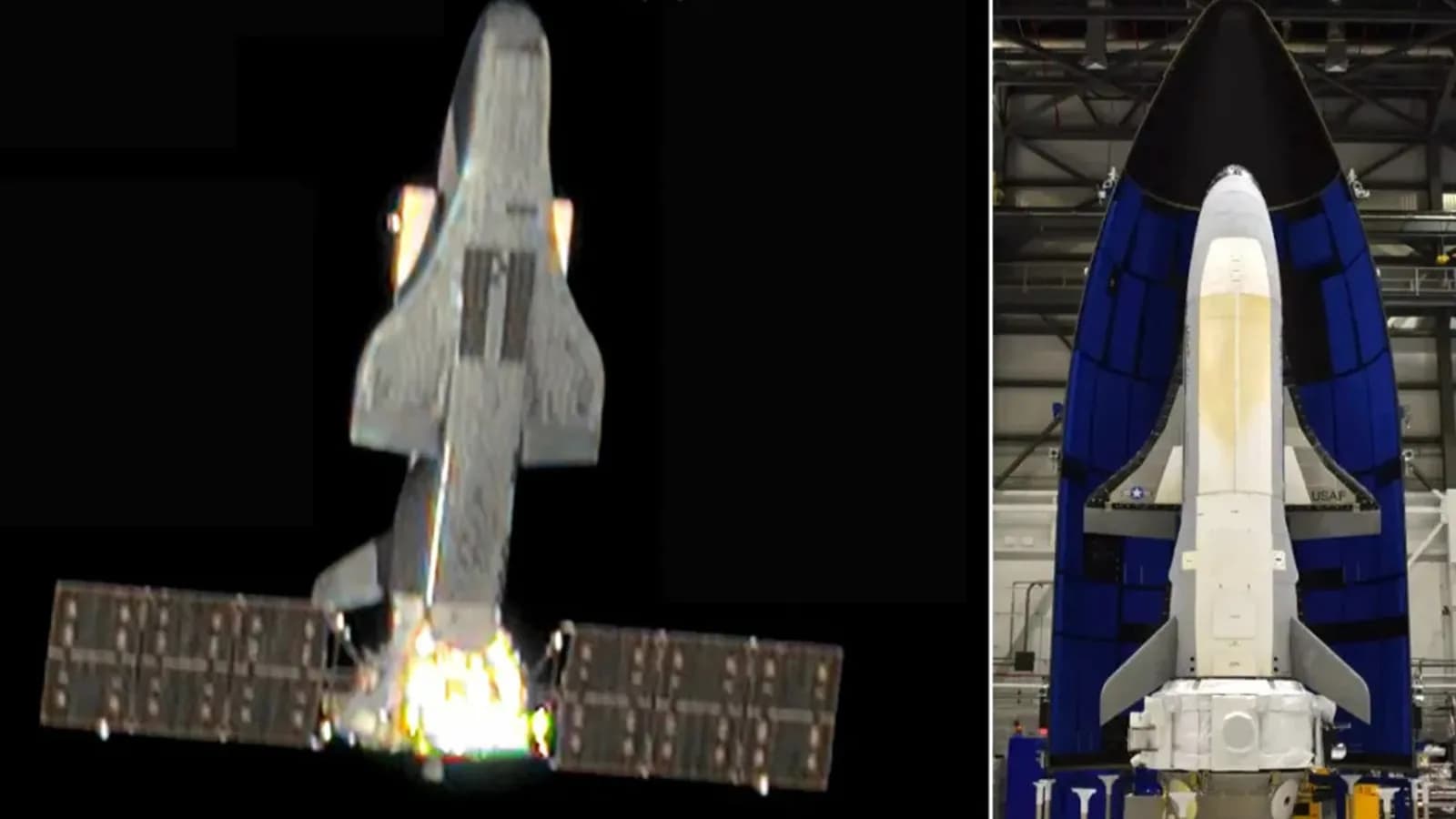
China’s experimental reusable spaceplane, long glimpsed only in grainy pictures, now has a sharp orbital image released by U.S. intelligence, and it looks remarkably like America’s own X-37B.
The Defense Intelligence Agency published the photo in Challenges to Security in Space, its latest unclassified report. A Maxar satellite, now operated by Vantor, took the picture, which carries a 2024 copyright date. DIA’s caption calls the craft a “PRC Spaceplane.”
A near twin of the X-37B
The resemblance is hard to miss. Both are miniature shuttles with small wings and twin vertical tails. Upward-opening doors sit above a central payload bay, and a tail extension carries solar panels deployed on each side. Two bays on the underside appear to hold the main landing gear in the same tricycle layout the X-37B uses. The clearest visual difference is the wings, which on the Chinese craft are noticeably wider from front to back.
DIA doesn’t say which of China’s two spaceplane designs is pictured. Its report names Shenlong and Tengyun as China’s primary models, and Shenlong is the name most often attached to the vehicle China has been flying.
A sharper look at a known craft
The image itself isn’t new. A far grainier version surfaced in 2024 in a presentation by then-U.S. Space Forces-Korea commander Col. John Patrick, when the Space Force and Maxar declined to say what it showed. DIA’s release removes the doubt and adds detail.
Four flights and a remote runway
China is believed to have flown the vehicle on four orbital missions since 2020. On the third, from Dec. 14, 2023, to Sept. 6, 2024, it was seen releasing several smaller objects, and their purpose is still unknown. The fourth launched Feb. 7, 2026, and there’s no public sign it has come home.
The Space Force, by comparison, flies two X-37Bs, which have logged eight missions since 2010, most recently OTV-8 in August 2025. Satellite imagery points to a remote airbase in northwest China, with a runway of about 16,400 feet (5,000 meters), as the Chinese craft’s landing site.
Why spaceplanes worry military planners
DIA’s report singles out spaceplanes because they are reusable and highly maneuverable, which suits missions ordinary satellites can’t do. Defense analysts have warned that those same traits make them handy for slipping close to other spacecraft, whether to inspect them, gather intelligence or, in the worst case, interfere with them.
Reuse also changes the economics. Recovering and refurbishing rocket stages, fairings and capsules could sharply cut the price of reaching orbit, and that cost advantage is a big part of why the technology matters.
One exhibit in a much bigger warning
The spaceplane is a single exhibit in a report with a far wider brief. The 2026 edition, the third in DIA’s series, lays out the space defense and military goals of China, Russia and the emerging space powers Iran and North Korea, including their strategies, plans and intentions.
It tracks the growing stockpiles of dual-use space systems that can serve both civilian and military purposes, and it points to deepening space cooperation among U.S. adversaries. It also examines the orbital environment itself, including hazards such as debris.
DIA says its goal is to give the public a clearer picture of who is operating in space, with what, and why.
Source: https://interestingengineering.com/military/dia-confirms-china-spaceplane-image-x-37b-comparison
Related articles