A black hole splitting in two sounds impossible but physics has a loophole
Black holes are famous for colliding and merging into larger ones. However, could a black...
This story was prepared automatically by software.
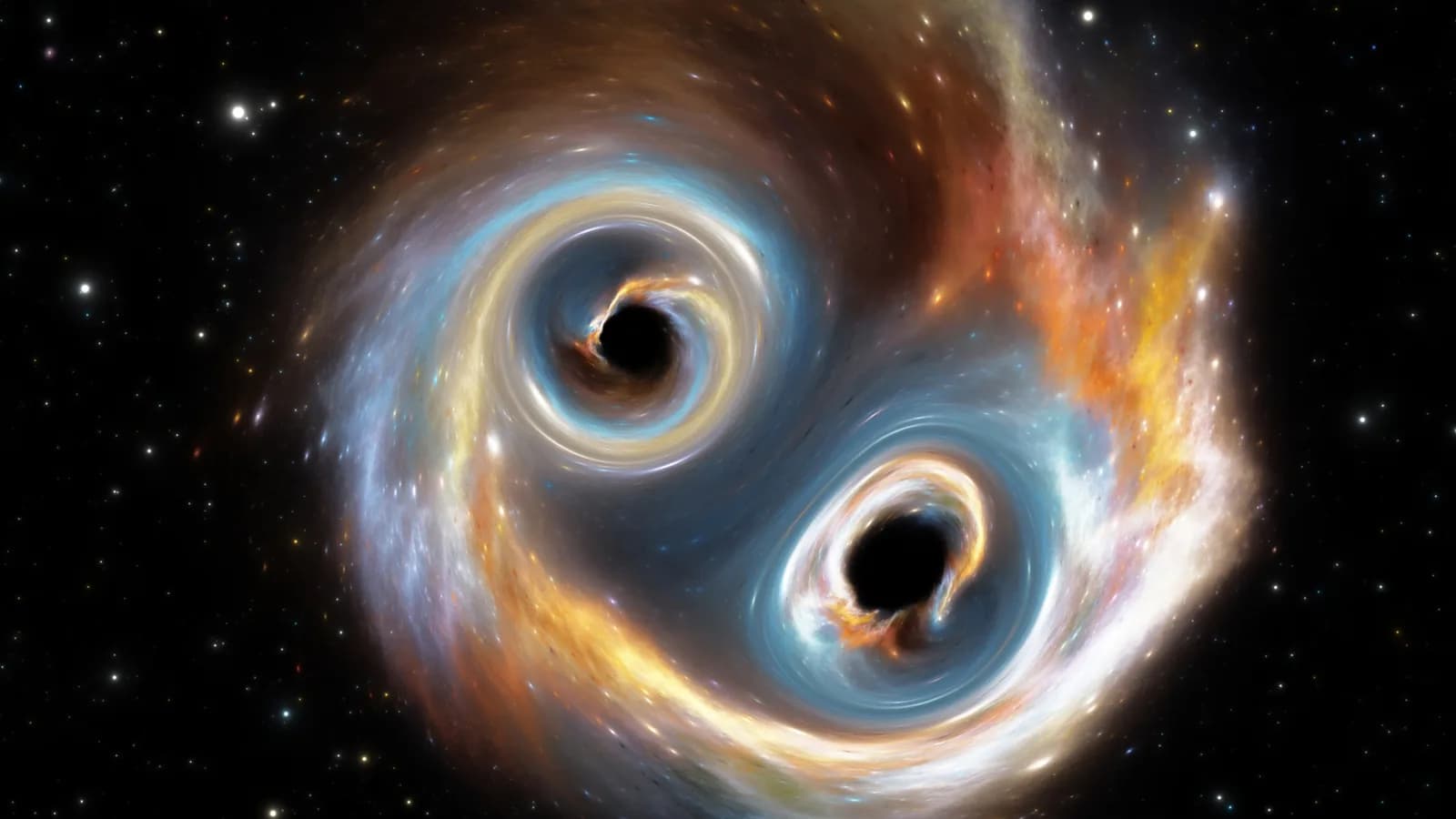
Black holes are famous for colliding and merging into larger ones. However, could a black hole tear itself apart and become two black holes?
A new theoretical study exploring the answer to this question suggests that a black hole spinning almost as fast as physics allows might be able to split, although the laws governing black holes make such a breakup extremely difficult.
The findings could help scientists understand the limits of Einstein’s theory of general relativity and investigate whether black holes can behave in ways that challenge our current understanding of the universe.
“Our analysis clarifies the theoretical landscape where black holes may fragment, which is particularly relevant for primordial black holes and catastrophic events such as black hole mergers,” the study authors note.
Why black holes resist splitting
One major obstacle is entropy, a measure of how many microscopic arrangements a system can have while appearing the same from the outside.
For a non-rotating black hole, entropy increases with the square of its mass. Splitting one black hole into two smaller ones with the same combined mass would therefore reduce their total entropy, making the process thermodynamically unfavorable.
The researchers investigated whether certain conditions could overcome this obstacle.
“In our study, we investigate which physical laws normally prevent a black hole from splitting into two. We also investigate if certain circumstances may allow a split to happen,” Francesco Sannino, study co-author and a professor of physics at the University of Naples Federico II, said.
Extreme rotation offers a narrow loophole
The researchers found that rapidly rotating black holes could provide a possible way around the entropy barrier.
Rotation changes the relationship between a black hole’s mass, angular momentum and entropy, potentially making fragmentation more favorable than it would be for a non-rotating black hole. Researchers can investigate this property through methods such as measuring black hole spin.
However, satisfying the entropy requirement is not enough. The two resulting black holes must also have enough energy and momentum to move apart instead of falling back together.
Once the researchers accounted for this requirement, the window for a split narrowed considerably, potentially remaining open only for black holes spinning close to their maximum possible rate.
If a split occurred, the black hole’s horizon — the boundary beyond which light cannot escape — would divide into two separate horizons. Traced through time, this changing geometry would resemble a pair of trousers, with one section branching into two legs. This is the origin of the study’s unusual term, ‘pair-of-pants topologies.’
Could unfamiliar physics change the outcome?
The researchers also explored more exotic scenarios involving additional spatial dimensions and theories that extend beyond Einstein’s general relativity. In higher-dimensional gravity, certain black-hole-like objects, such as black strings, can become unstable and fragment.
Under some conditions, splitting can become thermodynamically favorable, particularly when one resulting fragment is much smaller than the other.
However, a favorable entropy balance does not prove that fragmentation will actually happen. The calculations identify possible conditions, not a confirmed mechanism for ordinary black holes to split.
“We cannot yet give a single probability for a black hole to split. It depends on how gravity behaves beyond Einstein’s theory, and we are working to quantify this,” Sannino said.
“We expect small primordial black holes to be more prone to splitting than much larger astrophysical black holes. We may detect a split indirectly: gamma-ray telescopes such as Fermi-LAT can search for signals from tiny black-hole fragments that might form during mergers,” he added.
The next step is to quantify how likely fragmentation could be under different models of gravity. If tiny primordial black holes can split, their potential signatures might offer an indirect way to investigate the process.
For now, the research work establishes a theoretical possibility under restrictive conditions, not evidence that any black hole has ever been divided into two.
The study is published in the journal Physical Review D.
Related articles