
Battery-free smart glasses use blinks and jaw movement to sense pulse and chewing
Everyday eyeglasses could one day track heart activity, jaw clenching and eating habits without a...
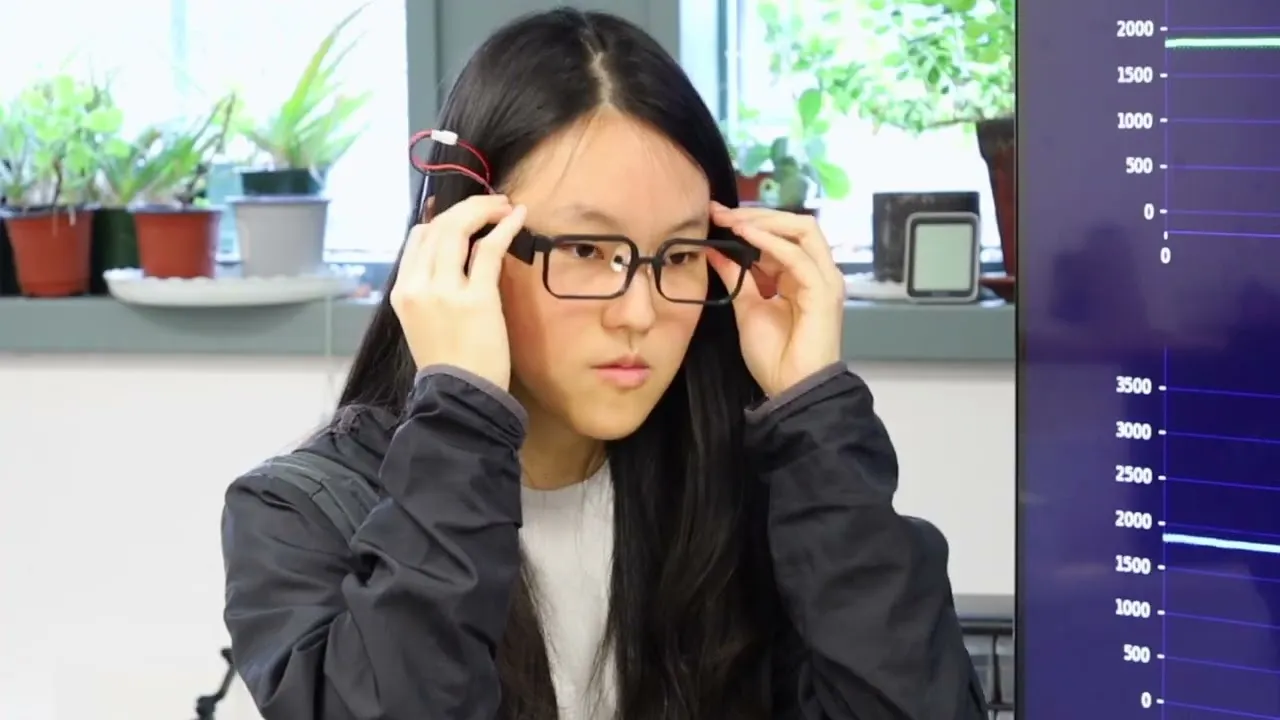
Everyday eyeglasses could one day track heart activity, jaw clenching and eating habits without a battery, thanks to sensors that turn a blink, a chew or an arterial pulse into the electricity needed to detect it, Northwestern University engineers report.
The prototype, called GlassTENG, uses sensors that harvest mechanical energy from facial movements and convert it into electrical power. Nivedita Arora, who led the work at Northwestern’s McCormick School of Engineering, said the idea is to turn glasses, which she says about half the population already wears, into health wearables without asking anyone to change habits.
A little static, a lot of signal
Three paper-thin triboelectric nanogenerators sit at the heart of the design. They rely on static electricity: when two different materials touch and then separate, electrons can move between them and create a brief charge. Each flexible sensor holds layers that repeatedly press together and pull apart as the face moves. A blink, a clenched jaw or even blood pumping through an artery can drive them. In Arora’s words, a blink helps power the sensor that detects the blink.
The team placed one sensor at the bridge of the nose, near the angular artery and the muscles around the eyes, where it picks up pulse, blinking and eyebrow movement. A second sits near the temple, over the superficial temporal artery, and detects pulse and jaw motion. A third, closer to the ear, senses chewing and clenching.
Different movements leave different electrical fingerprints. An arterial pulse, the lightest force tested, produced about 50 to 100 millivolts. Blinks and eyebrow raises generated roughly 200 to 500 millivolts, while strong jaw movements such as chewing and clenching reached as high as 1.5 volts.
How accurate is it?
In tests, 20 participants wore the glasses while blinking, raising their eyebrows, clenching their teeth, tapping their teeth, eating and talking. Machine-learning algorithms analyzed the signals to identify each activity and reached 93.8% accuracy across all six. The glasses recognized teeth tapping with 99% accuracy and jaw clenching with 96%, and they separated those movements from everyday activities such as talking and eating.
Almost no power
Many wearables draw power continuously, which calls for bigger batteries and regular recharging. GlassTENG’s three sensors consume a combined 4.1 microwatts, which the team says is orders of magnitude less than many conventional sensing technologies. Data stream over Bluetooth to a smartphone or tablet.
Health uses and next steps
The researchers see potential for monitoring cardiovascular health, bruxism (involuntary jaw clenching and teeth grinding), fatigue and eating behavior throughout the day. Study coauthor Nabil Alshurafa, an associate professor of preventive medicine, computer science and electrical and computer engineering, said glasses could prompt wearers to relax a clenched jaw or become more aware of how they eat.
Arora said the long-term goal is on-device computation that works without a battery, so glasses could give immediate feedback when they detect a physiological event. Alshurafa said the aim is wearables that help people “recognize and change what we’re doing in the moment.”
The study appears in the Proceedings of the 2026 ACM International Symposium on Wearable Computers. Master’s students Raj Dave, Jovanis Prodanich and Yung-ching Lai are co-first authors, and Ansys, Inc., partially supported the work.
Related articles
Tiny chip stores memories in flowing water without conventional electronics
Yale researchers have found a way to make flowing fluids remember what happened before, using...
Oxygen-based chipmaking method controls 2D crystal growth with over 99% success
Researchers in South Korea have developed a semiconductor manufacturing technique that controls where individual crystals...

Meta releases Muse Wonder, its first frontier model for personal and professional agents
Meta’s Superintelligence Lab launched Muse Wonder and Muse Wonder Full, its first frontier-class models, emphasizing Active Memory and long-running agent work. Wonder is available via the Meta Model API and Muse Code; Wonder Full is limited to Muse Code subscribers.

Anthropic to share first Q3 figures with investors as it prepares for a possible record IPO
CNBC reports Anthropic will disclose third-quarter financials for the first time to institutional investors meeting at its San Francisco headquarters this week, as the AI lab prepares for what could be a roughly $2 trillion IPO.

Reuters: OpenAI and Anthropic sought control over what outside AI safety evaluators can publish
According to Reuters, OpenAI and Anthropic pushed for significant control over outside evaluators’ publications over trade-secret concerns, even after publicly endorsing editorial independence. Talks have shifted in recent days, and both labs dispute parts of the characterization.

OpenAI and Anthropic tell UK lawmakers voluntary AI pledges are not enough
At a UK parliamentary hearing, OpenAI and Anthropic backed a statutory AI safety framework, saying voluntary commitments are not a durable plan for frontier risk. Google DeepMind and Meta declined to support new legislation, deepening a public split among labs.