
Germany’s 17 Million Immigrants: Where They Come From
Germany is home to 17 million people born abroad. See where they came from and where German emigrants live around the world.
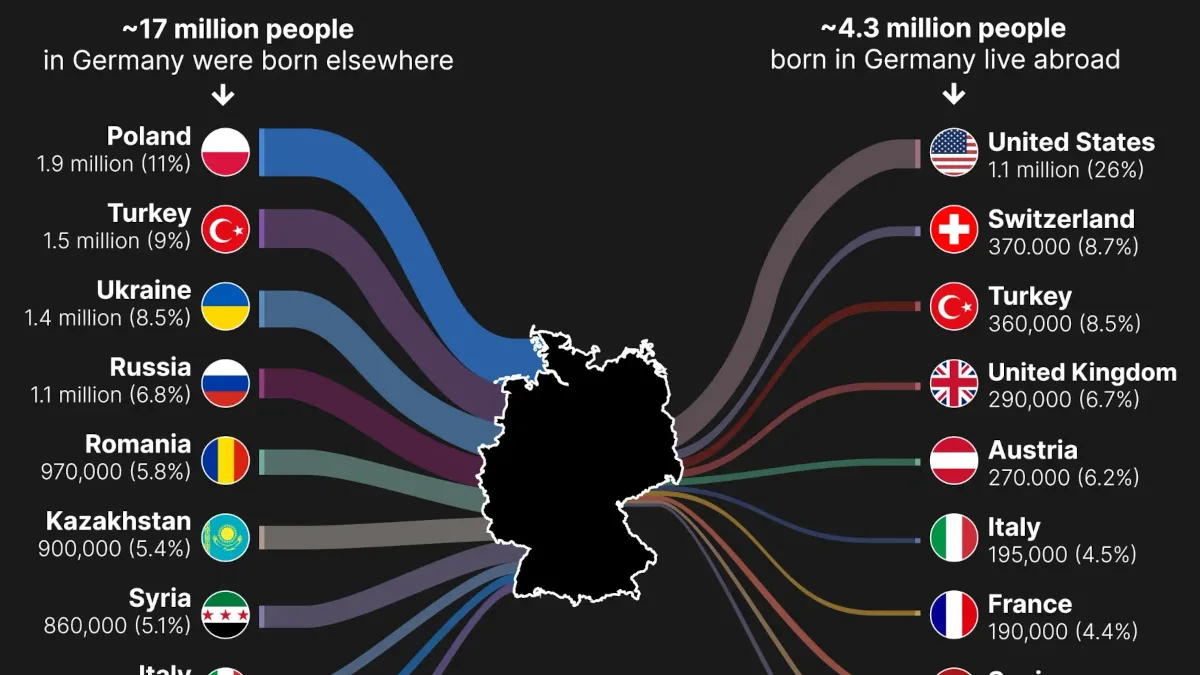
Where Germany’s 17 Million Immigrants Were Born
Key Takeaways:
About 17 million people living in Germany were born abroad, compared with 4.3 million German-born people living overseas.
Poland is the largest birthplace among Germany’s foreign-born population, while the U.S. is the leading destination for German-born emigrants.
Germany has expanded skilled-worker immigration pathways to help address labor shortages.
Germany is one of the world’s largest destinations for international migrants, shaped by decades of labor migration, European mobility, and more recent refugee arrivals.
This graphic by DataPulse Research uses UN international migrant stock data compiled by Our World in Data and analysis from DataPulse Research to show where Germany’s foreign-born residents originated and where German-born emigrants live.
The figures represent people living outside their country of birth, rather than annual migration flows.
Where Germany’s Immigrants Come From
The table below ranks the largest countries of origin for Germany’s foreign-born population, based on data compiled by Our World in Data.
RankCountry of OriginShare (%)
1 Poland11.0
2 Türkiye9.0
3 Ukraine8.5
4 Russia6.8
5 Romania5.8
6 Kazakhstan5.4
7 Syria5.1
8 Italy2.6
9 Afghanistan2.1
10 Czech Republic2.1
Poland accounts for 11% of Germany’s foreign-born population, followed by Türkiye at 9% and Ukraine at 8.5%. These populations reflect several migration waves, including postwar labor recruitment, EU labor mobility, and more recent humanitarian migration from Ukraine and Syria.
Germany’s broader migration footprint extends beyond its foreign-born population. In 2025, 21.8 million residents, or 26.3% of the population, had an “immigration history,” meaning they had immigrated themselves or both parents had immigrated. This measure also includes some people born in Germany, making it broader than the foreign-born population shown in the graphic.
Germany’s Immigration Policies
Labor shortages have helped shape Germany’s immigration policies. The expanded Skilled Immigration Act broadened pathways for qualified workers, including an Opportunity Card for job seekers and expanded access to the EU Blue Card. According to the OECD, reforms implemented in 2024 also made the recognition of foreign qualifications more flexible.
Alongside these labor migration measures, Germany has pursued integration programs and policies addressing asylum and irregular migration.
Where German-Born Emigrants Live
The U.S. hosts the largest population of German-born emigrants, at 1.1 million, or roughly one in four living abroad.
European countries also feature prominently. Switzerland, the UK, and Austria are among the largest destinations, reflecting geographic proximity, employment opportunities, and established migration links. Türkiye also ranks highly, illustrating how migration between the two countries extends in both directions.
RankDestination CountryShare (%)
1 US26.0
2 Switzerland8.7
3 Türkiye8.5
4 UK6.7
5 Austria6.2
6 Italy4.5
7 France4.4
8 Spain4.1
9 Netherlands2.9
10 Greece2.9
These figures differ from annual departure statistics. In 2025, Switzerland, Austria, and Spain were the most common destinations recorded for people moving out of Germany.
Learn More on the Voronoi App
For another look at changing global migration patterns, see Ranked: Countries With the Fastest Immigration Growth (2019–2024) on the Voronoi app.
Related articles

US Navy’s 10,140-ton destroyer tests air defenses with two Nordic allies in Baltic
The USS Paul Ignatius, a U.S. Navy guided-missile destroyer, conducted live-fire drills and air-defense exercises...

Bangladesh-Malaysia recruitment reforms revive old questions over the cost of migration
Bangladesh and Malaysia have made several government-level agreements for labour migration over the years, but problems such as syndication, excessive recruitment costs and human rights abuses remain…

US’ 100,000-ton aircraft carrier returns from Iran with hundreds of war kill markings
After 321 days on deployment, the USS Abraham Lincoln has finally returned home. The ship...

US’ 100,000-ton aircraft carrier strike group launched 450 land-attack cruise missiles against Iran
One of the most powerful aircraft carrier strike group of the United States launched more...

45 MQ-9 Reapers, 12 F-15Es: US military logs 81 aircraft lost or damaged in Iran war
The United States now lists 81 aircraft as lost or damaged during operations against Iran...

Commandos take a ride on huge attack submarines during NATO war exercise
British commandos were spotted on a submarine while carrying out a daring operation. They emerged...