
Cockpit chaos: Flydubai Israel flight’s 14,000-ft plunge, hijack, stabbing explained
Flydubai Flight FZ1073 was supposed to make a routine trip from Dubai to Tel Aviv...
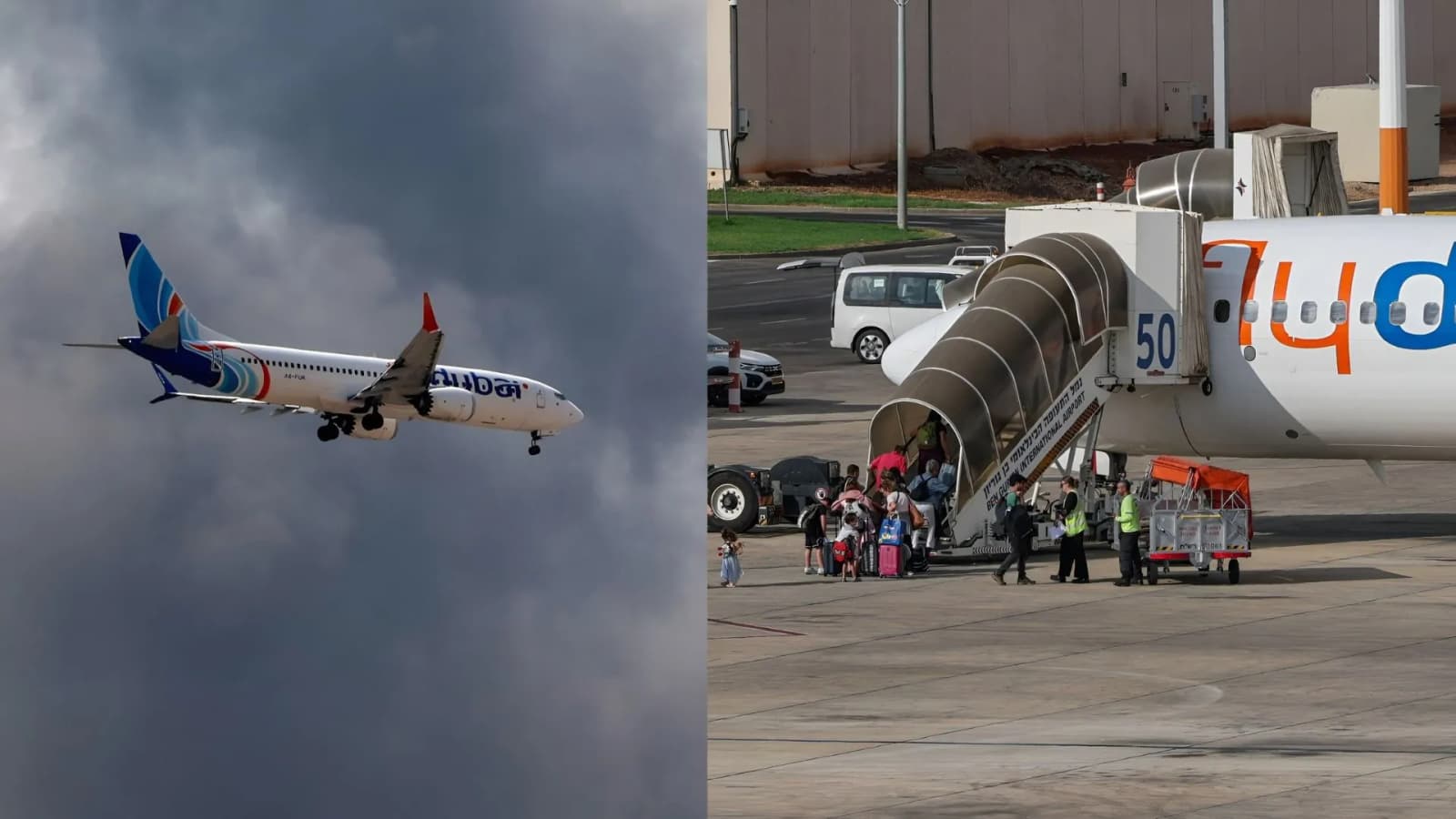
Flydubai Flight FZ1073 was supposed to make a routine trip from Dubai to Tel Aviv on Wednesday morning. Instead, the Boeing 737 Max 8 plunged thousands of feet after a violent confrontation erupted inside its cockpit.
The aircraft carried more than 170 passengers, including Israelis, as it crossed Saudi Arabian airspace. Flight-tracking data later showed the jet lost nearly 14,000 feet in less than 30 seconds. What followed turned a normal commercial flight into a hijack scare. Israeli officials said one pilot stabbed the other and apparently tried to crash the aircraft.
Passengers and crew members eventually forced their way into the cockpit. They subdued the suspected attacker and helped restore control of the aircraft.
The jet then diverted to Tabuk, Saudi Arabia, where it landed safely. Both pilots went to a hospital with injuries, while Saudi authorities arrested the suspected attacker.
Flight turns dangerous
FZ1073 departed Dubai International Airport bound for Ben Gurion International Airport near Tel Aviv. The route normally crosses Saudi Arabia and Jordan, making the aircraft’s position unsurprising when the emergency began.
The situation changed rapidly as the aircraft flew over Saudi Arabia. Flight data showed a dramatic loss of altitude before the first emergency signal appeared.
The descent lasted less than a minute. The aircraft dropped nearly 14,000 feet during the initial plunge, according to Flightradar24 data cited by Reuters.
That sudden change would have been immediately noticeable inside the cabin. Passengers later described screams and confusion as people realized something was seriously wrong.
The aircraft also transmitted emergency signals during the incident. One signal indicated a general emergency, while another corresponded to unlawful interference or a hijacking situation.
That second signal escalated the security response. Israeli authorities scrambled fighter aircraft as officials tried to determine what had happened aboard the commercial jet.
Cockpit fight erupts
The reason for the emergency soon became clearer. Israeli officials said the co-pilot attacked the pilot with a knife. Prime Minister Benjamin Netanyahu said the co-pilot appeared to be trying to crash the aircraft after stabbing the other pilot.
The injured pilot has since been identified as Indian national Smit Machchhar. He suffered stab wounds during the cockpit confrontation, which Israeli officials are investigating as a possible attempt to seize control of the aircraft.
Passenger accounts described a chaotic scene near the cockpit. One passenger’s family member said she heard screaming before seeing a man holding a knife and a pilot on the floor.
The violence left both pilots injured. Saudi officials later confirmed that the captain and co-pilot received hospital treatment after the aircraft reached Tabuk.
At that point, passengers faced a problem beyond the physical attack. Someone inside the flight deck had allegedly attacked a member of the crew while the aircraft remained airborne.
Netanyahu said passengers and a crew member eventually entered the cockpit. They reportedly found the injured pilot and subdued the suspected attacker.
A second group of pilots also played a crucial role. Netanyahu’s spokesman said two off-duty pilots were traveling aboard the flight and later took over the aircraft.
Passengers regain control
The cockpit intervention appears to have been the turning point. Once passengers and crew restrained the attacker, the aircraft could be stabilized and redirected toward a suitable airport. The replacement pilots then prepared for an emergency landing.
Tabuk became the destination. The airport’s air traffic control center received a distress call from FZ1073 requesting an emergency landing at 8:44 a.m. local time.
Emergency crews prepared for the aircraft before it touched down at 9:45 a.m. The Boeing landed safely, bringing the immediate danger to an end.
The passengers could not continue to Israel immediately. They remained in Saudi Arabia for about eight hours as Flydubai arranged replacement aircraft.
A replacement Flydubai flight eventually carried the stranded passengers toward Israel. The aircraft later landed at Ben Gurion Airport in Israel, ending the ordeal for those aboard the original flight.
ISRAELIS HOME AFTER FLYDUBAI HIJACKING ATTEMPT
All Israeli passengers stranded in Saudi Arabia after today’s attempted Flydubai hijacking have returned home.
PM Netanyahu met passengers who helped subdue the attacker.
One woman recalled: “I didn’t pray for the plane to… https://t.co/E0OhbCXmRn pic.twitter.com/SrNBlvztt9
— Mossad Commentary (@MOSSADil) September 30, 2026
Both original pilots remained under medical care after suffering injuries during the cockpit confrontation. Saudi authorities also arrested the suspected attacker.
Israeli authorities are also examining whether terrorism could have played a role. Officials have not ruled out that possibility, but they have not established a terrorist motive or explained what triggered the cockpit confrontation.
The incident has left investigators with several unanswered questions. Flydubai has not established why the cockpit confrontation began, and officials have cautioned against premature speculation.
Investigators must now reconstruct the cockpit struggle and the aircraft’s rapid descent. They will also examine the emergency signals and the actions that allowed the Boeing 737 Max 8 to recover.
Source: https://interestingengineering.com/culture/all-about-israel-bound-flydubai-flight-chaos
Related articles

125-million-year-old fossil: Earliest true mammal ever built for swimming
Chinese and international researchers have identified a newly described mammal species that lived about 125...

Decap is the man behind the drums behind your favorite song
I don't think I'm going to hurt anyone's feelings by pointing out that Decap doesn't have the name recognition of Kendrick Lamar, Olivia Rodrigo, or Charli XCX.

Scientists use Pompeii’s exact eruption date to make volcano dating far more precise
Roman writer Pliny the Younger left behind the only firsthand account of Mount Vesuvius’ eruption...

Kids turned the comment section of an NPR podcast into a group chat
Middle schoolers, likely blocked from other apps and social networks, apparently turned the Spotify comment section under an episode of NPR's Wild Card into an impromptu group chat.

Gaming’s biggest horror series are more vital than ever
For the third year in a row, I've been scared out of my wits by a new Silent Hill game. First it was the modern remake of Silent Hill 2, then the Japan-set spinoff Silent Hill F.

Caught on camera: How smart home devices are reshaping courtroom evidence law
A Taiwanese man used footage from his family’s robot vacuum to catch his wife in...