Ranked: Births vs. Deaths in 12 Major Countries
Which countries have the most births and deaths? Explore 2025 projections and the growing demographic divide between Asia and Africa.
This story was prepared automatically by software.
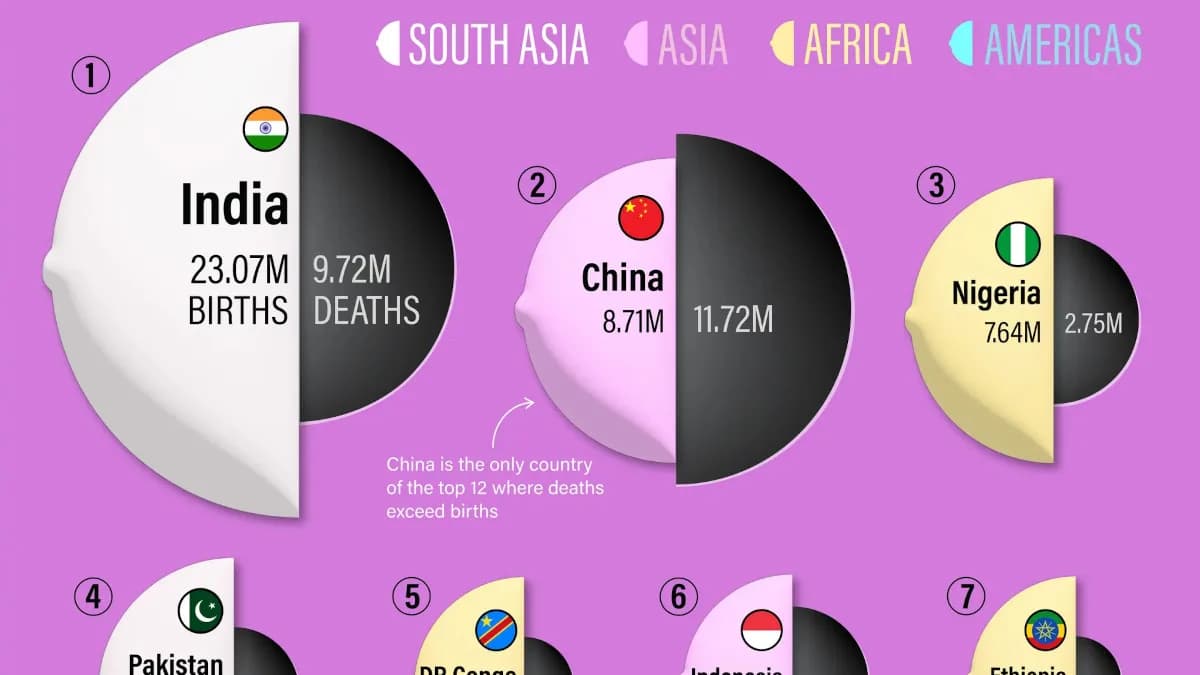
How Births and Deaths Compare Across 12 Major Countries
Key Takeaways:
India leads the world with 23.07 million projected births in 2025, compared with 9.72 million deaths.
China is the only country among the top 12 where deaths exceed births, with roughly 3 million more deaths than births.
Five African countries rank among the top 12, reflecting the continent’s comparatively high fertility rates and youthful populations.
The balance between births and deaths varies dramatically around the world, with some countries experiencing rapid natural population growth while others face aging and shrinking populations.
This visualization, created by Julie R. Peasley, compares projected births and deaths in the 12 countries with the most births in 2025, using figures from the United Nations’ World Population Prospects 2024.
Which Countries Have the Most Births and Deaths?
The following table ranks countries by projected births in 2025, using data from the United Nations Population Division Data Portal.
Rank
(based on births)CountryBirths in 2025
(millions, proj.)Deaths in 2025
(millions, proj.)
1 India23.079.72
2 China8.7111.72
3 Nigeria7.642.75
4 Pakistan6.911.64
5 DRC4.560.94
6 Indonesia4.442.20
7 Ethiopia4.180.79
8 USA3.663.09
9 Bangladesh3.440.90
10 Brazil2.531.53
11 Egypt2.450.66
12 Tanzania2.420.40
India records nearly three times as many births as China, highlighting the growing demographic gap between the world’s two most populous countries.
Meanwhile, the United States has the narrowest positive gap between births and deaths among the 12 countries, at just 570,000.
Why Asia and Africa Dominate Global Births
Asia’s enormous population explains its dominance in absolute births and deaths. However, fertility has fallen sharply across much of the region, particularly in East Asia, where aging populations are contributing to higher death totals.
Africa presents a different picture. Nigeria, the Democratic Republic of the Congo, Ethiopia, Egypt, and Tanzania collectively account for approximately 21.25 million births, compared with just 5.54 million deaths.
Although global fertility rates vary considerably, sub-Saharan Africa has the world’s highest regional fertility rates. Its younger population and larger average family sizes are expected to increase the continent’s share of global births in the coming decades.
What Falling Fertility Means for Population Growth
Globally, fertility has been declining, with many countries already below the replacement level of approximately 2.1 children per woman. These include China and the United States. The U.S. Census Bureau reports that American fertility has continued declining, although births still exceed deaths nationally.
Meanwhile, improvements in healthcare and declining mortality have supported population growth in many developing countries. Nevertheless, infectious diseases remain an important public health challenge, particularly where access to healthcare is limited.
As fertility declines and populations age, more countries may eventually experience deaths exceeding births. However, population momentum means global population growth can continue for decades even as average family sizes shrink.
Learn More on the Voronoi App
To explore how changing birth rates are reshaping global demographics, check out Falling Fertility Rates in the World’s 10 Biggest Countries on the Voronoi app.
Source: https://www.visualcapitalist.com/cp/ranked-births-vs-deaths-in-12-major-countries/
Related articles