Four-legged ANYmal solves giant Rubik’s Cube with only its feet in 30 steps
A four-legged robot has solved a giant Rubik’s Cube on its own using nothing but...
This story was prepared automatically by software.
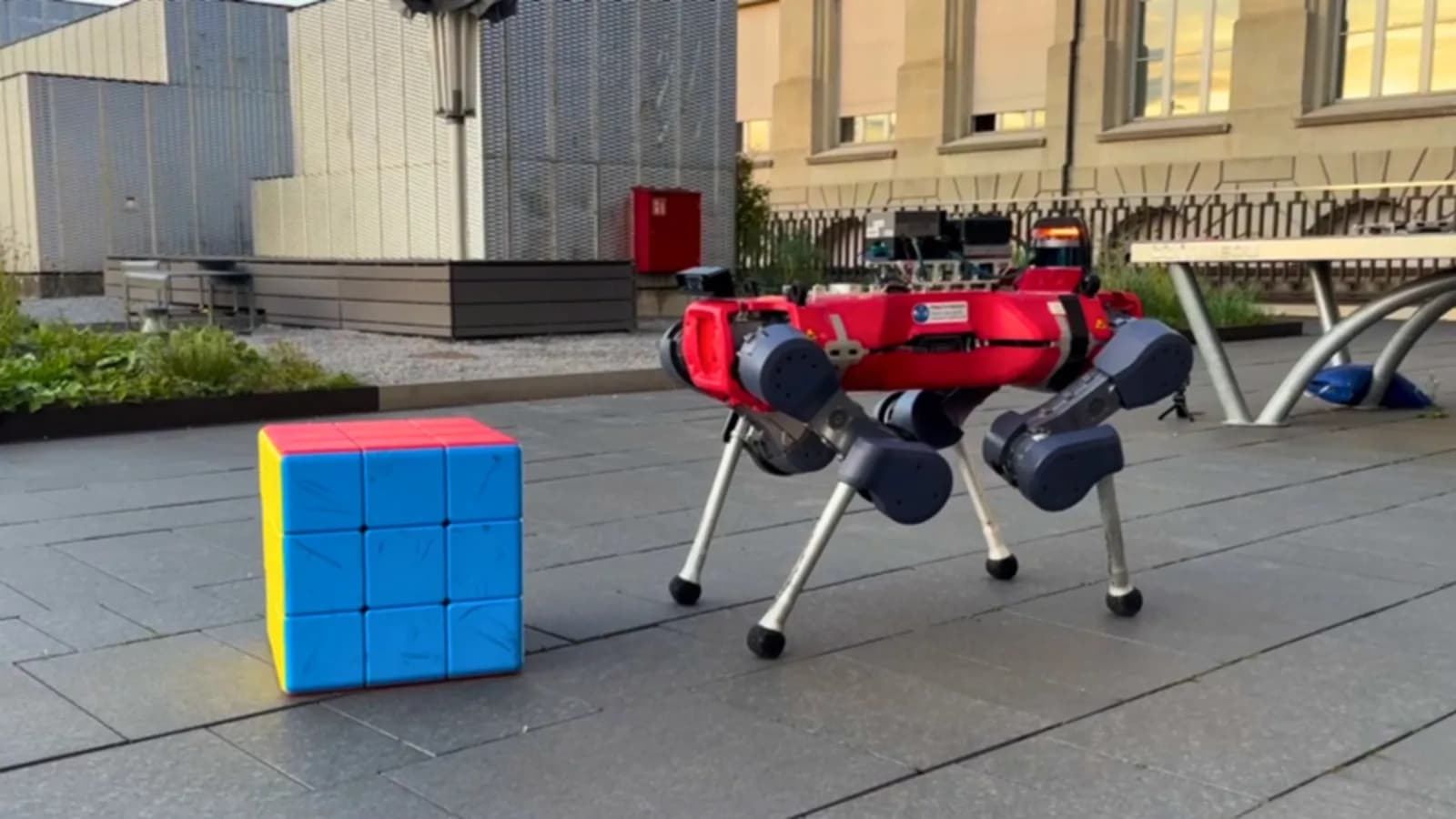
A four-legged robot has solved a giant Rubik’s Cube on its own using nothing but its feet, researchers at ETH Zürich and NVIDIA report. The machine, an ANYmal-D, completed three full solves on real hardware, each taking about 30 steps and 8 to 9 minutes.
Look, plan, then act
The robot first scans the cube, then plans, then carries out the solution. It walks around the freestanding cube and flips it to see every side with its onboard depth camera, a ZED X Mini, and pieces together the color of every square. A standard cube solver then produces the solution, and a planner turns it into robot moves: repositioning, flips and layer turns.
Between moves, the camera keeps updating the cube’s position so the robot can step into the right spot for the next skill. Up to about 6.6 feet (2 meters), the system located the cube to within about 0.8 inch (2 centimeters) at the median and read colors correctly 100% of the time indoors and 98.7% outdoors, according to the researchers.
Four foot skills
Everything the robot does with the cube comes from feet-only skills. Two flips tip the cube 90 degrees toward or away from the robot. To turn a layer, the right foot pins the cube in place while the left foot turns the top two layers a quarter turn counterclockwise. The clockwise turn is made by mirroring the counterclockwise skill.
The robot must keep the other layers locked while reorienting the cube, because an accidental twist would ruin the rest of the solution, TechEBlog noted.
Learned in simulation
The team trained the skills in simulation using reinforcement learning, in which the robot earns virtual rewards for landing its feet in the right spot, turning layers cleanly and staying balanced. A “teacher” that could see everything in the simulation was distilled into a “student” that uses only depth images from the robot’s front cameras and its own joint sensors. A temporary helping force steadied the cube early in training and was gradually removed.
Built to handle surprises
The researchers tested the skills on low-friction floors, cobblestones and mossy cobblestones, with misaligned layers and with the robot’s leg pulled by a rope. They also pushed the cube away with a stick and blocked a flip with a heavy box. The policies recovered from these disturbances and tolerated changes in where the cube sat relative to the robot. The flipping skills also worked on other objects, such as a small light box and a cylindrical container.
Why it matters
The team says the result shows how onboard perception and coordinated use of feet can let a quadruped finish long, multi-step physical tasks without any extra arms or grippers. In simulation, they found that onboard depth sensing improved performance, that memory in the controller improved reliability and that controlling the whole body together helped the robot pin and push at once.
Only three autonomous hardware solves were reported, and the sources do not give the cube’s size or weight.
The work comes from ETH Zürich’s Robotic Systems Lab and appears on a project page and in a research paper posted on arXiv.
Source: https://interestingengineering.com/ai-robotics/anymal-robot-solves-giant-rubiks-cube-with-feet
Related articles