Ranked: Countries With the Most Leisure Time
Which countries have the most free time? Explore global leisure rankings and why Europe leads while Asia lags behind.
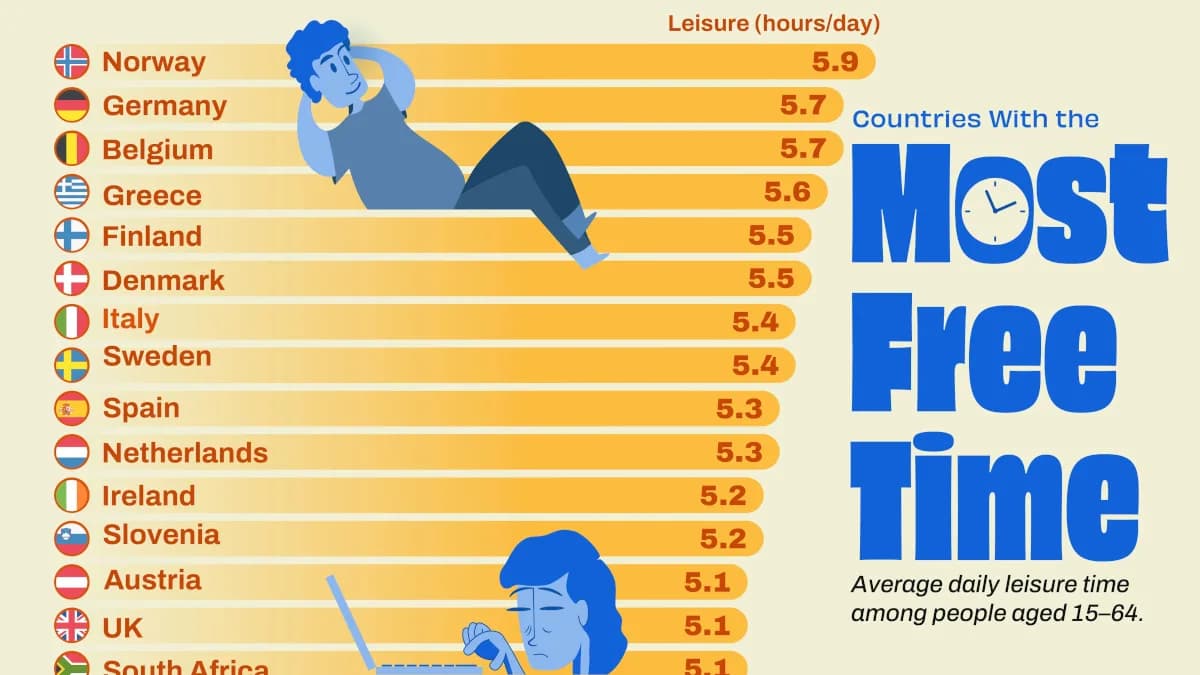
Which Countries Enjoy the Most Leisure Time?
Key Takeaways:
Norway leads with 5.9 hours of daily leisure time, equivalent to more than 41 hours per week.
European countries dominate the ranking, with four Nordic nations among the top eight.
Mexico averages just 3.4 hours of daily leisure, roughly 2.5 hours less than Norway.
How much time do people actually have to themselves each day?
From watching TV to spending time with friends and family, leisure is an important part of daily life. But the amount of time people spend on these activities varies considerably across countries.
Using the OECD Time Use Database, this visualization ranks 34 countries by average daily leisure time among people aged 15–64. The figures come from the latest available national surveys, which vary in year.
Which Countries Have the Most Free Time?
The following table ranks countries by daily leisure hours, based on OECD data updated in 2026.
RankCountryLeisure (minutes/day)Leisure (hours/day)
1 Norway3545.90
2 Germany3415.68
3 Belgium3395.65
4 Greece3355.58
5 Finland3305.50
6 Denmark3295.48
7 Italy3235.38
8 Sweden3215.35
9 Spain3165.27
10 Netherlands3155.25
11 Ireland3125.20
12 Slovenia3115.18
13 Austria3075.12
14 United Kingdom3065.10
15 South Africa3065.10
16 Estonia3015.02
17 New Zealand3015.02
18 France2944.90
19 Türkiye2864.77
20 Australia2814.68
21 Hungary2814.68
22 United States2804.67
23 Luxembourg2764.60
24 Japan2694.48
25 Latvia2694.48
26 Poland2614.35
27 South Korea2584.30
28 India2544.23
29 Croatia2514.18
30 Lithuania2474.12
31 Portugal2414.02
32 China2283.80
33 Canada2113.52
34 Mexico2033.38
Germany (5.68 hours) and Belgium (5.65 hours) follow Norway at the top of the ranking, while Greece and Finland round out the top five.
At the other end, Mexico averages just 3.38 hours of daily leisure. That’s a gap of roughly 2.5 hours per day, or nearly 18 hours per week, compared with Norway.
Why Does Europe Have More Leisure Time?
Europe’s strong showing may partly reflect differences in working hours, paid leave, and cultural attitudes toward leisure. However, national time-use surveys also capture how people spend their days outside paid employment, so these rankings are not simply a measure of vacation time or shorter workweeks.
More leisure time does not necessarily mean lower economic productivity. According to the OECD’s 2026 productivity report, Norway and Denmark were among the most productive economies per hour worked in 2024.
Why Do Asian Countries Have Less Free Time?
Several major Asian economies appear in the lower half of the ranking. China averages 3.8 hours of daily leisure, compared with 4.3 hours in South Korea and 4.48 hours in Japan.
Long working hours and workplace expectations may contribute to these differences, but commuting, household responsibilities, and demographic patterns can also influence how people allocate their time. For additional context, see our ranking of countries with the longest workweeks.
Ultimately, leisure is only one dimension of quality of life. Alongside working hours, opportunities for recreation help shape how rewarding free time feels.
Learn More on the Voronoi App
For another perspective on global working habits, explore Mapped: The World’s Hardest Working Countries in 2025 to see where employees work the longest hours.
Source: https://www.visualcapitalist.com/ranked-countries-with-the-most-leisure-time/
Get the latest news delivered to your inbox.
Related articles