
Robot dog finishes 26-mile marathon on a single battery charge, beating human efficiency
A four-legged robot has completed a full marathon on a single battery charge, covering 42.195...
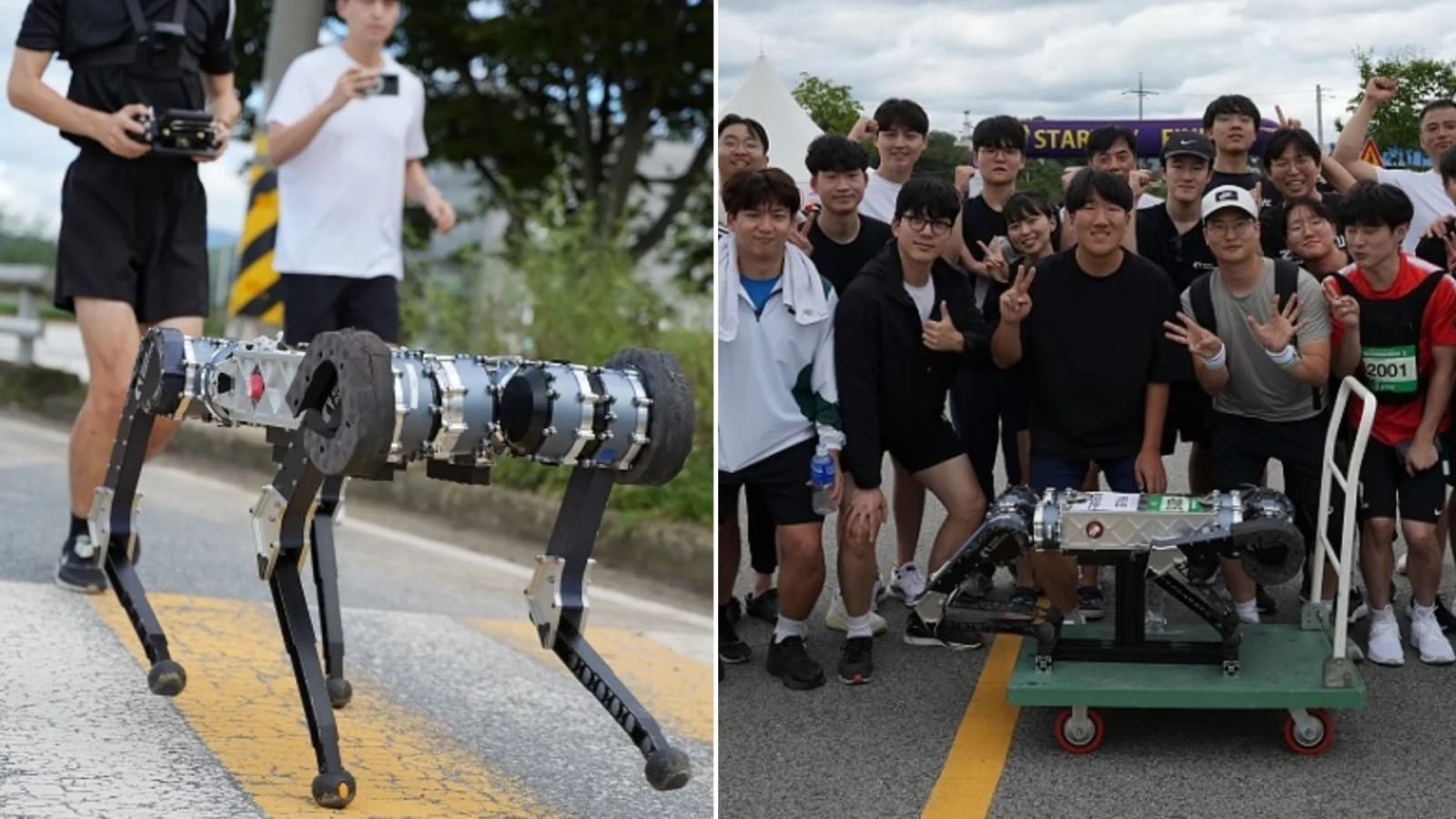
A four-legged robot has completed a full marathon on a single battery charge, covering 42.195 kilometers in 4 hours, 19 minutes and 52 seconds while using substantially less energy to move its weight than a human.
The robot, called RAIBO2, was developed by researchers at South Korea’s KAIST and completed the marathon during the 2024 Sangju Dried-Persimmon Marathon. The team published its findings in Nature on September 23, 2026.
The achievement addresses one of the biggest limitations facing legged robots: endurance. Unlike wheeled machines, quadruped robots must continuously spend energy supporting their bodies while also losing energy through impacts, joint movement, and foot-ground interactions.
A marathon without a recharge
RAIBO2 maintained an average speed of about 2.64 meters per second, or 5.9 mph, throughout the marathon. It completed the 42.195-km course without replacing or recharging its battery.
The result followed an earlier failed attempt by the research team. In September 2024, an earlier version ran out of battery at around the 37-km mark during a marathon event. KAIST said the robot consumed more energy than expected because it repeatedly changed speed while adjusting to other runners on the course. The team subsequently redesigned several aspects of the system and continued refining its locomotion.
Rather than simply installing a larger battery, the researchers focused on reducing how much energy the robot loses while moving.
Efficiency is the real breakthrough
The Nature study describes RAIBO2 as an energy-efficient quadruped developed through a comprehensive analysis of mechanical, electrical, and locomotion losses.
The researchers made its legs lightweight and designed the motor-driving electronics to reduce electrical losses. The researchers also developed a locomotion policy designed to minimize energy dissipation during movement.
Machine learning played an important role in that process. The team used simulation and reinforcement learning to train the robot’s movement policy, allowing it to learn gaits that reduce unnecessary joint movement, foot-ground collision losses, and other sources of wasted energy.
The researchers also considered the robot’s physical design and control system together rather than optimizing them independently. This included changes to the leg mechanism and motor-drive circuitry.
The resulting efficiency is expressed using a metric called cost of transport (COT), which measures the energy required to move a given weight over a given distance. RAIBO2 achieved a COT of 0.25, compared with a human benchmark of 0.37 cited in the study.
That does not mean the robot is universally more efficient than humans at every form of movement. Rather, under the study’s COT comparison, RAIBO2 required less energy relative to its weight and distance traveled.
Longer-range robots could have practical uses
The researchers say the improvements could help extend the usefulness of quadruped robots in environments where wheels are impractical. Legged machines can potentially navigate mountainous terrain, disaster zones, stairs and other uneven environments, but their operating range has traditionally been constrained by battery capacity.
The Nature paper notes that previous quadruped robots have generally been limited to roughly 20 kilometers of travel per charge. RAIBO2 offers more than three times that range under the comparison presented in the study.
That could matter for applications such as search and rescue, industrial inspection and outdoor reconnaissance, where sending a robot back to a charging station can be difficult or impossible.
The team has effectively treated endurance as a whole-system engineering problem rather than a battery problem. By reducing mechanical, electrical and locomotion losses simultaneously, RAIBO2 demonstrates how much farther a legged robot can travel without simply carrying a larger energy pack.
For quadruped robots, the marathon was therefore less about running 26.2 miles than demonstrating that the machines can become considerably more efficient at every step along the way.
Source: https://interestingengineering.com/ai-robotics/robot-dog-marathon-single-battery-charge
Related articles

I have some questions for Mark Zuckerberg
It’s a big week for Meta. The company just kicked off its big Connect conference on Wednesday, and the new Muse AI agent appears to be an early hit.

Google is sending an AI satellite into space next week
Google is getting ready to launch a satellite with its AI processors to test how well they perform in space, as reported earlier by The New York Times.

Why can’t we just keep rogue AIs off the internet?
AI agents keep getting loose, escaping supposedly secure tests to attack real-world targets, commandeer obscure wikis, and leave instructions for other agents to follow.

You might not miss what Nikon removed from its cheaper full-frame Z5 IIC
Nikon waited five years to update its full-frame Z5 camera to the Z5 II, but today it announced a new variant of last year's upgrade that removes features instead of introducing improvements in order…

Everything is spying on you and there’s no opting out
Earlier this month, Apple announced that its new Apple Watches will have the ability to continuously listen to every spoken word they detect and create summaries of whatever's going on around you.

Meta’s Muse AI Charms can interact with each other
Meta's handheld AI gadget, called the Muse Charm, will be able to recognize and interact with other nearby Charms when it launches later this year.