
Zinc-air battery hits 98% efficiency, 820-hour lifespan with new graphene catalyst
A group of scientists in China has recently come up with a graphene catalyst that...
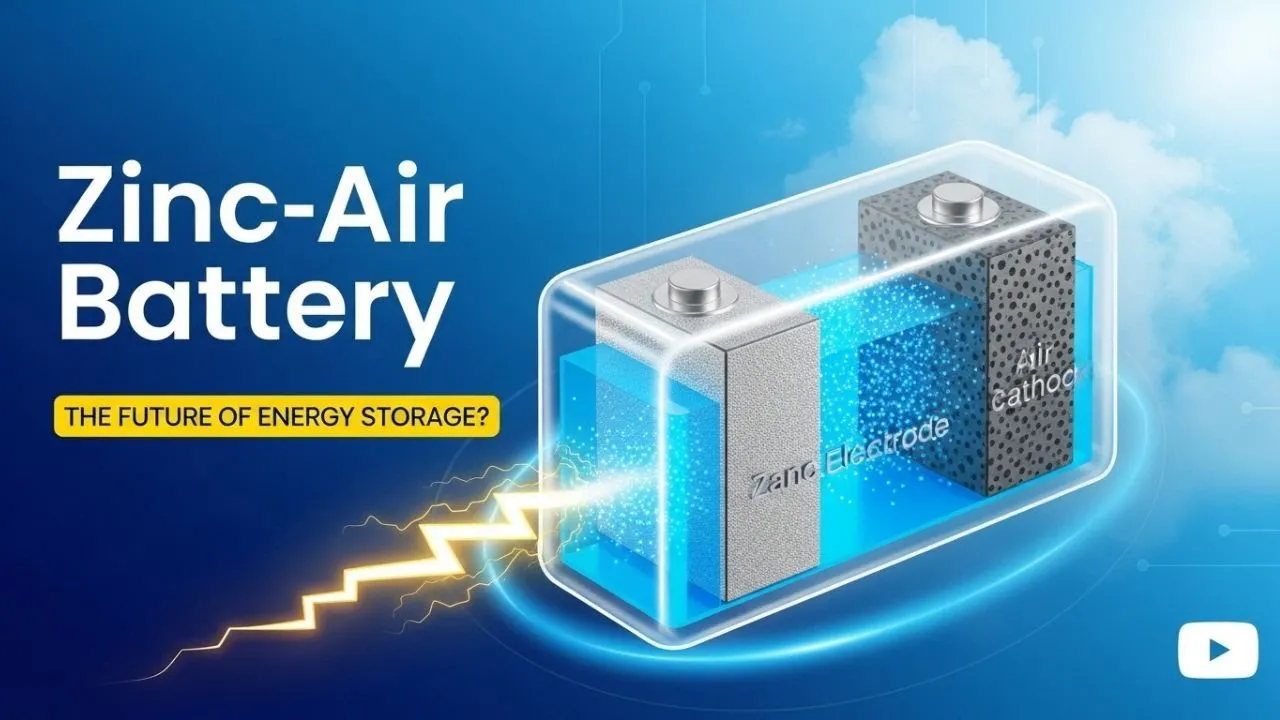
A group of scientists in China has recently come up with a graphene catalyst that raises zinc-air battery efficiency to about 98 percent, and allows them to operate for more than 820 hours.
The fluorinated graphene electrocatalyst, or FG-3, consists of 3.1 percent fluorine. It was created by a team headed by Wen Zhenhai, PhD, and Huang Junheng, PhD, from the Fujian Institute of Research on the Structure of Matter (FJIRSM), at the Chinese Academy of Sciences (CAS).
According to the scientists, their graphene catalyst could significantly improve the efficiency and durability of zinc-air batteries. In lab tests, the battery achieved an impressive 98 percent round-trip efficiency and operated stably for over 820 hours in ambient air.
Moreover, it retained 97.6 percent efficiency after 1,500 charging and discharging cycles. Wen and Huang believe that the findings could lead to better and more efficient next-generation energy storage systems.
Zinc-air battery challenges
Zinc-air batteries (ZABs) generate electricity using zinc metal and oxygen from the surrounding air. They use zinc metal as the negative electrode as oxygen reacts at the positive electrode. They are considered a promising alternative to lithium-ion (Li-ion) batteries because they can store more energy.
Additionally, zinc is abundant, relatively inexpensive, and has high energy density. But, until now, they have been virtually impossible to recharge. This is largely due to the complex chemical reactions that occur during charging and discharging.
These reactions require a lot of energy, which can reduce the efficiency of zinc-air batteries and cause their materials to wear out faster. To tackle this challenge, the Chinese researchers turned to a two-electron reaction that involves oxygen and hydrogen peroxide, which is faster and more reversible.
“The two-electron (2e–) O2-H2O2 interconversion pathway has attracted growing attention for its faster intrinsic kinetics and better reversibility,” the team pointed out. To make the fluorinated graphene, they applied a controlled heating process that gradually removed fluorine from the material, and restored its electrically conductive carbon structure.
A reliable new battery
The controlled heating process helped the team create several graphene samples. All had different fluorine concentrations. FG-3 exhibited the best performance, as it conducted electricity more efficiently and helped speed up chemical reactions.
The material also featured a large surface area, evenly distributed fluorine, as well as improved interaction with the electrolyte. More tests revealed that the fluorine-carbon bonds changed the electrical properties of the nearby carbon atoms.
To further evaluate its performance, the research team tested the catalyst in zinc batteries. Tests showed that the FG-3 graphene catalyst performed exceptionally well, and hit 97.4 percent hydrogen peroxide selectivity and 98 percent Faradaic efficiency.
A non-rechargeable zinc-air battery built with the catalyst achieved a peak power density of 569 milliwatts per square centimeter (mW cm-2). At the same time, the rechargeable version achieved 98 percent round-trip efficiency.
It also maintained 97.6 percent efficiency after roughly 1,500 charging cycles and operated steadily for over 820 hours in normal air. According to the scientists, the findings could provide a new strategy for making carbon catalysts without relying on metals. “The catalyst enables highly reversible O2-H2O2 interconversion and delivers outstanding performance in zinc-based batteries.” the team concluded in a press release.
The study has been published in the journal Angewandte Chemie International Edition.
Source: https://interestingengineering.com/energy/zinc-air-battery-hits-98-efficiency-820-hour-lifespan
Related articles

Sony’s WH-1000XM6 headphones are $130 off today only
If you missed out on Prime Day’s headphones deals, you’re in luck. Sony’s latest flagship headphones are selling for even less than they did during Amazon’s big fall sale.

Google is making inline links more prominent in AI responses
Google is updating its AI search results to make inline links appear "higher up in responses more frequently," according to a blog post.

Alienware’s latest 34-inch QD-OLED gaming monitor is $50 off
The Alienware AW3426DW is discounted to $742.22 at Amazon, just over $50 off its usual price of $799.99.

Sony made a $5,900 gold-plated Walkman MP3 player
Sony has announced a trio of new Walkman portable media players that start at an already absurd $1,899.99 for the NW-ZX900 and climb all the way up to $5,899 for the gold-plated NW-WM1ZM3.

World’s most advanced fighter jet makes arrested landing aboard 100,000-ton aircraft carrier
The world’s most advanced stealth fighter jet recently made its first arrested landing aboard a...

NVIDIA’s latest 120-billion-parameter model completes agent tasks 5x faster than rivals
NVIDIA has unveiled three open AI models designed to bring autonomous agents to more computing...