
3 missions in 13 hours: SpaceX launches astronaut crew, 130 satellites, and secret spy payload
If rocket launches feel common now, Thursday night was a loud reminder of how fast...
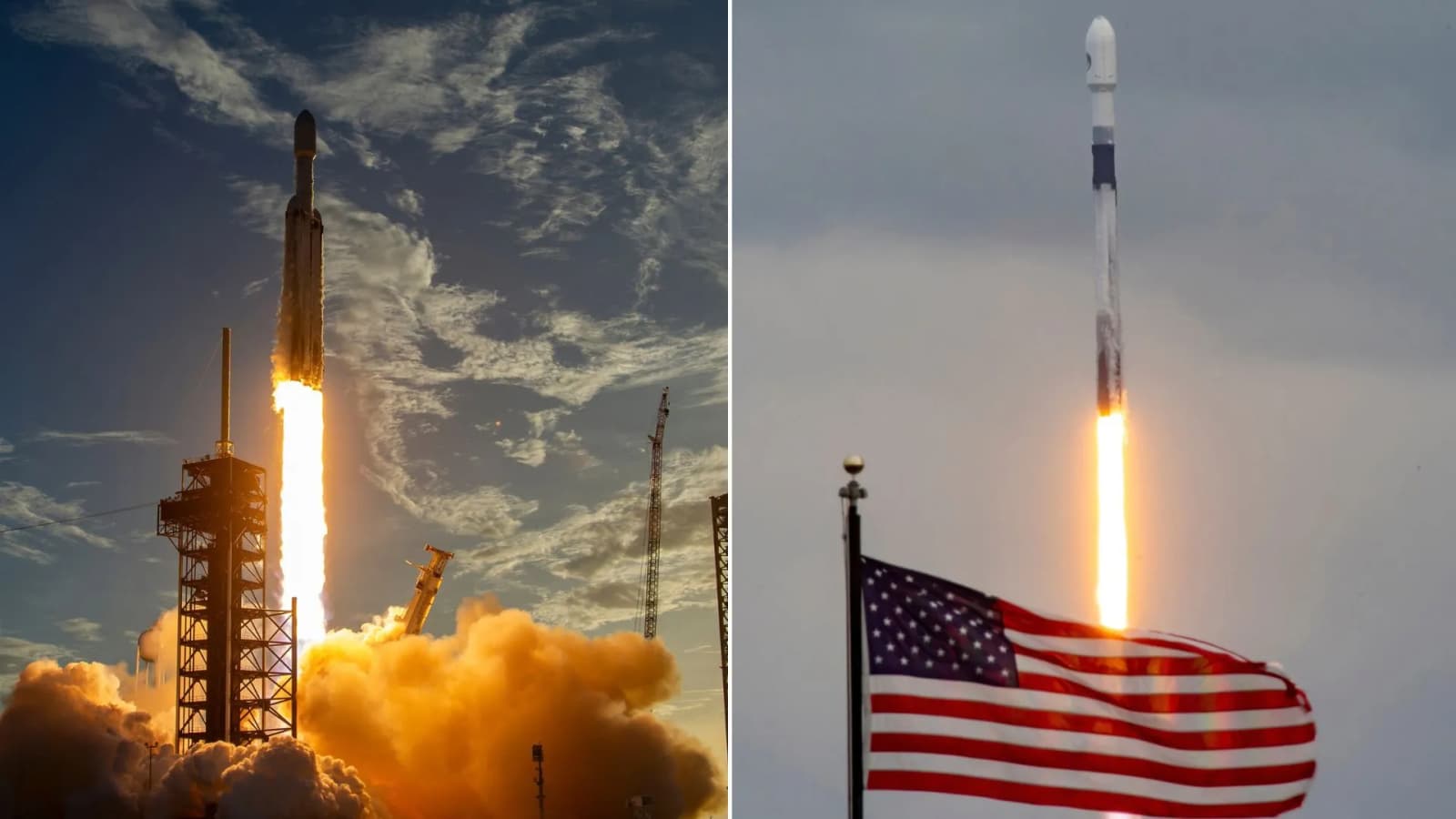
If rocket launches feel common now, Thursday night was a loud reminder of how fast things are changing.
In less than 13 hours, SpaceX launched three separate orbital missions, capping the marathon off with a roaring midnight liftoff of its massive Falcon Heavy rocket.
The late-night launch was for the National Reconnaissance Office (NRO), the defense agency that operates America’s fleet of spy satellites. Designated NROL-97, the classified mission marks the first time a Falcon Heavy rocket was tapped for an NRO deployment.
Falcon Heavy launches NROL-97 from pad 39A in Florida pic.twitter.com/LQxZZzTneI
— SpaceX (@SpaceX) October 2, 2026
Three launches, one day
It was an exceptionally busy day at the launch pads. The madness began Thursday morning when a Falcon 9 lifted four astronauts on the Crew-13 mission toward the International Space Station. Hours later, a second Falcon 9 rocket roared into the sky from California, carrying a payload of 130 satellites for the Transporter-18 rideshare mission.
Then came the heavy hitter. At 11:54 p.m. EDT, the triple-booster Falcon Heavy cleared the pad at NASA’s Kennedy Space Center, cutting a bright line of fire through the dark Florida sky.
SpaceX has pulled off only three launches in such a short window once before, matching a 12.5-hour streak set in March 2025. Coupled with a test flight of the massive next-generation Starship rocket on Monday, Thursday’s surge meant all three of SpaceX’s active rocket models took flight over just three days.
Little is known about what NROL-97 actually carried into orbit. The NRO keeps its satellite operations under tight secrecy, and SpaceX cut its live stream shortly after launch at the agency’s request. But using a Falcon Heavy hints at the mission’s scale. The rocket combines three modified Falcon 9 cores, yielding massive thrust meant for extraordinarily heavy cargo or deep-space destinations.
The Falcon Heavy generates over five million poundsof thrust at liftoff, which is required for either massive satellite buses or direct injection into Geostationary Earth Orbit (GEO) ~22,200 miles up.
The secret, symbolic mission
Interestingly, the mission’s patch offered a symbolic glimpse into its purpose.
Space.com reported that it bears the Latin phrase “Orbem mundi mutandum conservare”—”To preserve a changing world.” The crest also pays tribute to the 25th anniversary of 9/11, depicting a lighthouse whose beam aligns with the 9 and 11 markers on a clock face, surrounded by four stars representing the hijacked flights.
Shortly after staging, the rocket’s two outer boosters peeled away and guided themselves back down to Earth. They touched down almost simultaneously at Cape Canaveral Space Force Station.
The core booster was left to fall into the sea, intentionally expendable to give the secret payload its final, powerful push into the dark.
SpaceX demonstrated the strength of its reusable hardware during this launch surge, highlighted by a Falcon 9 booster completing its 25th flight for the Transporter-18 mission. The side boosters on the NROL-97 Falcon Heavy brought significant flight heritage to the classified national security launch, having previously supported major scientific and weather monitoring missions such as GOES-U and the Roman Space Telescope.
The busy week also featured the long-awaited milestone of Starship reaching Earth orbit during its 14th test flight on Monday. The 393 feet (120 meter) tall vehicle reached orbital velocity, deployed a batch of Starlink satellites, and performed a controlled ocean entry.
Related articles
New center bids to supercharge nuclear isotope production for deep-space missions
Canada is moving to expand its role in supplying nuclear isotopes that could power spacecraft...
Schneider tests quantum chip that improves home energy forecasting by up to 41%
Australian government-backed Silicon Quantum Computing (SQC), whose investors include telecom giant Telstra and Commonwealth Bank,...

Digital twin tech from US, Korea could predict toxic ammonia leaks on new ships
The US, South Korea and Germany have recently joined forces in order to develop a...
Mapped: The World’s Digital Leaders in 2026
Which economies are the most digitally connected? See how 159 economies rank in the ITU’s 2026 ICT Development Index.

Breaking up (with Elon Musk) is hard to do
In a throwback to MySpace-style internet drama, Shivon Zilis announced that she and the father of four of her children, Elon Musk, had broken up on X.

OpenAI’s Dot agent is enterprise software that can also order your dinner
It's a tale as old as last week: OpenAI's new agent platform, called Dots, is full of cute little guys who can do your bidding.