
CERN researchers report first observation of differences in nucleons within the atom
Researchers at the ATLAS Collaboration at the CERN have found the origins of an observation...
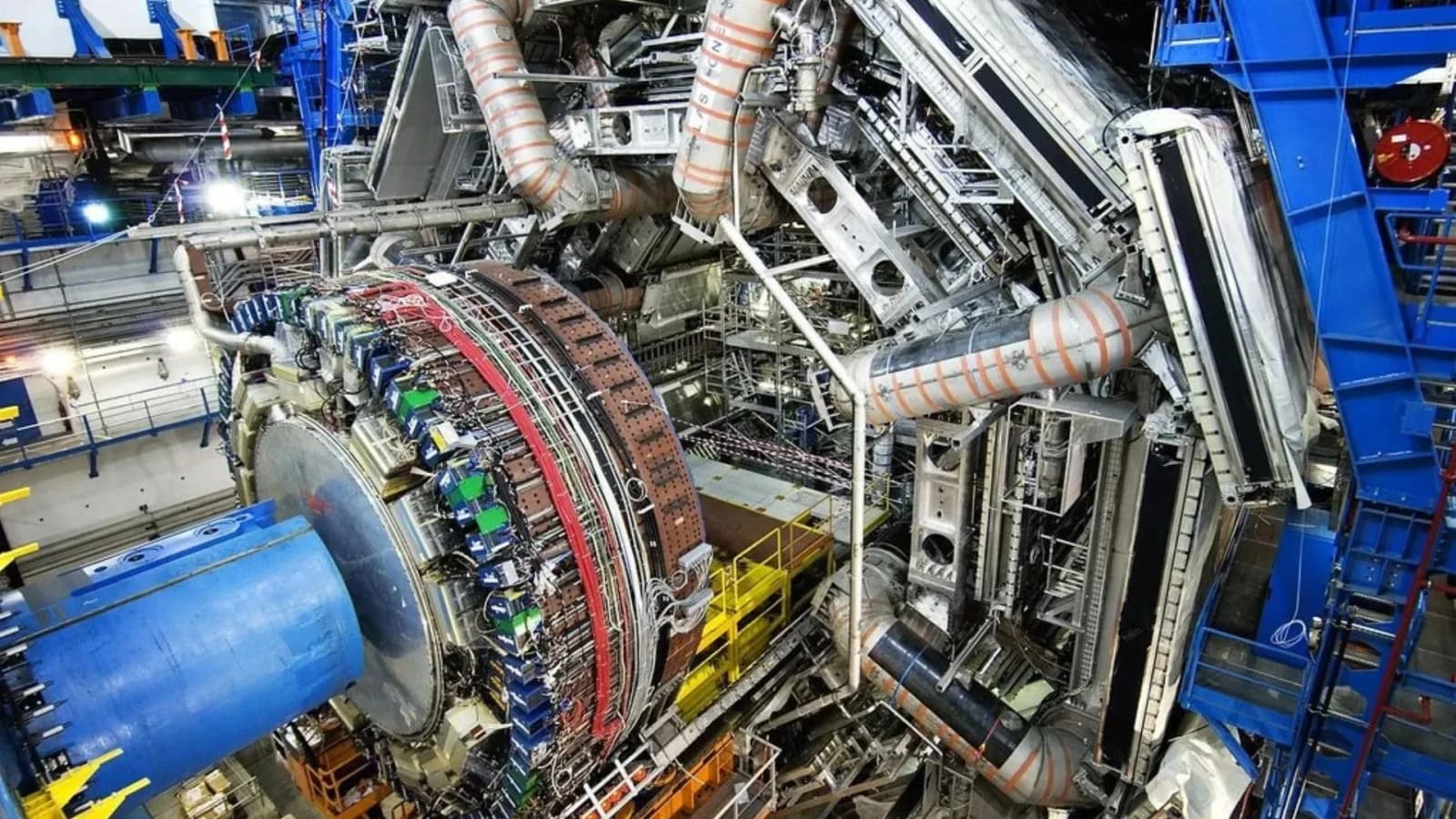
Researchers at the ATLAS Collaboration at the CERN have found the origins of an observation made over 40 years ago. In data studied from experiments carried out in 2018, the scientists found that nucleons located at the edge of a nucleus have a different internal structure than those near the center.
For most of us, the atom is the smallest and indivisible part of a chemical element. For nuclear physicists though, it is the largest unit that they usually consider and is a complex collection of subatomic particles going beyond the protons, neutrons and electrons as they seek to find out the nature and behaviour of these components.
Previous observations of nucleons, i.e.- protons and neutrons that are located inside the atomic nucleus, have shown that the momentum distribution of the quarks and gluons inside them is altered because of their location. This observation was first made in 1982 by the European Muon Collaboration (EMC), another experiment group at CERN. However, the reasons for this observation had remained elusive.
This observation, referred to as nuclear parton distribution functions (nuclear PDFs or nPDFs) are also surprising because the energy needed to bind the nucleon inside the nucleus is tiny when compared to energy needed to resolve the patrons inside it.
ATLAS solves the mystery
Researchers at ATLAS used ultra-peripheral collisions of lead ions to solve this mystery. In these collisions, the ions do not meet head-on. Instead, they pass by each other without overlapping but interact through their electromagnetic fields. In some collisions, a photon emitted by one nucleus strikes another, generating narrow particle streams that we can study to learn more about partons inside the nucleus.
Usually, these interactions break the nucleus and release ‘forward’ neutrons that can be detected by zero-degree calorimeters (ZDCs) of the ATLAS experiment. In a smaller number of these interactions, a photon may not break apart the nucleus but strike only a nucleon, generating no ‘forward’ neutrons.
The researchers used data from collisions of lead ions carried out in 2018,with integrated luminosity of 1.72 nb⁻¹.
How were nPDFs spotted?
To spot rare events where a photon struck only a nucleon, the researchers selected collisions that produced at least two jets but little additional activity in the ZDCs. They then split these collisions into two classes: inclusive collisions, which generate forward neutrons (denoted 0nXn), and the other peripheral collisions, which do not have forward neutrons and are denoted 0n0n.
In inclusive collisions, the struck nucleon can be located deeper in the nucleus, whereas in the peripheral collisions, it is likely to be at the edge of the nucleus. Using measurements of the observed jets, the researchers assigned proxy variables for parton kinematics. X+ is one such variable that helps estimate the fraction of nucleon’s momentum that the struck parton is carrying.
By comparing x+ distributions of the two event classes, the researchers were looking to spot changes in PDF. They noticed a clear slope when inclusive and peripheral collisions were compared indicating a difference in their nPDFs.
To determine whether these differences were statistically significant, the team performed statistical tests, which confirmed that nucleons near the edge of the nucleus have different parton distributions from those near the center, a press release said.
Related articles

Ultra-high-power lasers open new pathways for non-destructive material inspection
Superman’s X-ray vision isn’t actually that super. X-rays work well for seeing through thin objects...
US scientists find 7-volt switch can strain sapphire thousands of times its depth
Researchers in the US have recently discovered that a 7-volt pulse applied to an ultra-thin...
US scientists turn 95% calcium-rich eggshell waste into stronger magnesium alloys
U.S. researchers have demonstrated a way to turn powdered eggshells into stronger, harder magnesium alloys,...