
Bicycle-inspired robot can perform wheelies, jumps, and front flips at high speeds
Researchers have developed a bicycle-inspired robot capable of performing acrobatic maneuvers while maintaining balance at...
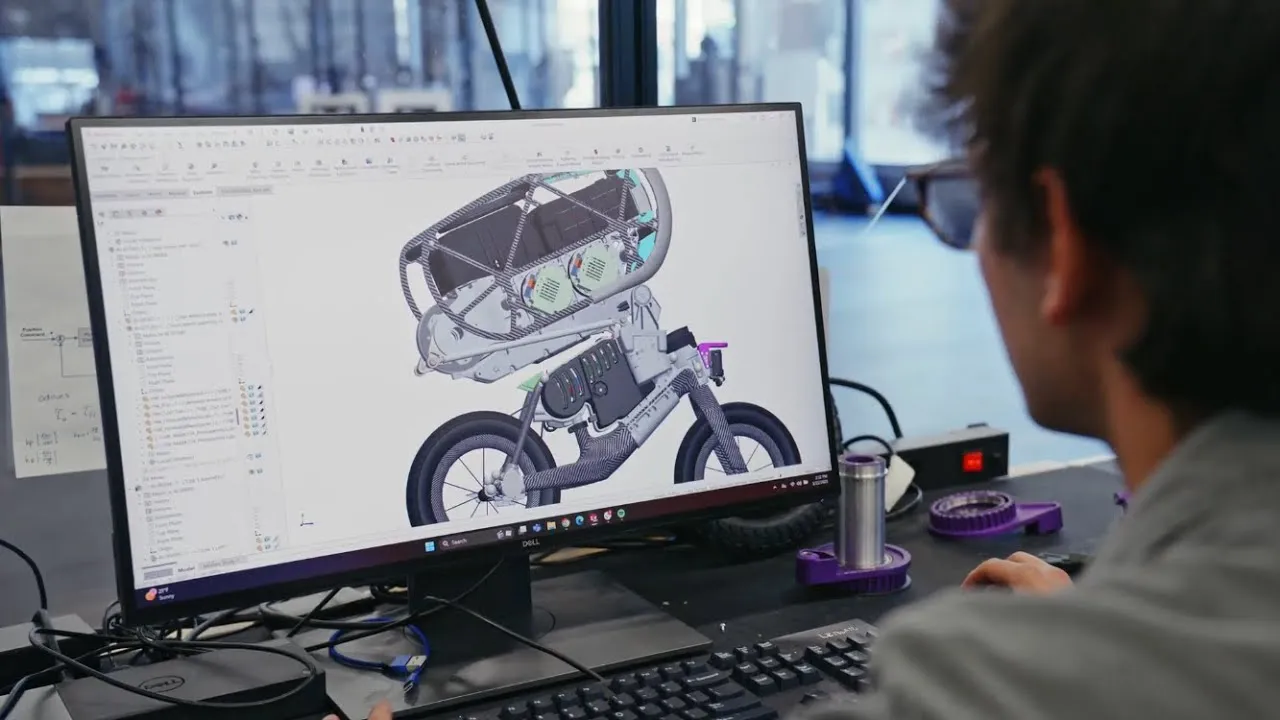
Researchers have developed a bicycle-inspired robot capable of performing acrobatic maneuvers while maintaining balance at high speeds.
The Ultra Mobility Vehicle (UMV) uses a moving reaction mass to control its stability and execute complex movements.
The robot can perform jumps, wheelies, flips, and other maneuvers inspired by mountain biking and trials cycling.
The researchers trained the machine using reinforcement learning, enabling it to navigate obstacles and perform dynamic movements.
Robot bicycle jumps
Researchers at the Robotics and AI Institute (RAI Institute) have developed the Ultra Mobility Vehicle (UMV), a bicycle-based robot designed to combine fast wheeled movement with the agility of legged machines.
The 51-pound (23.5-kilogram) robot can drive at speeds of up to 8 meters per second (18 mph), balance on its rear wheel, hop sideways, perform wheelies, and execute front flips. Its design uses a movable reaction mass and reinforcement learning to achieve these maneuvers with just five actuated degrees of freedom (DoF), reducing mechanical complexity compared with conventional legged robots.
The UMV consists of three main structural components: a head, a neck, and a bicycle frame. Unlike conventional bicycles, its head houses most of the robot’s mass, including its computing hardware, batteries, and powerful jumping actuators. A spatial linkage connecting the head to the bicycle frame allows the robot to shift its mass and change its orientation during movement.
The linkage consists of the neck and two tie rods, which work together to control the head’s position relative to the bicycle. Two actuators drive the primary movement, while another pair works through the tie rods to enable lateral motion. These mechanisms help the robot generate the forces needed for jumping and maintain balance when operating on a single wheel.
Two additional actuators control steering and rear-wheel drive, enabling conventional bicycle-like movement. The complete system uses five actuated degrees of freedom, allowing it to perform a range of dynamic maneuvers without reaction wheels, kickstands, or other dedicated static stabilization mechanisms.
AI-powered robot acrobatics
The researchers used reinforcement learning (RL) to train the UMV to perform different movements in simulation before transferring the learned control policies to the physical robot. The training process used NVIDIA Isaac Laboratory and the Proximal Policy Optimization algorithm.
During training, the simulation varied parameters such as mass distribution, friction, motor strength, control delays, and sensor noise. This domain randomization was intended to help the learned policies handle differences between simulated and real-world conditions.
The researchers developed four main control policies for driving, wheelies and hopping, flipping, and jumping. The policies control the robot’s joint movements through lower-level proportional-derivative controllers. The resulting behaviors transferred from simulation to hardware without additional training.
The robot can maintain balance while moving forward or backward, turn in place around its rear wheel, and perform track stands with minimal movement. During rear-wheel hopping, it can move laterally in different directions, overcoming the directional limitations of conventional wheeled platforms.
In one experiment, the UMV autonomously approached a 1-meter-high platform, jumped onto it, drove across the surface, and jumped down. It repeated the sequence 15 times, demonstrating consistent jump trajectories during ascent.
The robot also performed front flips by jumping and drawing its body into a tighter configuration. This movement reduces its rotational inertia, allowing it to spin faster. During the maneuver, its pitch angular velocity reached approximately 17 radians per second, and the robot completed the rotation and landed in less than half a second.
The researchers tested the system in a laboratory using motion-capture equipment to improve state estimation. Future development will focus on more robust hardware, improved batteries and motor drivers, and onboard sensing that reduces reliance on external motion-capture systems. The team sees potential applications in urban delivery and long-distance reconnaissance across rough terrain, where speed, maneuverability, and obstacle clearance are important.
Related articles

The AI race is back on
Last week, Anthropic and OpenAI looked like they had the AI race to themselves, pulling ahead with increasingly powerful models that left their rivals in the dust.
New 360-degree air defense radar with detection range exceeding 205 miles can transform warfare
Leonardo DRS has launched its new cxMHR radar and begun initial production of the system,...

Save up to 20 percent on gift cards for REI, Barnes & Noble, and more
While we cover a lot of deals on specific products, it’s rare that we find worthwhile savings on gift cards that let you save on essentially anything the store sells.

YouTube sticks new labels on AI-generated songs
YouTube is adding a "Made with AI" label to tracks that were "altered or fully generated" using AI, with a similar approach to its existing process for applying AI labels to videos.

As a TV enthusiast, I was hoping for more from the Apple TV 4K
It's been four long years since the last Apple TV 4K was released, and in that time there have been lots of hopes and dreams for features in whatever comes next.

Now that Character.AI is going bankrupt, what happens to all of its users’ data?
New York Attorney General Letitia James revealed a years-long multi-state investigation against Character.