
Scientists develop novel route to produce nanoporous ceramic materials at just 1,472 °F
A team of Japanese researchers has obtained Silicon Carbide (SiC) crystals at approximately 1,472 °F,...
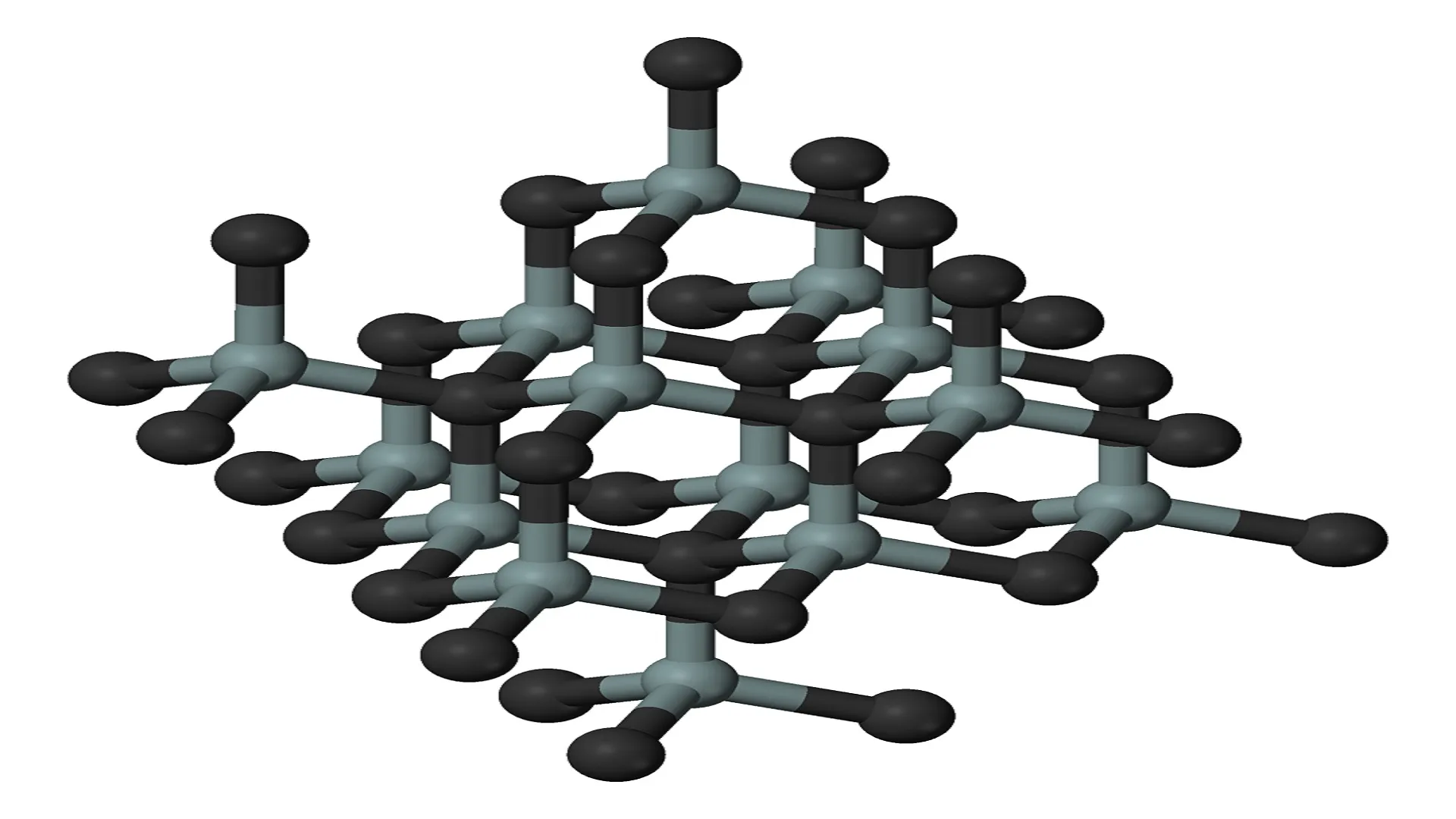
A team of Japanese researchers has obtained Silicon Carbide (SiC) crystals at approximately 1,472 °F, two-fold less than the temperatures at which commercial production begins.
Typically, in an industrial setup, the purest form of SiC is obtained at temperatures reaching 4,500 °F. However, at such high processing temperatures, formation and control of its porous structure at the nanometer scale becomes a challenge.
Scientists at the Institute for Materials Research (IMR) at Tohoku University circumvented the problem.
Low temp LMD forms SiC crystals
Using the age-old technique of liquid metal dealloying (LMD) under milder thermal conditions (1,472 °F), they generated SiC nanomaterial crystals with a distinct porous architecture.
In LMD, a solid precursor is dipped into multiple molten metals for selectively remove a specific element.
”LMD is a method that has been previously applied mainly to metals, intermetallic compounds, and semimetals, but our research expands the scope to strongly covalently bonded ceramics,” said Hidemi Kato, professor at the Institute for Materials Research, Tohoku University.
Researchers took molten bismuth and immersed Mn5SiC, a layered solid precursor, into this liquid bath. They discovered that Manganese melted away and got mixed with the molten metal, while the Solid SiC precursor rearranged to form crystalline β-SiC.
3-D nanoscale plates
The newly formed structure comprises nanoscale plates that were interconnected in the three-dimensional space.
The findings were recently published in Scripta Materialia, showing that first-principles energy calculations confirmed the stability of the framework obtained by this innovative technique.
Scientists proposed that the layered crystal structure of the precursor may have influenced the formation of the nanoplate architecture. However, they cautioned that further studies would be needed to ascertain the role of precursor structure in the growth and crystallographic orientation of the nanoplates.
Expressing hope from the modified LMD method, Kato in a statement said, “We think this approach could provide an exciting new strategy for designing nanoporous ceramics.”
The method adopted by Japanese researchers is likely to benefit the silicon carbide industry in the USA, which was valued at $1.80 billion in 2025, projected to reach $1.93 billion in 2026, according to a report published last year.
Much like a heavy-duty electric truck, it can handle much higher voltages, temperatures, and power with less energy loss and is one of the most critical semiconductor materials that powers modern electronics.
From powering AI data centers to improving electric-vehicle battery efficiency, Silicon carbide is a widely adopted material.
In an earlier study, scientists made significant progress in exploring ways of substantially enhancing the design of silicon carbide power devices that are slated for use in electric vehicles, trains, and many other vehicles.
With the expanding use of silicon carbide, including in robotics, defense, electric vehicles, solar power plants, renewable energy, and battery storage systems, experts have estimated its market to grow at an approximate 7.1% Compound Annual Growth Rate (CAGR) and reach up to $3.83 billion over the next decade.
Source: https://interestingengineering.com/innovation/scientists-produce-nanoporous-ceramic
Related articles
NASA battery survives -274°F extreme cold, could power future lunar rovers and tools
NASA has tested a solid-state battery that survived temperatures as low as minus 274 degrees...

Microsoft has a new machine learning tool to improve weather forecasts
Old-school physics-based weather forecasting and even new AI models typically become less reliable beyond two weeks, a problem Microsoft claims to have solved using machine learning.
US student builds smart X-ray tool that cuts 44-hour particle analysis to 10 hours
A student in the US has come up with a new automated X-ray tool that...

Ukraine claims Starlink is suddenly disrupting service for its military
Ukrainian officials claim the Elon Musk-owned Starlink put new limits on its service in the area without warning, disrupting the country's drone operations and missions, according to reports from…
Cold-proof alloys: Scientists find new class of metal that resist cracking at minus 423°F
A pair of experimental alloys has stayed tough at 20 kelvin, or minus 423 degrees...
X-ray imaging detects pores as small as 80 nanometers in nuclear fuel cladding
Researchers at Switzerland’s Paul Scherrer Institute (PSI) used a new X-ray imaging technique to examine...