
One camera, 500 commands a second: Racing drone hits 62 mph and outflies human champions
A racing drone that sees the world through a single camera has beaten three former...
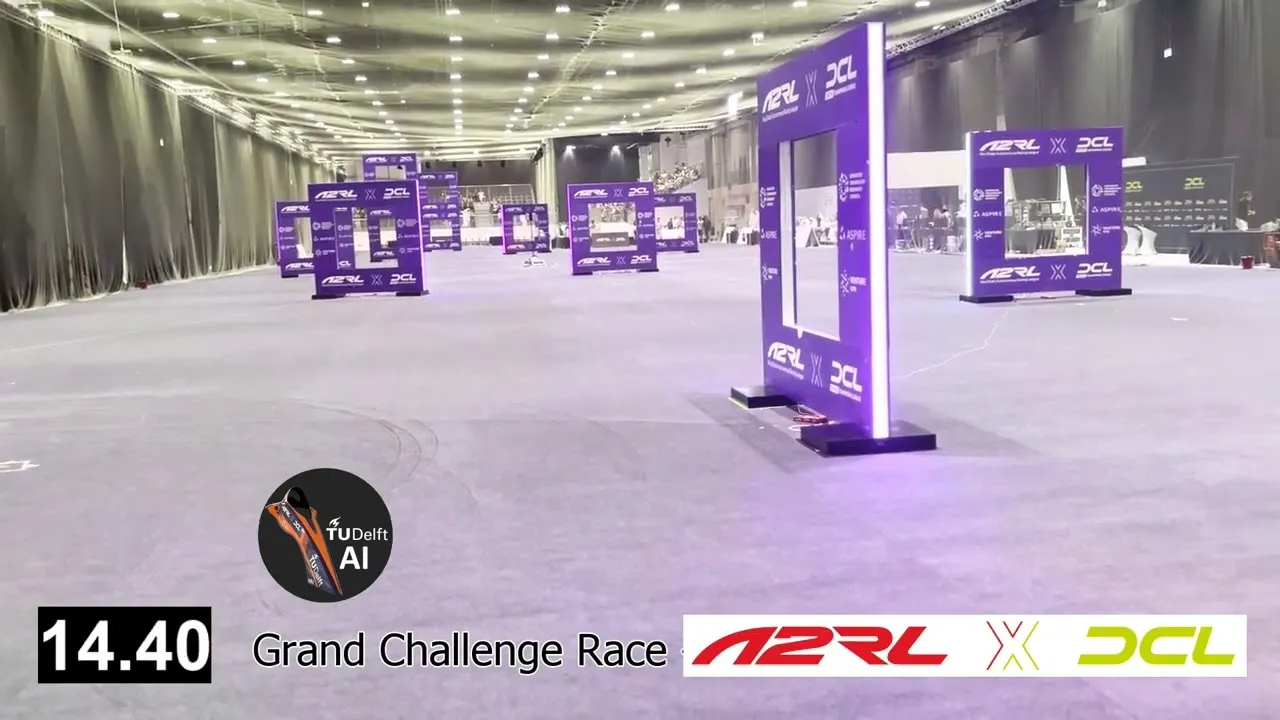
A racing drone that sees the world through a single camera has beaten three former human world champions and every other autonomous team in an international competition, reaching about 62 mph (100 kilometers per hour), researchers at Delft University of Technology report.
The system, called MonoRace, was developed at the MAVLab in TU Delft’s Faculty of Aerospace Engineering. Earlier leading autonomous racing systems relied on more sensors. MonoRace uses one forward-facing camera and an inertial measurement unit, or IMU, for perception, navigation and control.
How it sees the track
At racing speed, the drone has almost no time to interpret images that are blurry and distorted. A neural network picks out the racing gates in each frame, while the IMU and a model of the drone’s dynamics estimate its position and motion. No GPS or external motion tracking is involved. The software also had to cope with real-flight glitches such as camera interference and sensor saturation.
“We developed a robust way of combining what the camera sees with the drone’s own motion information,” said Stavrow Bahnam, the study’s main author, which lets it navigate without GPS.
A single network at the controls
Instead of a conventional control stack with several layers of intermediate controllers, MonoRace uses a small neural network that generates motor commands directly. It runs on a tiny onboard chip, the flight controller, issuing commands 500 times per second. The researchers trained it through reinforcement learning, which let it learn to control the drone while accounting for its physical limits.
Author Robin Ferede said skipping the step of planning a flight path first lets the controller react extremely quickly and exploit the drone’s capabilities, while staying small enough to run onboard.
Proving it on someone else’s track
The team tested MonoRace at the 2025 Abu Dhabi Autonomous Drone Racing Competition. The organizers designed and operated both the drone and the racing environment, so the researchers controlled neither the hardware nor the track. Even so, the TU Delft drone reached up to 100 kilometers per hour and defeated all other autonomous teams along with three former world champion human pilots.
Christophe De Wagter said the goal was not to give the robot stronger sensors and computers but to see how much intelligence could be drawn from limited resources. Racing, he said, forced the AI to be fast, robust and able to adapt when external reference measurements were unavailable.
Beyond the racecourse
Guido de Croon, a professor at TU Delft, said racing is a way of pushing robotic AI to its limits. Here the team optimized for speed, but he said the same approach could prioritize efficiency or safety, such as smooth, energy-optimal control for machines ranging from small vacuum cleaning robots to huge ship-to-shore cranes.
The researchers believe the principles could help many autonomous systems, including vehicles, mobile robots and future aerial and humanoid machines, make fast, reliable decisions with limited onboard computing.
The research was first published in the Science Robotics.
Related articles

The AI race is back on
Last week, Anthropic and OpenAI looked like they had the AI race to themselves, pulling ahead with increasingly powerful models that left their rivals in the dust.
New 360-degree air defense radar with detection range exceeding 205 miles can transform warfare
Leonardo DRS has launched its new cxMHR radar and begun initial production of the system,...

Save up to 20 percent on gift cards for REI, Barnes & Noble, and more
While we cover a lot of deals on specific products, it’s rare that we find worthwhile savings on gift cards that let you save on essentially anything the store sells.

YouTube sticks new labels on AI-generated songs
YouTube is adding a "Made with AI" label to tracks that were "altered or fully generated" using AI, with a similar approach to its existing process for applying AI labels to videos.

As a TV enthusiast, I was hoping for more from the Apple TV 4K
It's been four long years since the last Apple TV 4K was released, and in that time there have been lots of hopes and dreams for features in whatever comes next.

Now that Character.AI is going bankrupt, what happens to all of its users’ data?
New York Attorney General Letitia James revealed a years-long multi-state investigation against Character.