Ranked: The World’s 10 Tallest Mountain Ranges
From the Himalayas to the Saint Elias Mountains, discover the world's 10 tallest mountain ranges ranked by the average height of their three highest peaks, and why Asia dominates the list.
Which Mountain Ranges Are the Tallest in the World?
Key Takeaways
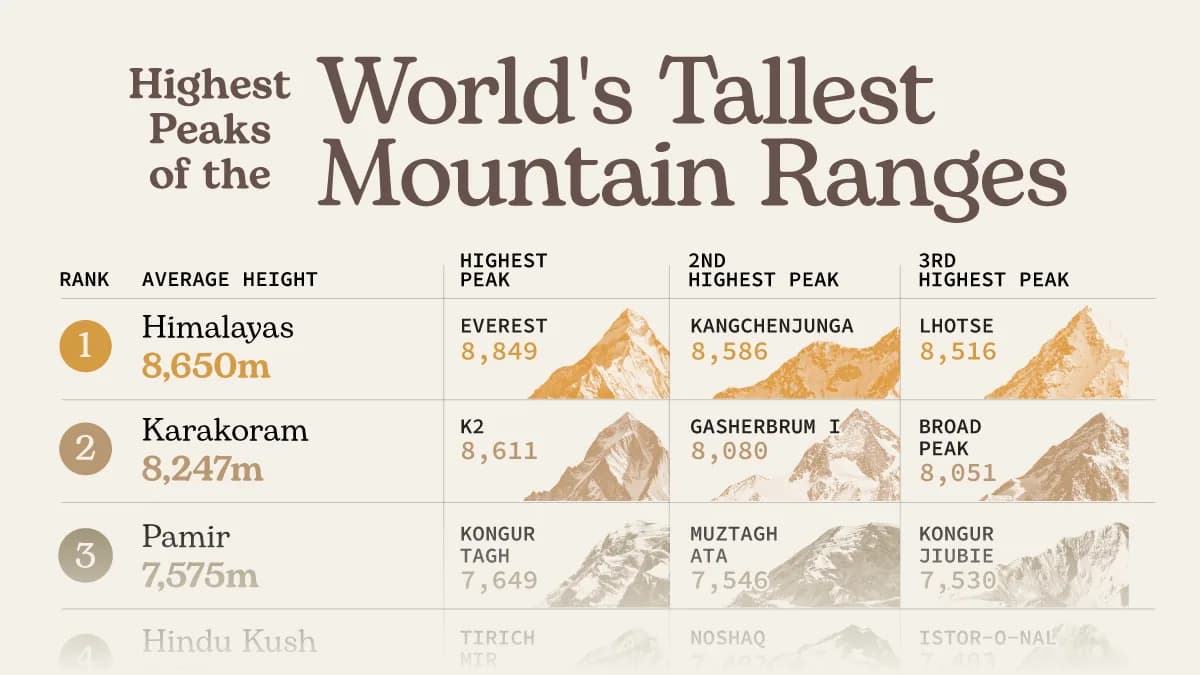
The Himalayas rank first, with their three highest peaks averaging 8,650 meters (28,300 ft) above sea level.
The Karakoram ranks second at 8,247 meters (27,057 ft), followed by the Pamir and Hindu Kush ranges.
Eight of the world’s 10 tallest mountain ranges surround the Tibetan Plateau.
The world’s highest mountains are concentrated in a handful of ranges, home to legendary summits like Mount Everest and K2. But which mountain ranges stand tallest when measured by more than just their highest peak?
This visualization ranks the world’s 10 tallest mountain ranges by the average elevation of their three highest summits, offering a broader comparison of the planet’s most extreme mountain systems.
The data comes from WorldAtlas and Wikipedia.
The Himalayas and Karakoram Dominate the Rankings
The Himalayas claim three of the world’s highest summits: Mount Everest (8,849 meters), Kangchenjunga (8,586 meters), and Lhotse (8,516 meters). All three exceed 8,500 meters (27,890 ft), a threshold that none of the other ranges in the ranking reaches with its third-highest peak.
Mount Everest’s fame and status as the world’s highest peak have made it a popular destination for climbers, contributing to a growing overcrowding problem, particularly during peak climbing season.
The table below ranks the world’s 10 tallest mountain ranges by the average height of their three highest peaks:
RankRangeAverage Height of the 3 Highest Peaks
MetersFeet
1Himalayas8,6508,650
2Karakoram8,2478,247
3Pamir7,5757,575
4Hindu Kush7,5347,534
5Tian Shan7,1637,163
6Nyenchen Tanglha7,1087,108
7Hengduan7,0287,028
8Kunlun7,0257,025
9Andes6,8836,883
10Saint Elias Mountains5,5635,563
The neighboring Karakoram range ranks second, led by K2 at 8,611 meters (28,251 ft).
Although Everest stands 238 meters higher, K2 is widely considered more dangerous and technically challenging to climb due to its steep terrain, rockfall and avalanche risks, and harsh, unpredictable weather.
The Pamir and Hindu Kush ranges follow in third and fourth place, with their three highest summits averaging 7,575 and 7,534 meters, respectively.
Interestingly, Tirich Mir, the Hindu Kush’s highest peak at 7,708 meters (25,289 ft), is taller than the Pamir’s Kongur Tagh (7,649 meters), despite the Pamir ranking higher overall.
Why Are So Many of the Tallest Ranges in Asia?
The concentration of extreme mountain elevations across Asia is largely the result of the Indian tectonic plate colliding with the Eurasian plate, a process that began tens of millions of years ago and continues to raise parts of the region today.
This ongoing geological activity has helped create the Himalayas and surrounding high-altitude mountain systems, making the Tibetan Plateau one of the world’s most remarkable regions for mountain building.
The table below shows the heights of the three highest peaks in each of the 10 tallest mountain ranges:
PeakRangeHeight (M)
EverestHimalayas8,849
KangchenjungaHimalayas8,586
LhotseHimalayas8,516
K2Karakoram8,611
Gasherbrum IKarakoram8,080
Broad PeakKarakoram8,051
Kongur TaghPamir7,649
Muztagh AtaPamir7,546
Kongur JiubiePamir7,530
Tirich MirHindu Kush7,708
NoshaqHindu Kush7,492
Istor-o-NalHindu Kush7,403
Jengish ChokusuTian Shan7,439
PshavellaTian Shan7,041
Khan TengriTian Shan7,010
Nyenchen Tanglha INyenchen Tanglha7,162
Nyenchen Tanglha IINyenchen Tanglha7,117
Nyenchen Tanglha IIINyenchen Tanglha7,046
Minya KonkaHengduan7,556
Zhong Shan FengHengduan6,904
Tai ShanHengduan6,626
Kunlun Goddess PeakKunlun7,167
Ulugh MuztaghKunlun6,973
Liushi Shan IIKunlun6,936
AconcaguaAndes6,961
Ojos del SaladoAndes6,893
Monte PissisAndes6,795
Mount LoganSaint Elias Mountains5,959
Mount Saint EliasSaint Elias Mountains5,489
Mount LucaniaSaint Elias Mountains5,240
Beyond the top four, the Tian Shan, Nyenchen Tanglha, Hengduan, and Kunlun ranges all have average top-three summit elevations exceeding 7,000 meters.
The gap between the Hengduan and Kunlun ranges is particularly narrow, with their three highest peaks averaging 7,028 meters and 7,025 meters, respectively, a difference of just three meters.
The Tallest Mountain Ranges Outside Asia
Outside Asia, South America’s Andes rank ninth globally, with their three highest summits averaging 6,883 meters.
The Andes are led by Aconcagua (6,961 meters), followed by Ojos del Salado (6,893 meters) and Monte Pissis (6,795 meters). Aconcagua is also the highest mountain outside Asia and the tallest peak in South America.
Rounding out the top 10 are the Saint Elias Mountains, spanning Alaska and northwestern Canada, where the three highest peaks average 5,563 meters.
The range is led by Mount Logan (5,959 meters), Canada’s highest mountain, followed by Mount Saint Elias (5,489 meters) and Mount Lucania (5,240 meters).
The contrast with Asia is striking: the Saint Elias Mountains’ three highest peaks average more than 3,000 meters below those of the Himalayas. Even so, the range is home to some of North America’s most formidable summits.
Learn More on the Voronoi App
For more mountain-related data, check out Fourteeners (Highest Mountains) of the US on Voronoi, a visual overview of the 97 mountains in the U.S. that exceed 14,000 feet (4,267 meters).
Get the latest news delivered to your inbox.
Related articles