
Scientists use far ultraviolet LEDs to transmit data at a record 1.5 Gbps
A collaboration of researchers from the Ferdinand-Braun-Institut (FBH) in Berlin and the Universities of Strathclyde...
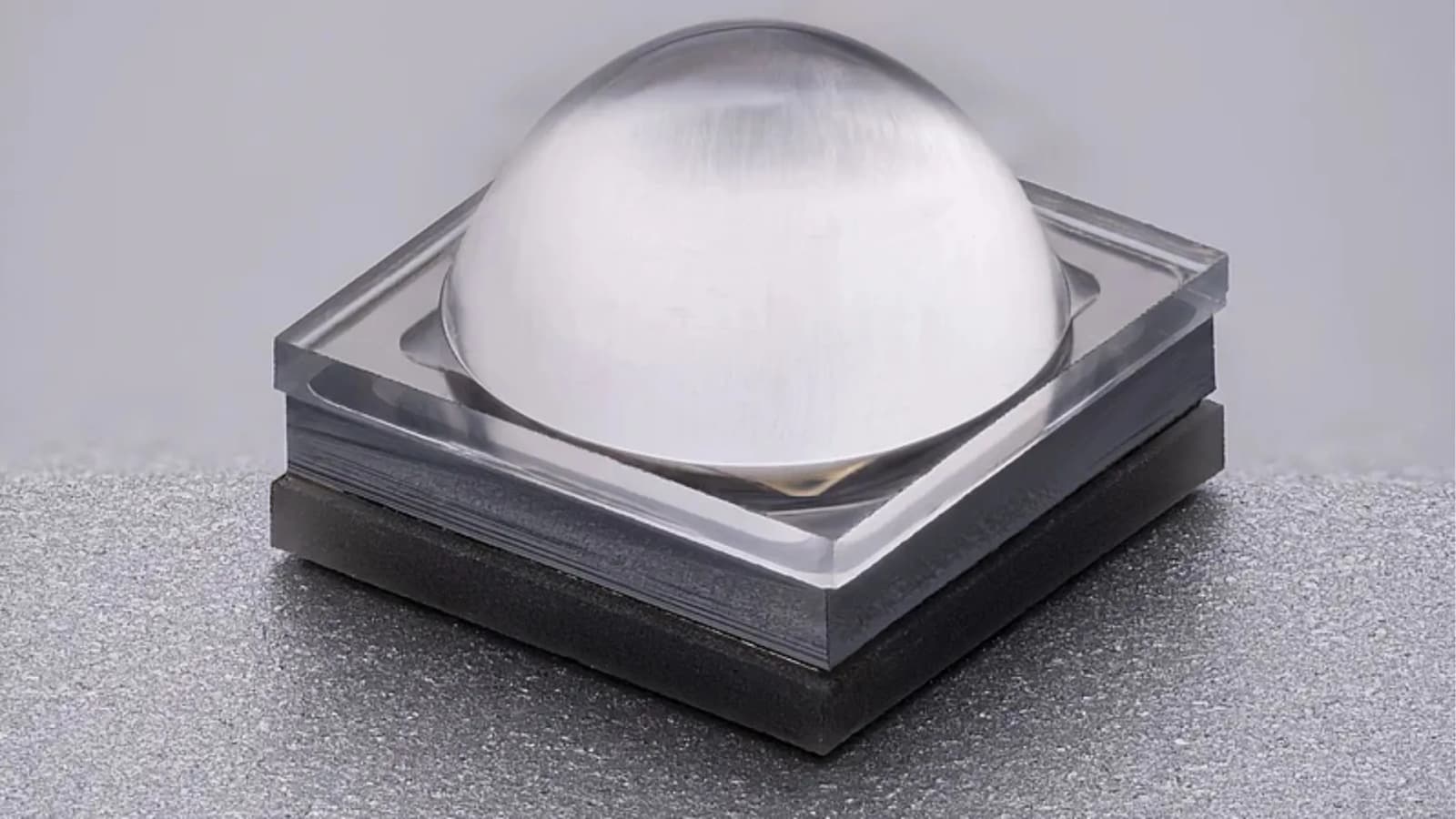
A collaboration of researchers from the Ferdinand-Braun-Institut (FBH) in Berlin and the Universities of Strathclyde and Cambridge in the UK have achieved a data transfer record using far-ultraviolet LEDs. The researchers clocked up 1.5 gigabits per second using their novel LEDs, a record for wireless optical communication below a wavelength of 235 nanometers (nm).
The surge of connected devices around us, from smartwatches to smart cars, has created a shortage of available frequencies that we can operate in. If civilian use of wireless technologies is exploding, military applications are also rising, and everything from drones to armored vehicles is now part of the larger set of attack units.
To overcome this, scientists are exploring optical wireless communication options that can complement radio frequencies. The hurdle with optical signals, though, is that sunlight contains radiation in these wavelengths, which can interfere with optical signals and make transmission unreliable and difficult. Ultraviolet C (UVC), though, offers a way out.
Avoiding solar interference
At wavelengths below 280 nm, solar radiation does not reach Earth’s surface since the upper layers of the Earth absorb them. UVC, whose wavelength spans between 100-280 nm, thus, becomes the ideal mode for optical wireless communication.
Researchers developed LEDs that emit UVC at wavelengths below 235 nm, which is also absorbed by the outer, non-living layers of the skin. This radiation does not penetrate the living tissue like longer-wavelength UV radiation. Scientists consider this UVC light safe for human health and can therefore use it for communication in devices that are in close proximity to humans as well.
The researchers also optimized their LEDs for optical communication in this wavelength range. The optimization helps them deliver high optical power and is suitable for data exchange indoors as well as outdoors. Further, the team also reduced the emitting surface into small areas to reduce junction capacitance and increase current density to ensure that the LEDs had a higher modulation bandwidth.
Optical communication system
Teams at Strathclyde and Cambridge built a direct line-of-sight optical wireless communication system as part of the UK’s TITAN, telecommunications research hub led by the University of Cambridge.
As the name suggests, in a line-of-sight communication system, the transmitter and receiver are placed in close proximity to each other. In this experiment, the two were placed only 12 inches (30 cm) away from each other in ambient room lighting conditions. The researchers were able to attain data transfer speeds of 1.5 Gbps, which is a record for short wavelengths.
Another advantage of short wavelengths is Rayleigh scattering which becomes stronger at these wavelengths. This scattering of light and even electromagnetic radiation by particles that are smaller than the wavelength of the radiation opens up the possibility of signals reaching the receiver, even when the transmitter is not in line-of-sight.
The researchers plan to use this feature to develop non-line-of-sight communication approaches with their far UVC LEDs.
“Reaching a data rate relevant to practical applications is an important first step,” said Jan Ruschel, senior scientist at FBH who was involved in the work. “Now we want to determine the distances and environmental conditions under which far-UVC communication can actually be used—especially without a direct line of sight.”
The research findings were published in the journal IEEE Explore.
Source: https://interestingengineering.com/science/far-ultraviolet-leds-transmit-data-record-speed
Related articles

US scientists develop catalyst to turn woody biomass into jet fuel components
A Rowan University research team is investigating how woody biomass could replace petroleum-derived components in...
US scientists create soft porous material that guides lithium ions for better batteries
An interdepartmental research team at Rice University in the U.S. has developed a soft porous,...

Arctic secrets revealed: Seven-year hydrophone record exposes what lurks beneath the ice
A hydrophone sitting half a kilometer beneath the Beaufort Sea has spent seven years listening...
Quantum battery: Scientists use charging to balance power, stable energy delivery
A collaboration of researchers from various parts of the world has identified the fundamental limits...

High-speed water droplets could damage supersonic vehicles, study reveals
A team of Boston University (BU) researchers led by Associate Professor Sheryl Grace is studying...

US scientists find solid battery material moves lithium ions rapidly above 260°F
A promising solid battery material lets lithium ions move rapidly when heated above 260°F (400...