
US humanoid robot gets four-finger hand with 13 degrees of freedom for tough tasks
Humanoid robots are increasingly being designed to work in environments built for people, but copying...
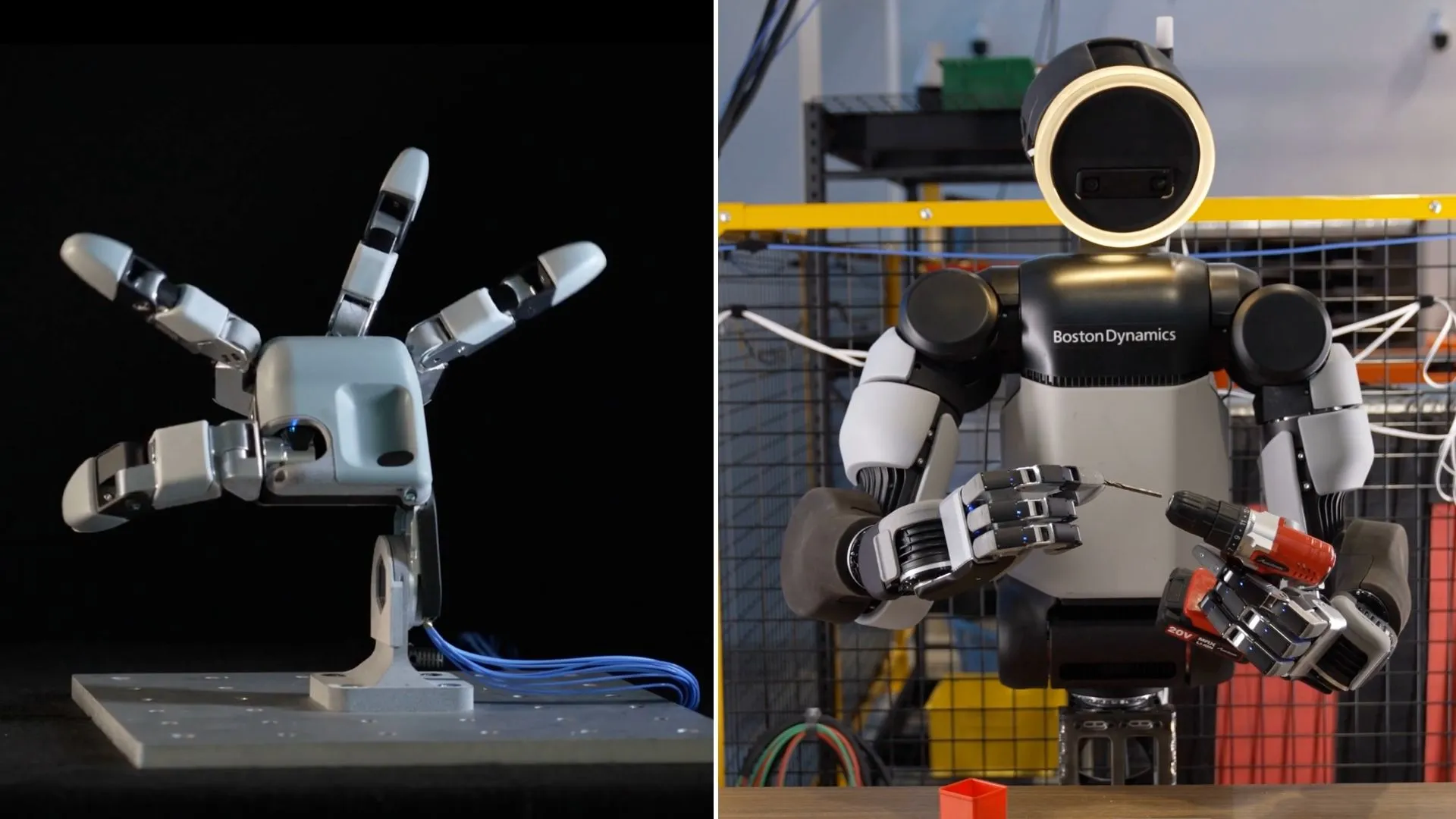
Humanoid robots are increasingly being designed to work in environments built for people, but copying the human body does not necessarily mean copying every part of it. Boston Dynamics is taking that approach with its latest Atlas hand, which uses four fingers and 13 degrees of freedom (DOF) rather than attempting to reproduce a conventional five-fingered human hand.
The company said the new hand was designed around a difficult combination of requirements: dexterity, strength, durability, sensing, manufacturability, and the ability to train robotic behaviors in simulation. The result is a hand intended not merely to grasp objects, but to manipulate them, recover from slips, and operate tools.
A four-finger hand with 13 degrees of freedom
The new hand increases Atlas’ articulation from the previous seven-DOF design to 13 DOFs. It uses four fingers, including a more capable opposable thumb, with three DOFs on each of the other fingers and four on the thumb. The company said the configuration allows the fingers to splay and provides greater control over their individual fingertips.
The joints use direct actuation and a single actuator type, and the actuators are encapsulated rather than relying on cables that cross the joints. The hand is roughly the size of a large human hand, an important constraint because Atlas is intended to work with human-scale tools and equipment.
Boston Dynamics also said the hand retains enough strength for demanding physical work. The company reported that it can carry a loaded mini-fridge weighing more than 100 pounds, matching the broader Atlas platform’s focus on industrial material handling. The production Atlas itself is rated for an instantaneous payload of 110 pounds and a sustained payload of 66 pounds.
Why Atlas does not have a pinky
The missing fifth finger is one of the more unusual aspects of the design. Boston Dynamics pointed out that adding a pinky would have been relatively straightforward, but the team tested whether it was actually necessary for the tasks the robot is expected to perform.
The company concluded that four fingers could already provide in-hand object reorientation, recovery from slipping grasps and the ability to manipulate tools while pressing their triggers. Adding another finger would also require three additional actuators, increasing the hand’s cost, size and number of potential failure points.
That tradeoff is particularly important for an industrial robot expected to operate repeatedly rather than simply demonstrate dexterity in a laboratory.
Designed around simulation as well as hardware
The new hand is also being developed with AI training in mind. Its mechanical design was optimized for high-fidelity simulation and sim-to-real reinforcement learning, allowing control policies trained in simulation to be transferred to physical hardware.
The hand uses backdrivable transmissions, meaning external forces can move the joints rather than being resisted by a rigid, high-friction mechanism. This allows Atlas to use proprioception, the ability to sense the position and motion of its own joints as part of its control system.
The hand also includes dense pressure-sensitive tactile sensors covering the fingertips and palm. These sensors complement proprioception by providing information about contact with objects.
The robotics firm said the combination of backdrivable hardware and controls designed to compensate for effects such as friction and motor cogging allows the hand to be modeled with high dynamic fidelity. Reinforcement-learning systems can then be exposed in simulation to variations in motor behavior, surface friction, object geometry, and disturbances before the resulting policies are tested on the physical robot.
Built for tools, not just gripping
The distinction between grasping and manipulation is central to the design. A conventional industrial gripper can be highly effective when objects, orientations, and the working environment are tightly controlled. A humanoid robot, however, is intended to work with a much wider variety of objects and workspaces.
The company noted that the new hand can perform several dexterous behaviors, including pinch grasps between the thumb and individual fingers, tripod grasps and controlled movements of the thumb across the other fingers. It is also designed to handle tools such as drills, grinders, nail guns, torque drivers and welding torches.
That capability could matter as humanoid robots move beyond simple material handling. Atlas is already being developed for industrial environments, with Boston Dynamics and Hyundai training the robot at a dedicated facility in Georgia on manufacturing and logistics tasks.
The new hand does not attempt to reproduce every capability of a human hand. Instead, it is betting that a simpler, strong, and highly controllable design can provide enough dexterity to perform useful physical work while remaining suitable for simulation, maintenance, and eventual large-scale manufacturing.
Related articles

New center bids to supercharge nuclear isotope production for deep-space missions
Canada is moving to expand its role in supplying nuclear isotopes that could power spacecraft...
Schneider tests quantum chip that improves home energy forecasting by up to 41%
Australian government-backed Silicon Quantum Computing (SQC), whose investors include telecom giant Telstra and Commonwealth Bank,...
Digital twin tech from US, Korea could predict toxic ammonia leaks on new ships
The US, South Korea and Germany have recently joined forces in order to develop a...
Mapped: The World’s Digital Leaders in 2026
Which economies are the most digitally connected? See how 159 economies rank in the ITU’s 2026 ICT Development Index.

Breaking up (with Elon Musk) is hard to do
In a throwback to MySpace-style internet drama, Shivon Zilis announced that she and the father of four of her children, Elon Musk, had broken up on X.

OpenAI’s Dot agent is enterprise software that can also order your dinner
It's a tale as old as last week: OpenAI's new agent platform, called Dots, is full of cute little guys who can do your bidding.