
Thread-thin FiberMotor slides like telescope to power soft robots and wearables
Engineers at EPFL in Switzerland have built a flexible motor that looks like a thread...
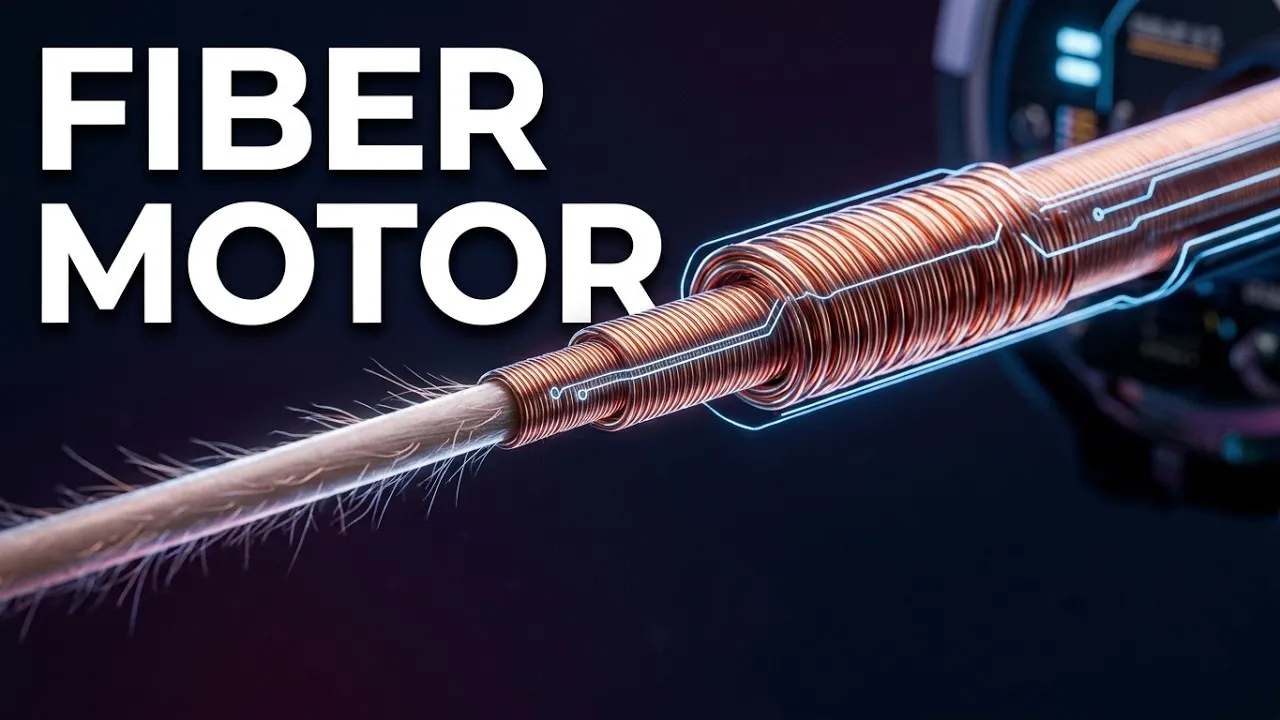
Engineers at EPFL in Switzerland have built a flexible motor that looks like a thread and produces enough force to drive soft robotic systems while remaining silent and bidirectional.
Called FiberMotor, the device measures 0.04 to 0.12 inches (1 to 3 millimeters) in diameter and converts electrical energy directly into motion. The study, “Fiber-Format Flexible Linear Electrostatic Motors,” was published in Advanced Materials.
A telescope made of fibers
FiberMotor is built from two concentric hollow fibers. Insulated copper-wire electrodes, only slightly thicker than a human hair, are tightly coiled around each fiber.
When voltage is applied, electrostatic forces repeatedly pull the fibers into alignment. That makes the inner fiber slide within the outer one, much like a telescope.
“Our FiberMotor is the first fiber-format, sliding motor,” said Herbert Shea, head of EPFL’s Soft Transducers Laboratory. “It produces enough force to actuate devices for soft robotic applications, while remaining silent, flexible, and bidirectional.”
Linear motion without bulk
Everyday movements like lifting, pushing and pulling rely on linear rather than rotational motion. Reproducing it has been a longstanding challenge in wearable robotics, the researchers said, because motors powerful enough to drive linear movements often need rigid gears, transmissions and other bulky parts.
So-called artificial muscles exist, but their range of motion is limited by how far their materials can stretch, contract or bend. FiberMotor’s movement range, by contrast, is limited only by the length of its fibers.
Without gears or transmissions , the device is also backdriveable, meaning an opposing force can safely move it. If a wearer moves unexpectedly or against the direction of drive, the fibers simply slide past each other rather than locking up. That lets it work more naturally with human movement than conventional motors.
Strength in numbers
In laboratory demonstrations, a single FiberMotor supported a stationary load equivalent to roughly 75 grams (2.6 ounces). Four motors bundled together generated enough force to lift a 46-gram (1.6-ounce) chocolate bar and flex a tendon-driven robotic finger.
The team also integrated the motor into a prototype garment shaped to fit a knee. Because the motors are thin and lightweight, the researchers envision distributing them throughout a smart textile instead of concentrating force in a single rigid unit.
From textiles to a start-up
The work builds on the lab’s 2023 debut of what it called the world’s first pump in the form of a fiber, which can be sewn into smart textiles to circulate fluids for thermoregulation and haptic feedback.
Next, the researchers are working to improve FiberMotor’s performance and durability using even thinner electrodes made mostly of insulators, along with optimized materials. They also plan to integrate feedback data about a wearer’s position and movements so the motor can quickly adapt to the wearer’s intention.
Ultimately, the team aims to apply the combination of force and flexibility to wearable assistive devices such as soft exosuits for mobility, wearable haptic systems for virtual reality and lightweight prosthetics.
First author Sylvain Schaller has already founded a start-up, Elecsyor, to commercialize the technology. The research was funded by the Swiss National Science Foundation and the Novo Nordisk Foundation.
Related articles

Video: Feather star-inspired robot moves underwater with just two actuators
Researchers at North Carolina State University have developed a soft underwater robot inspired by feather...

After Navier-Stokes, OpenAI’s 377 math results leave experts demanding a voice
OpenAI has published more than 370 new mathematical results, stunning mathematicians and igniting a debate...
US backs $1.5B conditional loan for chips used in drones, radar, missile defense
The US Department of War has offered semiconductor manufacturer Wolfspeed up to $1.5 billion in...
World’s first fleet-capable drilling robot hits 10x speed with 99% accuracy
A drilling robot built for data center construction has already punched more than 385,000 holes...

US microreactor that reached criticality in 150 days set for full-power test in 2027
A US-developed nuclear battery that achieved its first controlled chain reaction in roughly 150 days...

Nous Research raises $90 million at $1.5 billion valuation to take its open-source Hermes agent to businesses
Nous Research, developer of the open-source Hermes Agent, has raised a $90 million Series B led by Robot Ventures and is launching Hermes for Businesses, letting companies deploy customized AI agents while keeping their data private.