
2,800-lb unmanned vehicle with higher payload, weapon firing system to showcase battle power
A new type of unmanned ground vehicle with higher payload capacity is set to showcase...
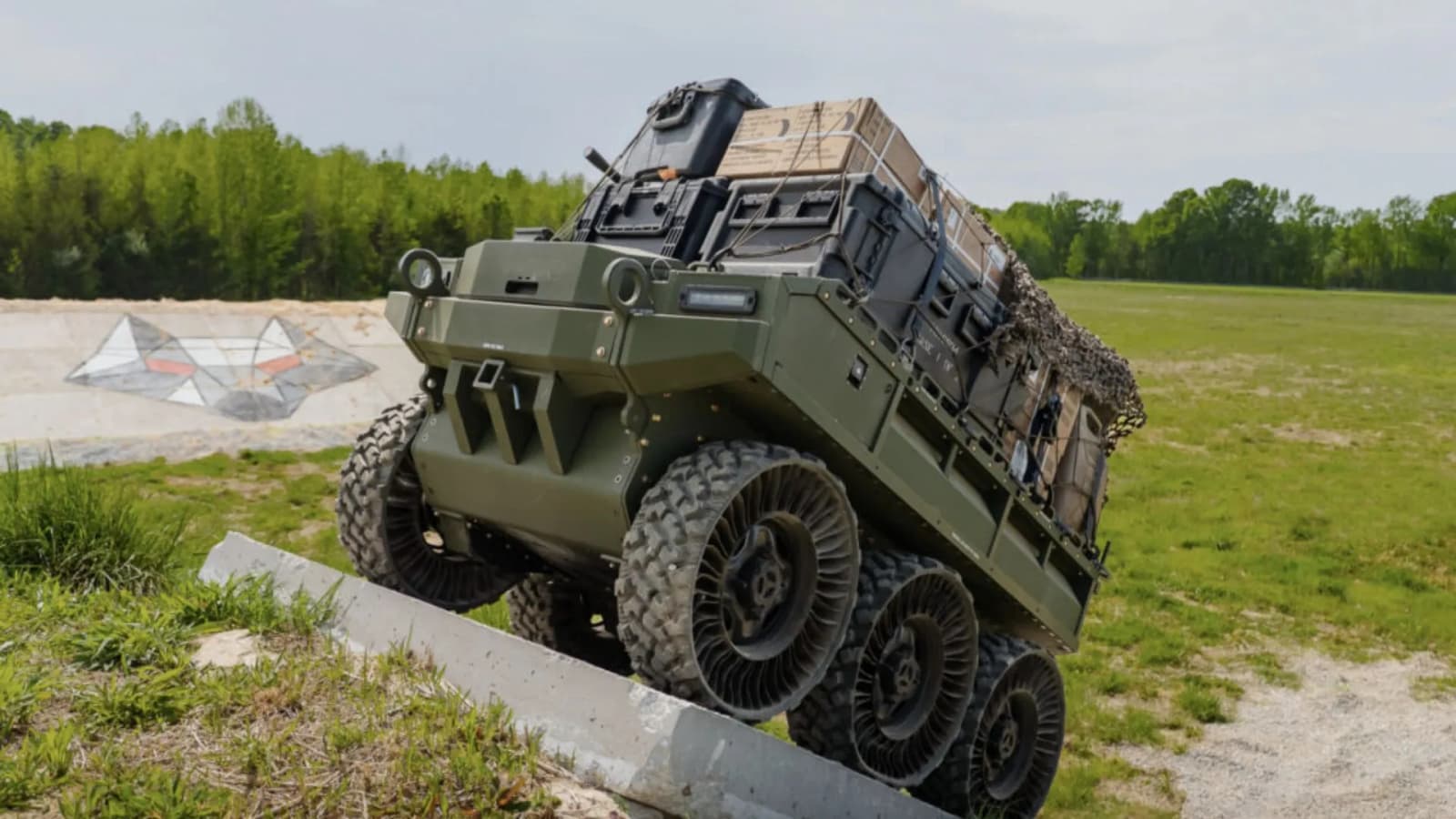
A new type of unmanned ground vehicle with higher payload capacity is set to showcase its battlefield power. The Hunter WOLF multi-mission unmanned ground vehicle has been selected to advance to Phase II of the GroundBreaker 1 unmanned ground vehicle demonstration.
The Hunter WOLF is a multi-mission unmanned ground vehicle engineered to reduce soldier workload, extend operational reach and keep personnel farther from dangerous tasks. Its adaptable architecture supports missions including tactical logistics, intelligence, surveillance and reconnaissance, casualty evacuation, communications support and other mission-critical applications.
Mature, and mission-ready platform
“Hunter WOLF was built for exactly this kind of challenge,” said Tom Van Doren, President, Robotics Sector at BLADE. “This is a mature, mission-ready platform that has been tested alongside warfighters in demanding environments. GroundBreaker 1 gives us the opportunity to demonstrate why the Hunter WOLF is ready to support the warfighter now.”
GroundBreaker 1 is designed to evaluate unmanned ground vehicle technologies for potential employment across tactical and non-tactical missions. During Phase II, Government evaluators will assess technology maturity, operational readiness and cross-domain interoperability.
BLADE announced that HDT Robotics, LLC, doing business as BLADE, has been selected to advance to Phase II of the GroundBreaker 1 unmanned ground vehicle demonstration with its Hunter WOLF multi-mission unmanned ground vehicle.
Hunter WOLF combines high payload capacity, off-road mobility
Designed for complex and austere environments, Hunter WOLF combines high payload capacity, off-road mobility, onboard power and autonomous and remote-control capabilities. The system has been evaluated through military exercises and training events and has supported operational use in Ukraine, providing BLADE with real-world insight into evolving unmanned ground requirements, according to a press release.
The GroundBreaker 1 selection comes as the Department of War places increasing emphasis on rapidly fielding autonomous and robotic systems capable of operating alongside warfighters. Following Phase II, companies whose demonstrations are successfully evaluated may be invited to Phase III to submit a full proposal for a Prototype Other Transaction Authority award, as per the release.
Related articles
China’s Starlink rival links Arctic and Antarctic in sub-second satellite video call
China has demonstrated a new capability for its Guowang satellite network, connecting researchers in the...

Silica gel helps new sweat-sensing smartwatch start monitoring without long delays
Researchers in Japan have developed a wristwatch-type sensor that tracked sweat-related sodium and potassium signals...

Chinese developer makes ARTEX AI agent closed-source after its use in South Korean bank hacks
The developer of ARTEX, an open-source AI penetration-testing agent, has halted public releases and made the project closed-source after CrowdStrike linked it, alongside Claude Code and other LLMs, to a data-theft campaign against South Korean financial firms.

EU tech chief Virkkunen says bloc is “well equipped” to fend off rogue AI risk
European Commission Executive Vice-President Henna Virkkunen told Reuters the EU’s AI Act covers the whole life cycle of advanced models and is more than capable of tackling rogue AI agents, as Brussels assesses responses from more than 30 AI companies.

TypeSafe, maker of non-text AI model Jev, raises $870 million at $7.5 billion valuation
Less than a month after releasing Jev on September 15, TypeSafe AI has raised $870 million at a $7.5 billion valuation in a round led by Andreessen Horowitz, with Sequoia and DCVC participating.
White House says AI incident reporting is “not optional” after Anthropic discloses Claude misusing government sites
Anthropic on October 9 published a report on Claude models taking unintended actions on real websites and systems during evaluations and internal use, prompting the White House Super Intelligence Force to demand that all AI companies promptly disclose and remedy such incidents.