
MI5 launches AI Threat Assessment Centre as spy chief flags AI-enabled bioweapons risk
MI5 Director General Sir Ken McCallum used his annual threat update to announce the AI Threat Assessment Centre (AITAC), bringing together UK expertise to assess AI national-security risks, and said he gives the greatest weight to AI's potential to change the stakes on bioweapons.

MI5 Director General Sir Ken McCallum announced on October 13, 2026 that Britain's domestic security service has launched the AI Threat Assessment Centre (AITAC), unveiling it during his annual threat update at Thames House in London.
What AITAC will do
According to MI5, the centre is housed within the service but draws together expertise from bodies including the UK's AI Security Institute (AISI), the National Crime Agency and the National Cyber Security Centre. It is producing all-source assessments that, in McCallum's words, "separate the bluster from the realities."
Politico reported that AITAC is the third centre of its kind at MI5, following similar units for terrorism and state threats. McCallum said the government, not AITAC, will decide how to respond to AI risks, but that the centre is meant to avoid "competitive analysis" and conflicting messages from different departments, giving officials "a single version of the truth."
Bioweapons and other risks
McCallum said the misuse case he weights most heavily is AI's potential to "change the stakes on existing or even new bioweapons," a threat he described as not yet realised, BBC News reported. He warned that "low-capability" terrorists could gain an uplift if safety guardrails in AI models fail.
He also said MI5 has caught terrorists seeking to use AI to improve reconnaissance and attack planning, with AI-enabled drones "adding a new twist," and that AI can produce propaganda and radicalising material tailored to individuals while "supercharging" the contest between cyber attackers and defenders.
Beyond misuse by human adversaries, McCallum pointed to risks posed by AI itself — the alignment problem. "Human history has given us no experience of facing an actor which is smarter than we are, is capable of outthinking us," he said.
Wider context
McCallum said MI5 is now devoting more resources to countering state threats than during the Cold War, and that national resilience — including protecting critical infrastructure, countering cognitive warfare and addressing technology threats — will receive "front-rank mission status" alongside counter-terrorism and countering state threats.
Sources: MI5, BBC News, Politico Europe.
Related articles

Mayhem 10 drones get upgraded to connect satellite, cellular and radio simultaneously
AeroVironment is preparing to strengthen communications on its Mayhem 10 autonomous military drone system with...

US optical chip gyroscope gets 2,000-fold sensitivity boost, detects slow rotation
Researchers at the University of California, Santa Barbara, and Caltech have developed a chip-scale optical...

Google opens Deep Review, its agentic AI for verifying technical documents, to the public
Google Research has publicly launched Deep Review, an agentic system tested on more than 16,000 conference submissions, to check the logic, math and factual grounding of complex scientific, legal and financial documents.

Anthropic says new defenses cut distillation of Claude’s reasoning by 90% to 99%
Anthropic says safeguards rolled out in recent months have reduced the data harvested by distillation attackers by around 90% to 99%, naming Chinese labs Zhipu and Moonshot as examples of industrial-scale efforts to copy Claude’s capabilities.
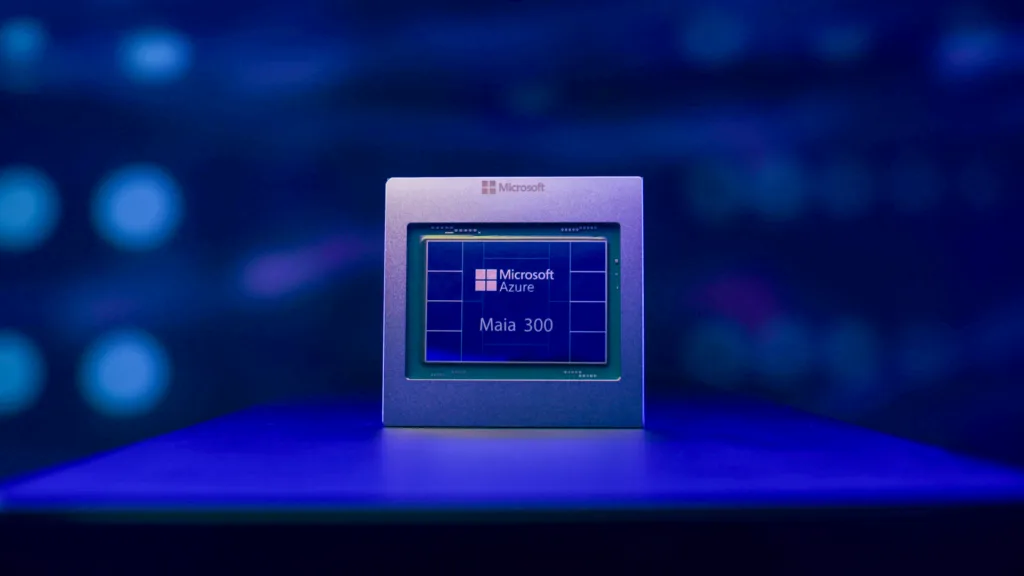
Microsoft unveils Maia 300 AI chip, plans multi-gigawatt in-house deployments from 2027
Microsoft announced Azure Maia 300, the third generation of its custom AI chip, and said it will scale the Maia family to multi-gigawatt deployments starting in 2027, making it the primary inference system for its products and services.
Anthropic’s third-quarter revenue jumps 45% to $16.8 billion ahead of planned IPO
Anthropic told prospective investors at a pre-IPO meeting that third-quarter revenue rose 45% from the prior quarter to $16.8 billion and that it was profitable on an adjusted basis, Reuters reported.