
Microsoft unveils Maia 300 AI chip, plans multi-gigawatt in-house deployments from 2027
Microsoft announced Azure Maia 300, the third generation of its custom AI chip, and said it will scale the Maia family to multi-gigawatt deployments starting in 2027, making it the primary inference system for its products and services.
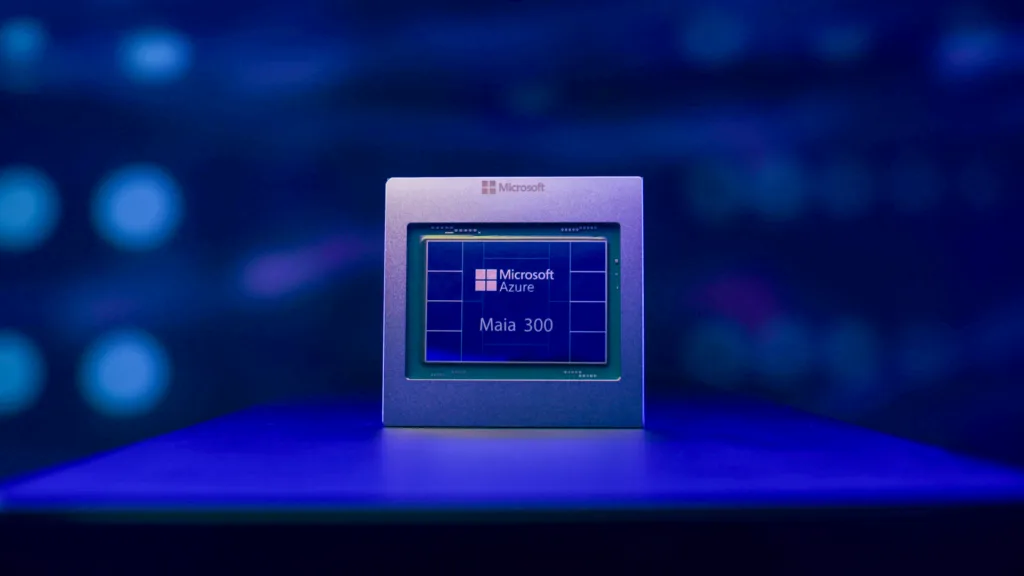
Microsoft on October 12, 2026 announced Azure Maia 300, the third generation of its custom AI chip, and said it will scale the Maia family to multi-gigawatt deployments starting in 2027. In a blog post, Scott Guthrie, Executive Vice President of Cloud + AI, said Maia will become the primary inference system for Microsoft products and services.
Key specifications
Microsoft says Maia 300 is designed for long-context reasoning, latency-sensitive conversational experiences and sustained, multi-step agentic tasks, and expects it to deliver 40% more tokens per megawatt than leading GPU-based systems. In a full 96-accelerator configuration, it delivers up to 7x the rack-scale token throughput of Maia 200.
- Compute chiplets are built on TSMC's N2P process node.
- Eight HBM4 stacks provide 18.0 TB/s of peak memory bandwidth within a 950-watt TDP.
- Each rack brings together 96 accelerators within a 167-kilowatt power envelope, with 27.6 TB of HBM capacity and 1.7 PB/s of aggregate HBM bandwidth.
- Support for low-precision formats such as enhanced MXFP4 reduces memory and bandwidth needs, enabling larger context windows.
Maia 200 already in production
The previous-generation Maia 200 is now serving production workloads including Microsoft Copilot, running OpenAI models, Microsoft's own MAI models and open-source model families, with GitHub Copilot and Microsoft Foundry to follow by year-end. Microsoft says Maia 200 is deploying across the United States, Europe and Australia and delivers up to 1.7x more tokens per watt for AI features in Teams and Copilot compared with leading GPU infrastructure.
A cost play
Reuters reported that Microsoft plans to deploy potentially more than a million Maia 300 chips next year to back its internal AI services. For comparison, Nvidia's most recent GB300 server racks hold 72 GPUs and use about 142 kilowatts. Microsoft did not name the GPU systems behind its 40% efficiency comparison. The company has said it expects to spend more than $175 billion in capital expenditures this calendar year, Reuters noted.
Production deployments of Maia 300 are set to begin in 2027.
Sources: Official Microsoft Blog, Reuters (via Investing.com).
Related articles

Mayhem 10 drones get upgraded to connect satellite, cellular and radio simultaneously
AeroVironment is preparing to strengthen communications on its Mayhem 10 autonomous military drone system with...
US optical chip gyroscope gets 2,000-fold sensitivity boost, detects slow rotation
Researchers at the University of California, Santa Barbara, and Caltech have developed a chip-scale optical...

Google opens Deep Review, its agentic AI for verifying technical documents, to the public
Google Research has publicly launched Deep Review, an agentic system tested on more than 16,000 conference submissions, to check the logic, math and factual grounding of complex scientific, legal and financial documents.

Anthropic says new defenses cut distillation of Claude’s reasoning by 90% to 99%
Anthropic says safeguards rolled out in recent months have reduced the data harvested by distillation attackers by around 90% to 99%, naming Chinese labs Zhipu and Moonshot as examples of industrial-scale efforts to copy Claude’s capabilities.

MI5 launches AI Threat Assessment Centre as spy chief flags AI-enabled bioweapons risk
MI5 Director General Sir Ken McCallum used his annual threat update to announce the AI Threat Assessment Centre (AITAC), bringing together UK expertise to assess AI national-security risks, and said he gives the greatest weight to AI's potential to change the stakes on bioweapons.

Anthropic’s third-quarter revenue jumps 45% to $16.8 billion ahead of planned IPO
Anthropic told prospective investors at a pre-IPO meeting that third-quarter revenue rose 45% from the prior quarter to $16.8 billion and that it was profitable on an adjusted basis, Reuters reported.